
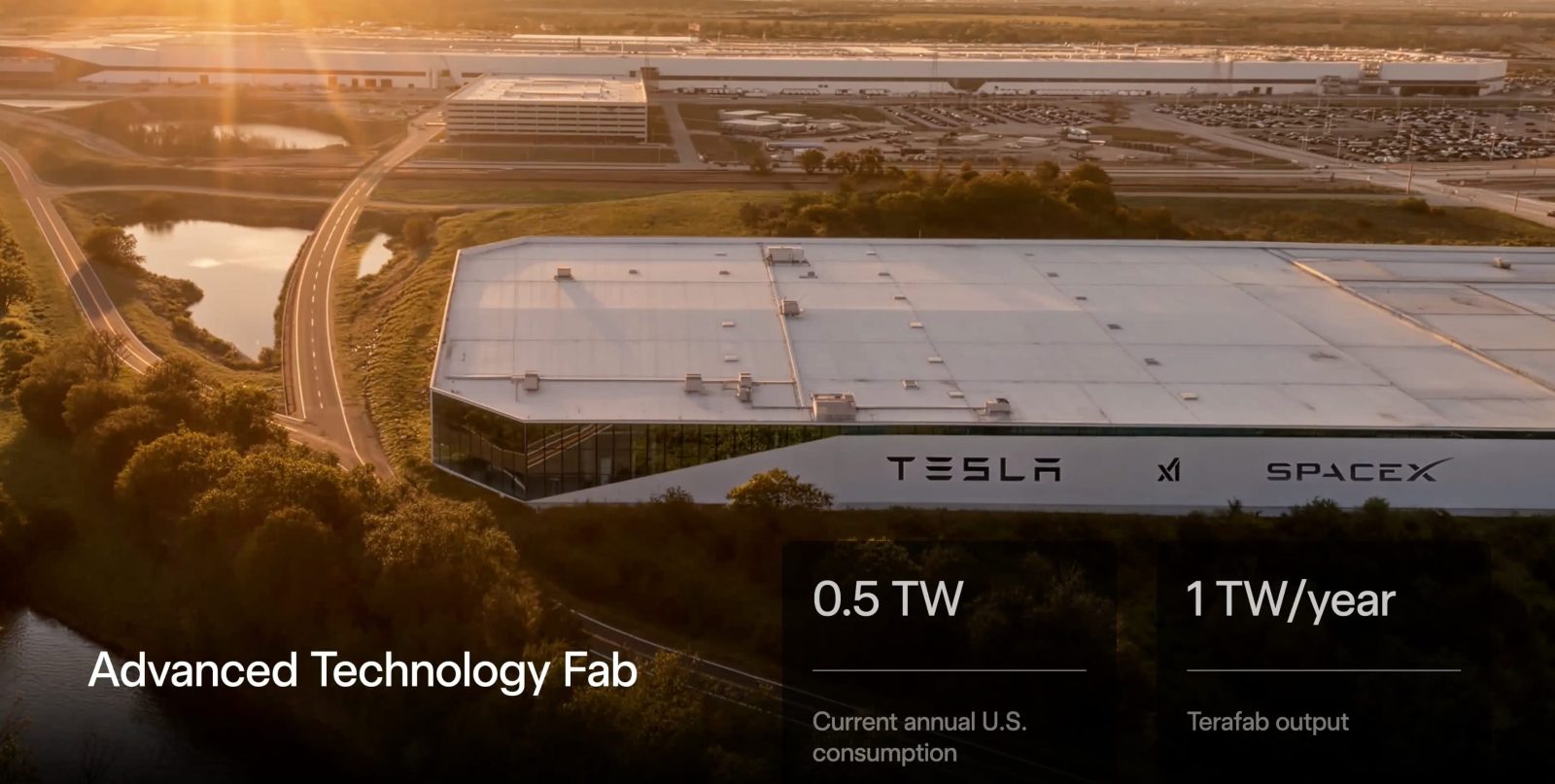
Tesla and SpaceX have unveiled “Terafab,” a joint $25 billion chip fabrication facility in Austin, Texas, that Elon Musk claims will produce 1 terawatt of computing power annually. It would be the largest semiconductor fab ever built — by an absurd margin.
Musk took the stage at the defunct Seaholm Power Plant in Austin on March 21 to officially launch the project, calling it “the most epic chip building exercise in history by far.”
What Tesla and SpaceX actually announced
Terafab is a joint venture between Tesla, SpaceX, and xAI — the AI company that SpaceX recently acquired in an all-stock deal. The facility is planned for the North Campus of Giga Texas and is designed to consolidate every stage of semiconductor production under one roof: chip design, lithography, fabrication, memory production, advanced packaging, and testing.
Tesla says it is targeting 2-nanometer process technology — the most advanced node currently entering commercial production. TSMC is only now beginning to ramp its own 2nm output, and it has spent decades and hundreds of billions of dollars building that capability.
The production targets are staggering. Terafab is designed for an initial output of 100,000 wafer starts per month, with ambitions to scale to 1 million wafer starts per month at full capacity. For context, that full-scale target would represent roughly 70% of TSMC’s entire current global output — from a single facility operated by companies that have never fabricated a chip.
Musk said the facility would produce between 100 and 200 billion custom AI and memory chips per year, powering Tesla’s “Full Self-Driving” software, the Cybercab robotaxi program, and the Optimus humanoid robot line. He also said millions of Optimus robots would help build and operate the facility.
Regarding why Tesla needs to do this in-house, Musk acknowledged his current suppliers: “We’re very grateful to our existing supply chain, to Samsung, TSMC, Micron and others,” but added, “there’s a maximum rate at which they’re comfortable expanding. That rate is much less than we would like… and we need the chips, so we’re going to build the Terafab.”
He claimed all the current fabrication facilities on Earth produce only about 2% of what he would need across all of his projects.
Two chip types and a space computing pitch
Terafab will produce two categories of chips: inference chips for Tesla vehicles and Optimus robots (such as Tesla’s current AI4), and D3 chips custom-designed for orbital AI satellites. Small-batch production of the AI5 is expected in 2026 with volume production projected for 2027 — though it’s worth noting that Tesla already delayed the AI5 to mid-2027 before this announcement, and the AI6 chip has been delayed roughly six months due to Samsung’s 2nm production slipping.
The most eyebrow-raising part of the presentation was the space computing vision. Musk said 80% of Terafab’s compute output would be directed toward space-based orbital AI satellites, with only 20% for ground-based applications. He argued that solar irradiance in space is roughly 5x greater than at Earth’s surface, and that heat rejection in vacuum makes thermal scaling viable. His conclusion: orbital AI compute could become cheaper than terrestrial alternatives within 2-3 years.
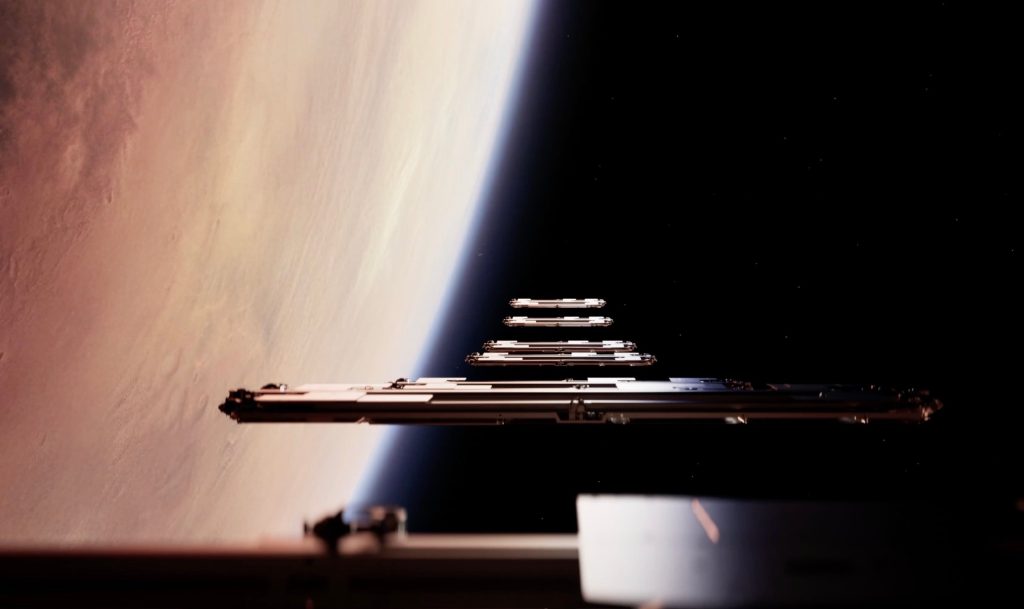
“We’re starting a galactic civilization,” Musk declared.
Tesla’s CFO acknowledged that the full Terafab cost — estimated at $20-25 billion — is not yet incorporated into Tesla’s record capital expenditure plan for 2026, which already exceeds $20 billion.
Electrek’s Take
This is Tesla’s Battery Day on steroids. And if you’ve been following how that turned out, you should be very skeptical.
In September 2020, Musk stood on a stage and promised a revolution in battery manufacturing with the 4680 cell. Tesla was going to ramp to 10 GWh within a year and eventually reach 3 TWh by 2030 — enough for 20 million cars annually. The dry electrode process was going to cut costs by 50%.
Five and a half years later, the 4680 program has been a disappointment. Tesla’s own top battery supplier said Elon doesn’t know how to make battery cells. The dry electrode process needed six or seven revisions. It took years longer than promised, and the 3 TWh target is a distant fantasy.
Tesla is estimated to be at only about 2% of its original cell manufacturing volume goal.
Top comment by HBrown
I don't believe this will work because building a chip fab is extremely difficult. Way more difficult than building a rocket factory or a manufactory for cars. But even if some miracle happens and they pull it off, it will take so long that it will have little to no impact on the Robotaxi program.
Even if everything goes perfectly, it will take 3-5 years to build. And that is likely an insanely optimistic timeline. The robotaxi wars are going to be decided in the next year or 2. It really won't matter if Tesla finally gains the ability to make their own robotaxi chips in 5 years if Waymo and Zoox take over the market in the next 2 years.
Now Musk wants us to believe he’s going to build a chip fab. Not just any chip fab — the biggest in the world, at 2nm, producing 70% of TSMC’s total output from a single building. Battery cell manufacturing is difficult. Chip fabrication at the leading edge is on another planet of difficulty. TSMC spent $165 billion over years to build six fabs in Arizona, and those won’t reach 2nm production until 2029. A single 2nm fab with 50,000 wafer starts per month costs roughly $28 billion, and it takes about 38 months just to build in the U.S. Tesla has zero semiconductor manufacturing experience.
The timing tells the real story. Tesla’s auto business is in freefall — sales declined for the second consecutive year in 2025, with a bloodbath in Europe and its first-ever annual decline in China. SpaceX, by contrast, is about to IPO at a potential $1.5-1.75 trillion valuation. This announcement is clearly designed to attach Tesla, a business in decline, and SpaceX, a business about to go public, to the AI hyperscaler narrative, a boat Musk has already missed with xAI, which he admitted “was not built right” and had to be bailed out by SpaceX.
And the cherry on top, or in space, rather, is the plan to put 80% of this compute in orbit. Data centers in space. Powered by solar panels. Launched by Starship. This is the kind of vision that sounds impressive on stage but has essentially zero connection to any near-term business reality, or any possible reality at all, according to most credible experts.
The whole thing reeks of desperation. Musk is hyping an 8th-gen AI chip while he still hasn’t delivered on the promises made with the 3rd generation. He’s promising to do in a couple of years what TSMC has spent decades and hundreds of billions of dollars building. We’ve seen this movie before with battery cells, and we know how it ends.


FTC: We use income earning auto affiliate links. More.



Comments