
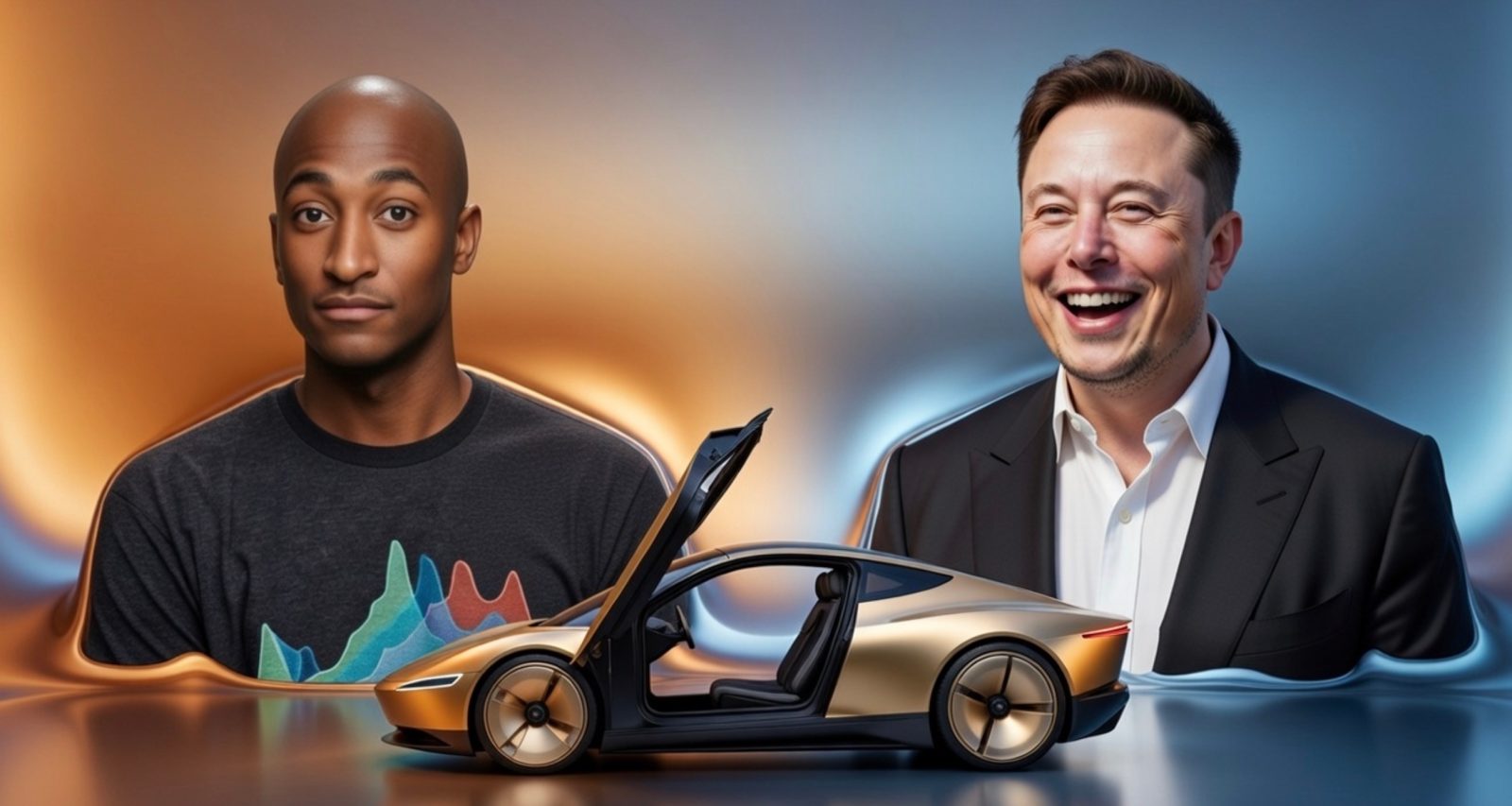
Elon Musk has reiterated his claim that Tesla will sell the Cybercab directly to consumers for under $30,000 before the end of the year, following the first production unit rolling off the line at Giga Texas on February 17. The announcement immediately set Tesla fans ablaze, not with discussions about the vehicle’s autonomy challenges, but with AI-generated images of YouTuber Marques Brownlee sporting a freshly shaved head.
Calm down, everyone. You almost certainly won’t get to see MKBHD’s bare head.
The bet
For those who missed the origin story, tech reviewer MKBHD made a bold bet following Tesla’s “We, Robot” event in October 2024. After Musk unveiled the Cybercab as a $30,000 electric robotaxi, Brownlee was so skeptical of Tesla hitting the price and delivery timeline that he vowed to shave his head on camera if Tesla actually delivers a Cybercab to a consumer for $30,000 or less before 2027.
Now that the first Cybercab has rolled off the production line, Tesla fans are flooding social media with memes of a bald MKBHD.
But Tesla bringing the vehicle to production and delivering it to consumers without a steering wheel or pedals are two widely different things.
Though Tesla fans got even more excited when Musk responded with “Gonna happen” and a laughing emoji, which, if you’ve followed Tesla for any length of time, is about as reliable as a promise carved into a melting ice sculpture.
Without a steering wheel and pedals, the Cybercab is entirely dependent on Tesla solving unsupervised self-driving, and without remote supervision, which doesn’t scale with consumer cars.
Tesla’s track record on delivering unsupervised FSD to consumers makes Musk’s Cybercab promise look like fantasy.
A decade of “next year, for sure”
Let’s review the timeline, because it’s genuinely spectacular in its consistency.
In 2015, Musk said Tesla would achieve “complete autonomy in approximately two years.” In 2016, he promised a fully autonomous drive from Los Angeles to New York — no human touch required. In 2017, he told a TED audience that drivers would be able to sleep in their Tesla within two years. In 2019, he promised robotaxis by 2020. In 2020, the software would be “feature complete” by year’s end. In 2023, full autonomy was coming “later this year.” In 2024, he said he’d be “shocked” if unsupervised FSD didn’t arrive in 2025.
It didn’t arrive in 2025.
Wikipedia now maintains a dedicated page titled “List of predictions for autonomous Tesla vehicles by Elon Musk,” which reads like a monument to optimism untethered from engineering reality.
After missing the 2025 deadline, Musk moved the goalpost again in January 2026, admitting Tesla needs roughly 10 billion miles of data to achieve “safe unsupervised self-driving.” At the time, Tesla’s cumulative FSD mileage sat at approximately 7 billion miles. It just reached 8 billion this week. Critics rightfully asked: if the internal metric for true autonomy is 10 billion miles, why was Musk promising unsupervised FSD in Austin just weeks prior?
Meanwhile, Tesla’s FSD stagnated through most of 2025 — even as Musk claimed progress was “going exponential.” By mid-2025, FSD still hadn’t improved, and Musk’s grand promise of unsupervised driving had been quietly downgraded to “less nag”.
By September 2025, Tesla changed the meaning of “Full Self-Driving” entirely, dropping its promise of unsupervised autonomy. And in December 2025, a California judge ruled that Tesla lied about FSD, finding the company made “actually, unambiguously false and counterfactual” claims about its autonomous capabilities.
The Cybercab’s very real problem
Here’s the thing Tesla fans celebrating MKBHD’s impending baldness are missing: the Cybercab doesn’t have a steering wheel. It’s not like a Model 3 where you can use FSD as a driver-assist feature and take over when it inevitably tries to merge into a concrete barrier. If unsupervised FSD isn’t solved, truly solved, not “Elon says it’s solved on X” solved, the Cybercab is a $30,000 two-seater that can’t move.
As we reported, Tesla rolled the first steering-wheel-less Cybercab off the line before actually solving autonomy. Continuous production isn’t expected until April 2026, and even Musk admits early production will be “agonizingly slow.”
The regulatory picture is equally bleak. Tesla’s robotaxi pilot in Austin operates in a geofenced area with teleoperation support, essentially the exact approach Musk spent years mocking Waymo for using. In California, Tesla hasn’t even applied for an autonomous vehicle permit, and just this week, Tesla had to drop its “Autopilot” marketing language to avoid a 30-day sales suspension.
Oh, and Tesla also can’t seem to secure the “Cybercab” trademark, thanks to a French seltzer company that filed first, leading the company to panic-file “Cybercar” and “Cybervehicle” trademarks mid-earnings call. So Tesla might deliver a vehicle it can’t legally call by its own name, powered by software that doesn’t work, to fulfill a promise Musk has been making and breaking for a decade.
MKBHD’s barber can relax.
Electrek’s Take
Look. Could Tesla deliver a few Cybercabs to a few hardcore fans in Austin and have them only drive in a limited geo-fenced area by the end of the year? Probably. But it would only be to make Musk right, and it would be shameful to make Marques shave his head over what would basically be a repeat of Tesla’s “autonomous delivery”, which happened once a year ago and never again.
Top comment by gary oblock
Tesla has clearly gone down a rabbit hole of Elon's making. I really think if they don't get rid of Elon and put in a more sensible CEO then they are doomed. Other EV makers are concentrating on improving what they sell and adding new technologies like compact LIDAR and solid state batteries but Tesla is squandering its resources on a dead end FSD and robots that can't possibly function given the current state of technology.
We’ve been covering Elon Musk’s self-driving promises since he first started making them, and the pattern is so predictable it borders on performance art. Promise unsupervised FSD by end of year. Miss deadline. Move goalpost. Repeat. For a decade.
The Cybercab is a fascinating vehicle concept, and we genuinely want to see affordable autonomous EVs become reality. But wanting something doesn’t make it real, and Musk’s confirmation that Tesla will sell the Cybercab to consumers this year doesn’t answer the only question that matters: will the car actually be able to drive itself?
Brownlee’s bet was smart because he understood something Tesla’s most enthusiastic supporters consistently refuse to accept: Elon Musk’s timelines on autonomy are not just occasionally wrong, they are wrong every single time, without exception. Until Tesla demonstrates a Cybercab completing a delivery to a paying customer who drives it home without a steering wheel, MKBHD’s hair remains exactly where it is.
We’ll believe it when we see it. We’ve been waiting since 2016.


FTC: We use income earning auto affiliate links. More.


Comments