

In what would be a “watershed moment,” Ford’s CEO, Jim Farley, reportedly spoke with the Trump Administration about partnering with Chinese EV makers in the US.
Is Ford using Chinese EV tech in the US?
China is the world’s largest electric vehicle market for a reason. Nearly 3 million BEVs were registered in China in Q4 2025, up 16% year-over-year (YOY) and driving global EV sales over the 4 million mark for the first time.
It’s no wonder global OEMs, such as Volkswagen, Toyota, Kia, Stellantis, Ford, and others, are partnering with China’s leading automakers to gain an advantage in overseas markets.
The US has, for the most part, blocked Chinese automakers by imposing massive tariffs on imports and proposing bans due to security risks. However, that may soon change.
Several people familiar with the matter told Bloomberg that Farley recently brought up the idea with the Trump administration to allow US carmakers to partner with Chinese EV brands to build vehicles in the US.
The plans would enable Chinese automakers to build vehicles in the US through joint ventures with domestic brands, according to the sources.
Discussions are still in the early stages, and no plans have been finalized, but the partnerships would likely involve sharing technology and profits.
Ford’s CEO has brought up the idea of using Chinese EV tech in the US with US Trade Representative Jamieson Greer, Transportation Secretary Sean Duffy, and EPA Administrator Lee Zeldin at the Detroit Auto Show last month, the sources claimed.
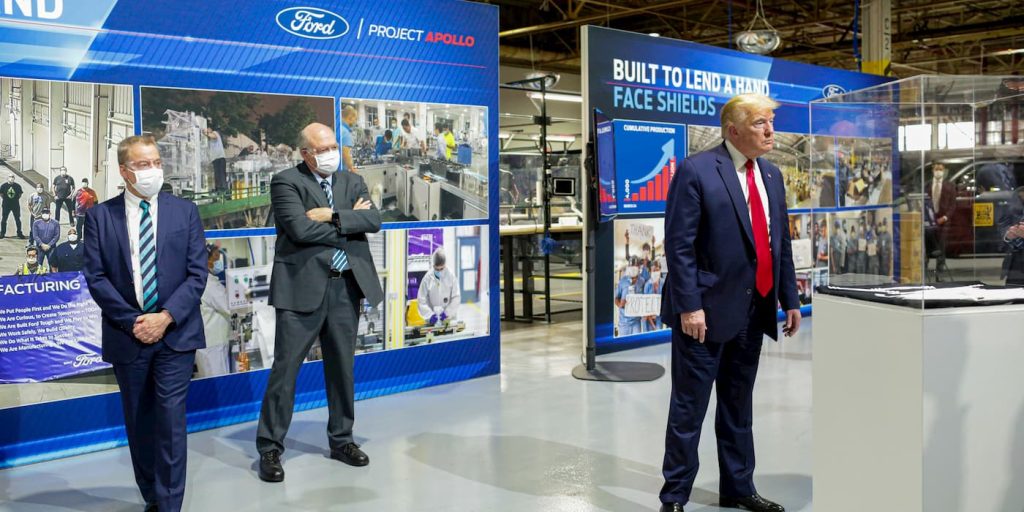
The news comes a little over a month after Trump raised the possibility, saying, “Let China come in,” at the Detroit Economic Club, a stark contrast to his previous comments (and actions). Trump said he would require Chinese brands to build US plants and hire American workers.
Crosstown rival GM told the Trump administration that it does not support allowing Chinese brands into the US, one of the sources said.
GM has warned in the past that US brands would lose market share, which would have a drastic impact on the North American supply chain.
Will it actually happen?
While the idea was brought up, the sources said, it would still face an uphill battle in Washington. We will learn more about the situation soon, with Trump planning to meet with China’s President, Xi Jinping, next month.
Allowing Chinese EV makers into the US would be a “watershed moment” that would shake up the market, but would that be a bad thing?
Canada formed a partnership with China last month that reduced the tariff rate from 100% to 6.1%, and most Canadians support the move, as it will help make EVs more affordable.
In the past few weeks, Ford has reportedly held talks with several leading Chinese EV makers, including BYD and Geely, about potential partnerships.
A deal with BYD would involve buying batteries for use in hybrid vehicles outside the US. A partnership with Geely, on the other hand, would reportedly involve allowing the Chinese automaker to use its underutilized plant in Europe and share technology.
Meanwhile, many US officials still strongly oppose it, warning of security risks. Duffy said at an event at Ford’s plant in Ohio last month, “I think they’ll look back at this decision and surely regret it to bring Chinese cars into their market,” regarding Canada’s EV deal with China.
Electrek’s Take
Will the US follow in Canada’s and essentially the rest of the world’s footsteps? Ford is already set to begin producing lower-cost lithium iron phosphate (LFP) batteries later this year at its new plant in Michigan, using licensed tech from China’s Contemporary Amperex Technology Co Limited (CATL).
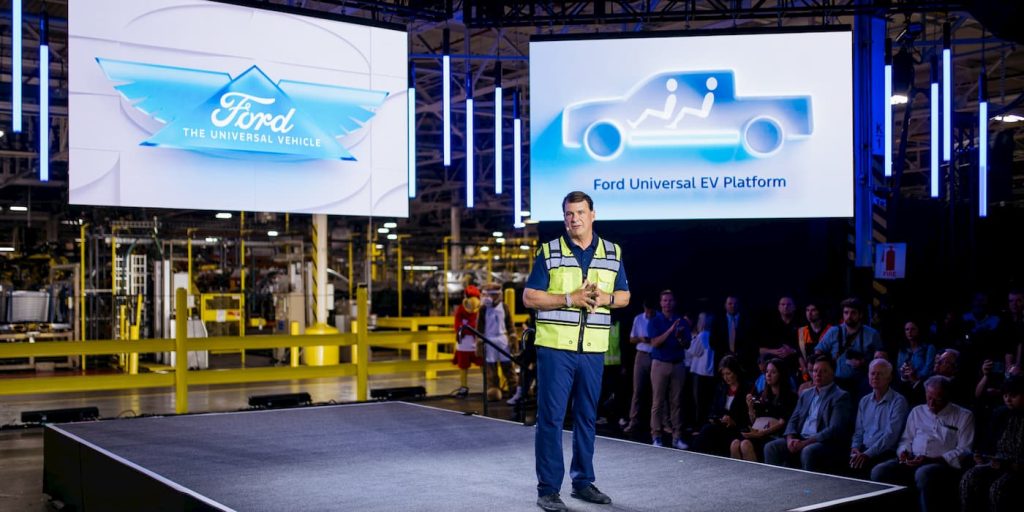
The LFP batteries will power new electric vehicles based on Ford’s Universal EV (UEV) Platform, starting with a mid-size pickup in 2027.
Ford said the electric pickup will start at around $30,000 and will have a lower cost of ownership than a Tesla Model Y.
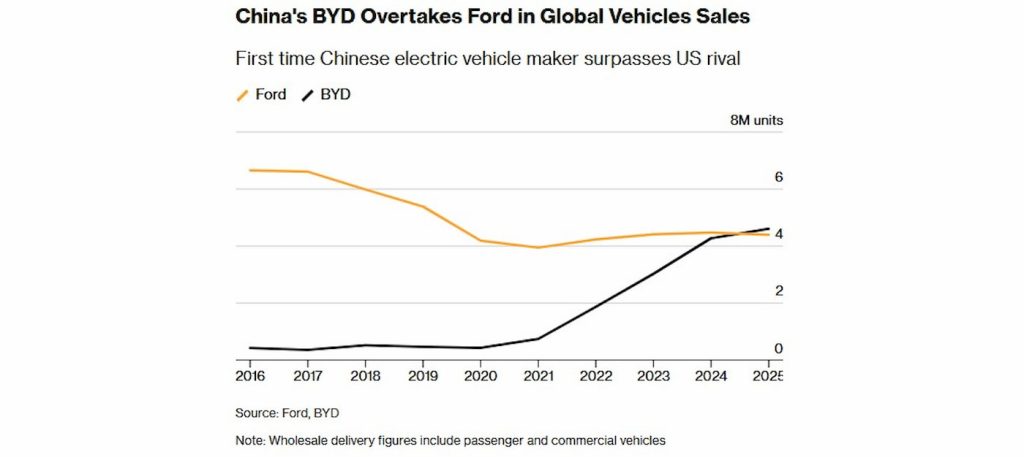
While Ford is betting on its new UEV platform for more affordable EVs in the US, it is relying more on partnerships to gain an edge overseas, where it’s quickly losing market share to BYD, Geely, SAIC, and other leading Chinese brands.
Top comment by mario drapeau
¨If you can't beat them join them¨ seem to be Ford philosophy. GM... I hesitate between "playing not to lose is the best way to lose" and ¨If you only build walls, you end up trapped behind them¨ Either way, they don't seem to be in a winning path.
For the first time, BYD sold more vehicles globally than Ford in 2025. BYD sold over 4.6 million new energy vehicles (EVs and PHEVs), while Ford reported total global sales just shy of 4.4 million.
Other automakers, such as Toyota, Hyundai, and Kia, are seeing promising results in China after partnering with domestic brands to use advanced software, advanced driver assistance systems (ADAS), and other EV tech to sell locally and export overseas.
With Ford and other US automakers falling behind in the global shift to electrification, a partnership may make sense.
The real question will be: Will the US and the Trump administration allow it? You can only put up an “Iron Curtain” for so long before the economy begins to stagnate, as China has shown us in the past.


FTC: We use income earning auto affiliate links. More.


Comments