
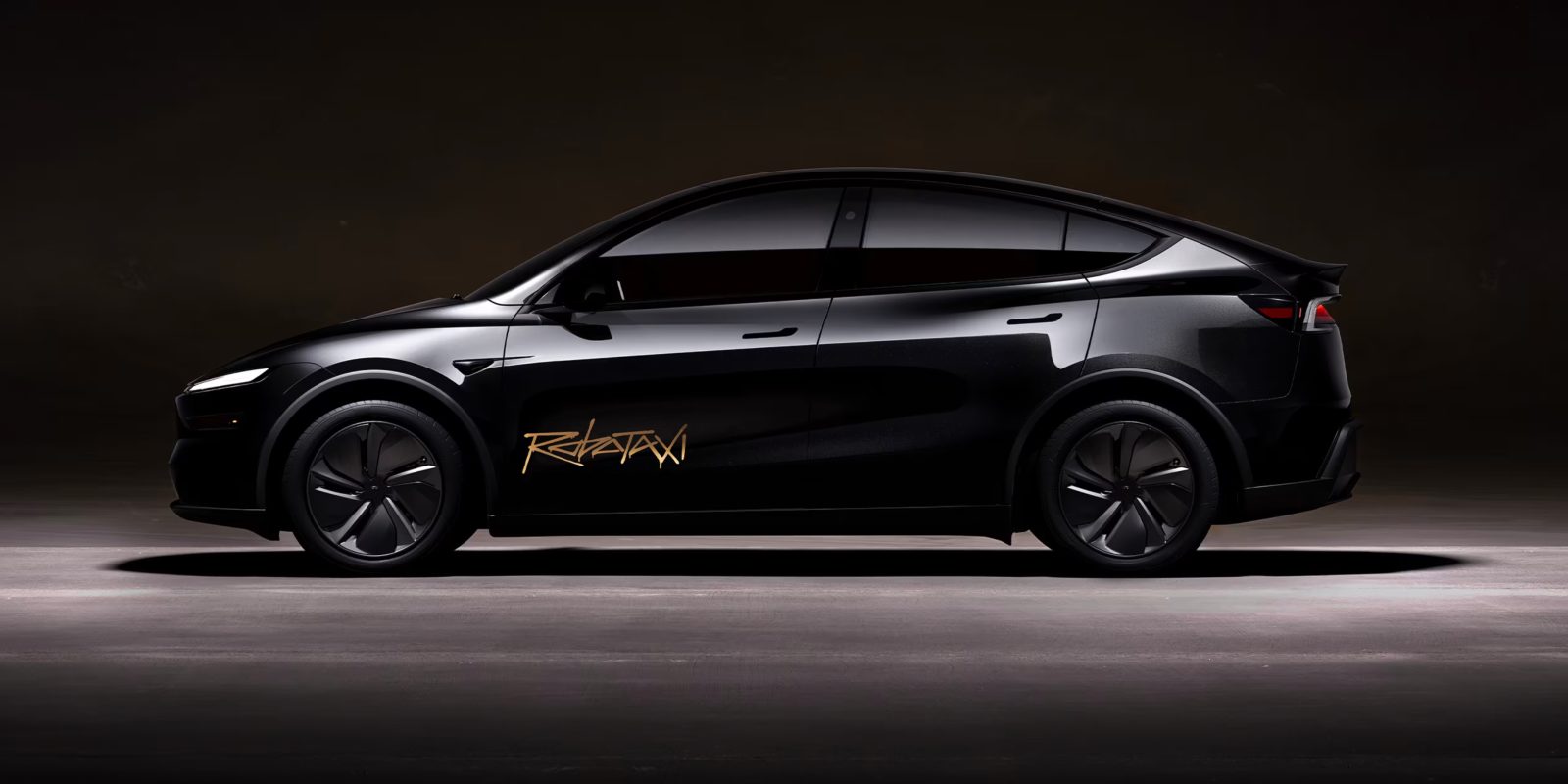
Tesla has once again suggested that it has Robotaxis operating in the San Francisco Bay Area, despite the company cannot legally operate autonomous vehicles in the state of California.
As part of today’s Q4/FY2026 earnings letter (see more coverage of Tesla’s earnings at our main earnings post here), Tesla once again released information about progress it has been making on its Robotaxi network.
This included mention of its progress in Austin, where the company recently offered a small number of rides where it had moved the driver to a chase vehicle to create the illusion of a true, driverless robotaxi.
Tesla said it “began testing driverless Robotaxis in Austin in December and began removing the safety monitor from customer rides in January on a limited basis.” That basis seems to be extremely limited, as some riders have tried and failed to find any unoccupied vehicle ever since the original announcement.
But further, underneath the same “Robotaxi” heading, Tesla continued and described its Bay Area operations in California:
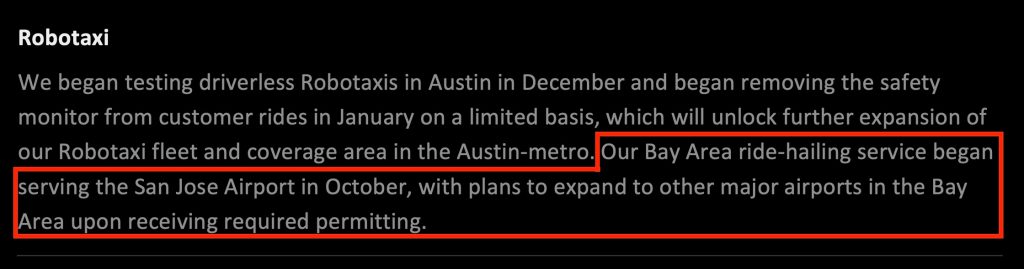
This is notable, because it’s under the Robotaxi heading. So, this suggests that Tesla is operating robotaxis in more than one city, right? Especially considering that CEO Elon Musk recently stated to the world that “Tesla’s rolled out Robotaxi service in a few cities.” “A few” typically means more than one (or, well, two).
However, Tesla currently only operates its Robotaxi service in two geographical regions, not “a few.” Those regions may cover more than one city proper, but “Bay Area” is typically considered one metro area, and Austin another (as Tesla organized them in its own earnings report).
But you may have noticed another interesting thing: the capitalization of the word “Robotaxi.”
Tesla is using the word “Robotaxi” as a brand, as opposed to “robotaxi,” which is a word that most people would use to describe an autonomously-operated driverless taxi.
Further, note how Tesla goes from the first sentence where it calls its Robotaxis “driverless” to the second where it describes its Bay Area cars as a “ride-hailing service.” Because despite being underneath the same Tesla umbrella, they are not under the same legal one.
By doing this, it’s getting away with what I’m sure it thinks is a clever deception: trying to convince people that it has driverless taxis operating anywhere at all, much less in multiple regions… including one where it cannot legally operate driverless vehicles.
Tesla still hasn’t applied for CA permits; must use drivers in cars
The thing is, California has actual regulations covering driverless vehicles, in order to ensure companies don’t just throw anything on the road and see what happens. Several companies have applied for permits to test driverless vehicles, or to operate them as an autonomous taxi service.
But Tesla has not done so.
As a result, its SF “Robotaxis” are not robotic at all – they’re driven by humans, in the driver’s seat, who actively operate the vehicle. The vehicles are equipped with Tesla’s level 2 “Full Self-Driving” technology, but that technology does not actually drive the car itself (Tesla recently got in trouble for this naming convention).
Tesla once bragged about its SF operations by stating that most of the drives activate FSD some of the time… the converse of which means that all of the drives are driven by humans some (or even most) of the time.
And despite it being reported many times over the course of last year that Tesla does not have a permit to use AVs, it continues to brand its efforts in the Bay Area as if they are autonomous.
The California Public Utilities Commission, which regulates taxi services in the state, stated last year that “Tesla does not hold a Drivered Pilot AV permit from the CPUC, so it cannot use a drivered AV in passenger service… Tesla is not allowed to test or transport the public (paid or unpaid) in an AV with or without a driver.”
We checked with the CPUC again today, and were told that there has been no change in Tesla’s status since the above statement.
Instead, Tesla can operate as a TCP – Transportation Charter Party-carrier, the same registration used by normal taxis.
Furthermore, AV permits take time to activate in California. Upon acceptance of the application, companies still have to wait months before offering rides.
These permits come with strict reporting requirements, and if you fail those reporting requirements, your permit can be suspended (which happened to Cruise). Reporting requirements are why Tesla has never logged any autonomous testing miles in California, despite having held a testing permit (separate from a permit to carry riders) for many years.
Tesla has applied for permits in other states, like Arizona, though the Arizona permit seems similar to the California permit that Tesla has, as far as we can tell. Musk has also stated that Tesla has applied for permits in Florida and Nevada.
This deception seems targeted at investors
It is interesting that the company hasn’t just included this in CEO Musk’s public statements, which are predictably false, especially on the issue of self-driving. The company has used this as an excuse before, claiming that its CEO’s statements shouldn’t be taken as reliable.
But this time, it has once again included this deception, in writing, in its filing to investors.
While there are enough weasel words used that the statement can be said to be technically correct (“Robotaxi” and “Full Self-Driving” are just branding, technically they said “ride-hailing” not “driverless” in the Bay Area section, etc. etc.), it seems quite clear that Tesla is trying to get people to think that its autonomous efforts are further along than they actually are. Which lays bare the motivation here: this is an attempt to pump the stock.
Top comment by taverngeek
Musk's autonomous driving promises not coming true didn't matter much when Waymo was in testing mode, but they matter now as Waymo has entered production mode and growing 400+% annually. They'll probably hit a billion dollars in revenues this year and well on the path to becoming a major business.
Musk will be in a bad position if he is still making promises while Waymo is becoming a major business.
And it’s not the first time Tesla has done this, as it did a similar move in its Q3 report.
Tesla’s weak performance in AVs is especially notable in comparison to its main competition in the driverless space, Waymo, which actually does have driverless taxis operating in several US metro areas – 6 as of last week, compared to Tesla’s 0-or-1-depending-on-how-charitable-you-want-to-be. And in comparison to Musk’s public statements, which stated Tesla would have Robotaxis operating in at least 47 metro areas by the end of 2025.
He’s now making similar statements about the end of this year – in fact, he just said on the call that Robotaxis would cover 25-50% of the US population by the end of this year. I guess we’ll see by the end of the year if the wolf is actually there this time.
Charge your electric vehicle at home using rooftop solar panels. Find a reliable and competitively priced solar installer near you on EnergySage, for free. They have pre-vetted installers competing for your business, ensuring high-quality solutions and 20-30% savings. It’s free, with no sales calls until you choose an installer. Compare personalized solar quotes online and receive guidance from unbiased Energy Advisers. Get started here. – ad*


FTC: We use income earning auto affiliate links. More.



Comments