
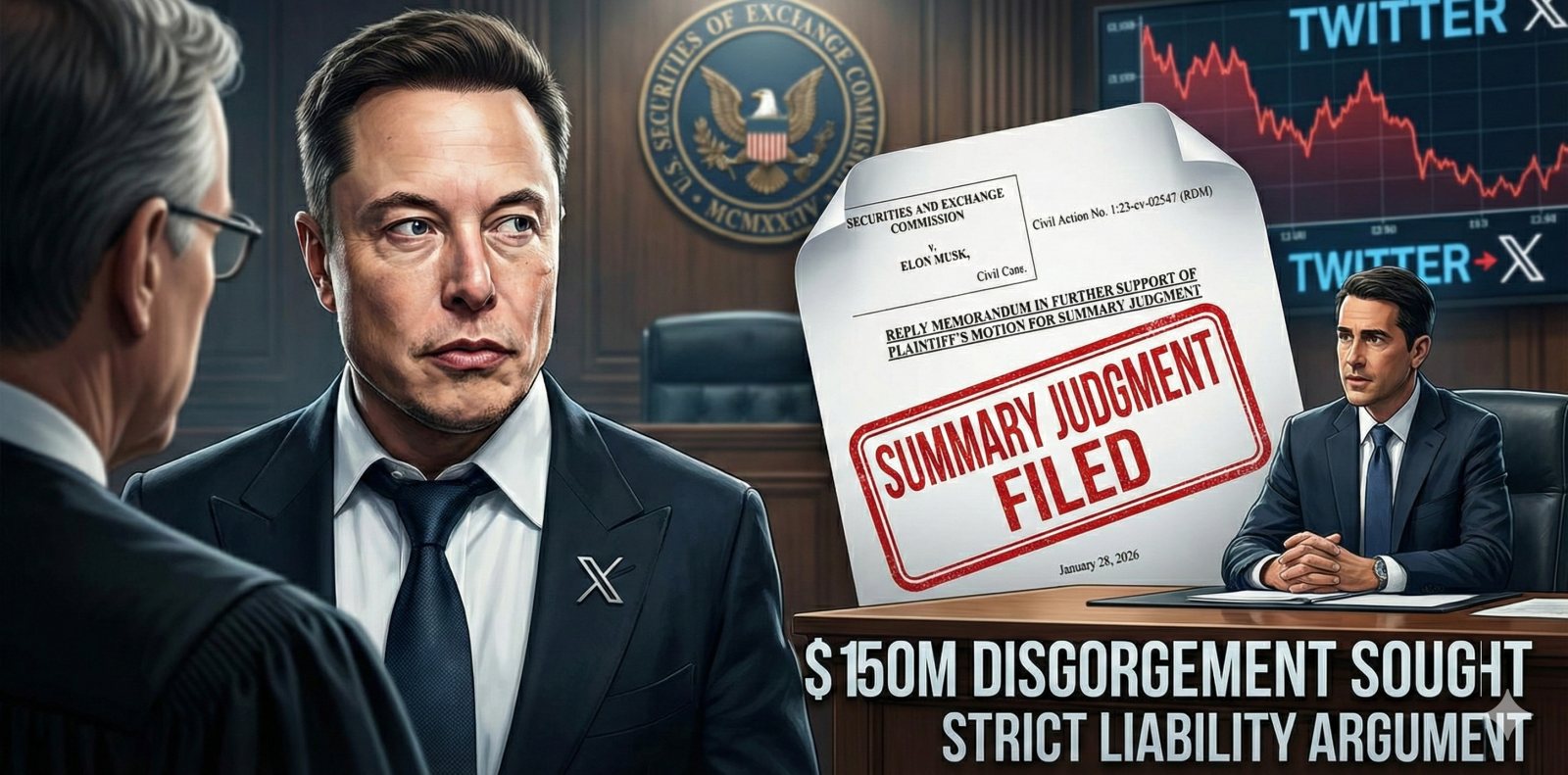
The SEC is not letting up on Elon Musk. In a new legal reply filed today, the regulator is asking a federal judge to grant summary judgment and find the Tesla CEO liable for violating securities laws during his 2022 acquisition of Twitter (now X).
As we’ve previously reported, Musk’s takeover of the social media platform has been a legal minefield from the start. Now, the SEC is arguing that the facts are so clear-cut that a trial isn’t even necessary to prove Musk broke the rules regarding stock disclosures.
The “Strict Liability” argument
At the heart of the new filing is the SEC’s assertion that it doesn’t matter why Musk was late in filing his Schedule 13D disclosure, only that he was.
Musk’s defense has attempted to argue that he acted in good faith and relied on advisors like Morgan Stanley. However, the SEC is pushing back hard, stating in the filing:
“Musk responds with three arguments, but none have merit. First, he incorrectly argues that Section 13(d) requires the SEC to prove state of mind. But neither the text of the statute nor any legal precedent supports that argument.”
The agency is leaning on the concept of “strict liability,” arguing that once Musk crossed the 5% ownership threshold on March 14, 2022, he had a mandatory 10-day window to tell the world. He didn’t disclose until April 4, and the SEC says that’s an open-and-shut case.
Between the time when Musk was required to disclose his more than 5% stake and when he did, the Tesla CEO purchased $500 million worth of Twitter shares with proceeds from selling Tesla shares.
$150 million in “underpayments”
The financial stakes here are massive. The SEC isn’t just looking for a “slap on the wrist” fine like the one Musk received in his infamous 2018 “funding secured” settlement.
Instead, the agency is seeking “disgorgement”, essentially forcing Musk to pay back the money they claim he saved by keeping the market in the dark. Because Twitter’s stock price surged over 27% once the disclosure was finally made, the SEC argues Musk was able to buy shares on the cheap for over a week. They estimate this “allow[ed] him to underpay by at least $150 million for shares he purchased after his beneficial ownership report was due.”
Beyond just the $150 million “refund,” the SEC is seeking Civil Money Penalties and a Permanent Injunction. While disgorgement covers the money they claim he saved, the civil penalties would act as a separate, punitive fine for the violation itself. Even more significant is the requested injunction, which would legally bar Musk from ever violating Section 13(d) reporting rules again. The SEC is effectively using Musk’s 2018 settlement history to argue that he is a “repeat offender” who requires a court-ordered leash to ensure future compliance.
What Happens Next?
Since the SEC has moved for Summary Judgment, the ball is now in the judge’s court. If the judge agrees that there are “no material facts in dispute,” they could rule on Musk’s liability immediately, skipping a trial altogether. This would lead directly to a “remedies phase” where the court decides exactly how many zeros will be on Musk’s check to the government. However, if the judge finds that Musk’s “state of mind” or constitutional defenses require more investigation, the case could head toward a full-blown trial, likely accompanied by more of the fiery legal battles we’ve come to expect from the Tesla CEO.
Electrek’s Take
We’ve seen this movie before. Musk has a long and storied history of fighting the SEC, often calling them names and accusing them of harassment. In this new filing, the SEC even takes a jab at Musk’s claims of “selective enforcement,” noting that he hasn’t identified a single person “similarly situated against whom the SEC has not enforced Section 13(d).”
Meaning, Musk complains that he is being unfairly targeted, but he can’t point to someone else who violated the rule and got away with it clean.
Top comment by Haggy
It's easy to say that it's not a slap on the wrist, but what does Musk have to give up if he has $150 million less? It's not as if he has to give up his morning latte or something meaningful. It will literally come down to a difference in numbers on paper or on a screen, not a change in financial ability.
While Musk has often found success in court, the SEC is betting that the “objective” nature of a filing deadline is harder to argue away than “state of mind” in a fraud case. If the judge grants this summary judgment, we could be looking at one of the largest fines ever levied against an individual for a disclosure violation, which makes sense considering this is one of the largest cases of disclosure violations ever.
As usual, Musk is fighting to the end. He vowed never back down from the SEC after claiming to be forced into a settlement for the “funding secured” tweets, but the SEC seems convinced they have him cornered on the law.
It honestly looks like they have a shot here, which would be a nice breath of fresh air during a time where securities fraud appears to be virtually legal in the US and SEC enforcement nonexistent.
Although it’s worth noting that this specific case started before Trump entered office and significantly reduced enforcement.


FTC: We use income earning auto affiliate links. More.



Comments