
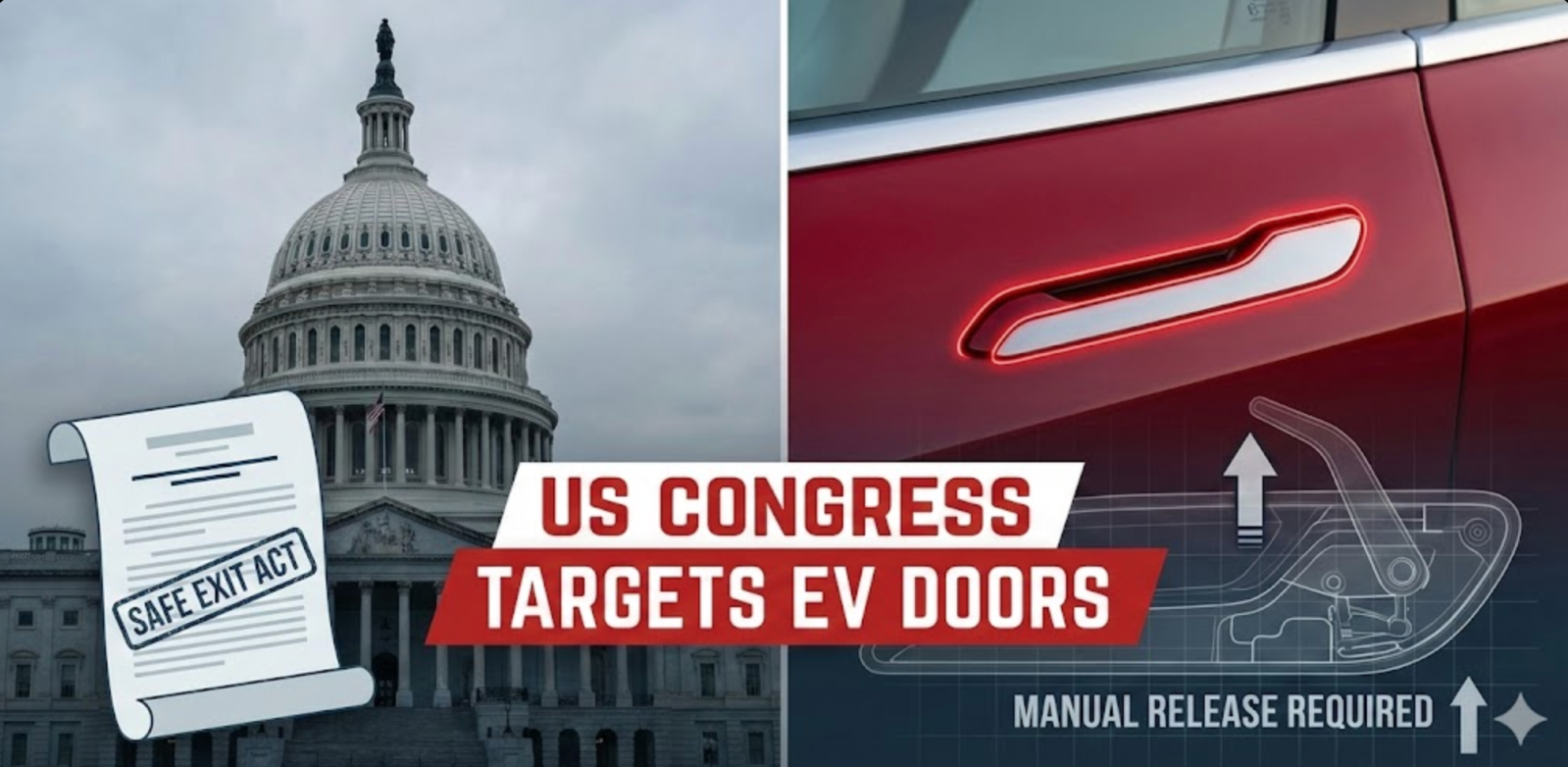
A new bill has been introduced in the US House of Representatives today that specifically targets the design of electric vehicle door handles, with the sponsor explicitly calling out Tesla and Elon Musk.
The bill, dubbed the “Securing Accessible Functional Emergency (SAFE) Exit Act,” aims to force automakers to install easy-to-find manual releases in case of power failure.
We have seen a trend in the auto industry, mostly led by Tesla, to move toward electronic door latches. Instead of a mechanical linkage that physically unlatches the door when you pull a handle, a button or sensor sends a signal to an actuator that pops the door open.
While this allows for frameless windows and smoother aerodynamics, it creates a safety concern: if the vehicle loses power, like in a severe crash, the doors can stay locked unless there is a mechanical override.
Most vehicles with electronic latches, including Teslas, do have manual releases. However, they are not always obvious or easy to access.
Now, U.S. Rep. Robin Kelly (IL-02) has introduced the SAFE Exit Act to mandate accessible manual releases. The press release for the bill does not mince words, directly attacking Tesla:
“Today, U.S. Rep. Robin Kelly (IL-02) introduced a bill addressing safety concerns with electric vehicle doors, including Tesla’s doors that have trapped people in their own cars. At least 15 people have died in car crashes due to Tesla doors not opening.”
The bill would require the National Highway and Traffic Safety Administration (NHTSA) to issue a final rule establishing performance and labeling requirements for electric doors. Specifically, it would mandate “easy-to-find manual releases for each door.”
Rep. Kelly made some harsh comments regarding Tesla’s CEO:
“Profits and, least of all, style, should not come before people’s lives. Elon Musk and his Tesla designs are not safe, nor efficient, and it has cost people their lives. When crashes or power loss leave drivers and passengers trapped inside their own cars, that is not innovation—it’s a safety failure.”
The legislation is backed by Consumer Reports, which has long advocated for intuitive manual releases. The bill would also require manufacturers to provide a way for first responders to access the vehicle from the outside when power is lost.
This move from the US follows a similar initiative made official in China just a few weeks ago. Tesla was made aware of the change in China ahead of time and it has reportedly been working on a solution, which now likely will make it to the US too if this new bill becomes law.
Electrek’s Take
I know some Tesla fans are going to get defensive because of the specific language targeting Musk and Tesla here, but I actually think this is a regulation that makes sense, even if the rhetoric is a bit heated.
Top comment by Aigars Mahinovs
Look at door handles of experienced car makers. Electronic door opening is not new. It is not unique to electric cars. These things have existed for many decades already - coupes of all types have used this for a LONG time. This is a well solved problem. Tesla just had to reinvent the bycicle and (as it often happens) did it poorly.
Basically all the door opening hangles used in such vehicles have a two-stage system - if you pull the door handle to open the door, the first part of the movement is very light to do - the handle pivots and triggers an electronic button that activates the electronic door opening sequence (including lowering the window and whatever else needed), but (and this is the KEY difference) if the electronic system is down and keep pulling the same door handle harder then the mechanical backup engages and the very same door handle pulls the door open mechanically with zero electricity required.
It's a standard safety feature. And Tesla skipped this. To save costs. And to make the "default" opener into a button (on Elon's personal insistence). Elon knew the button-operated, motorised door opening mechanisms from Rolls Royce and tried to emulate that experience. Without any concern for safety.
The reality is that while Tesla does have manual releases, they are poorly implemented in some models.
In the Model 3 and Model Y, the front doors have a manual release that is relatively intuitive (you pull up on the window switch panel), but the rear doors are significantly less intuitive.
Even if the information is in the owners manual, how many people who sit in the back of a Model 3/Y have read the vehicle’s manual?
It does feel that any death of someone stuck in a car and who cannot find the manual release is one too many.


FTC: We use income earning auto affiliate links. More.



Comments