
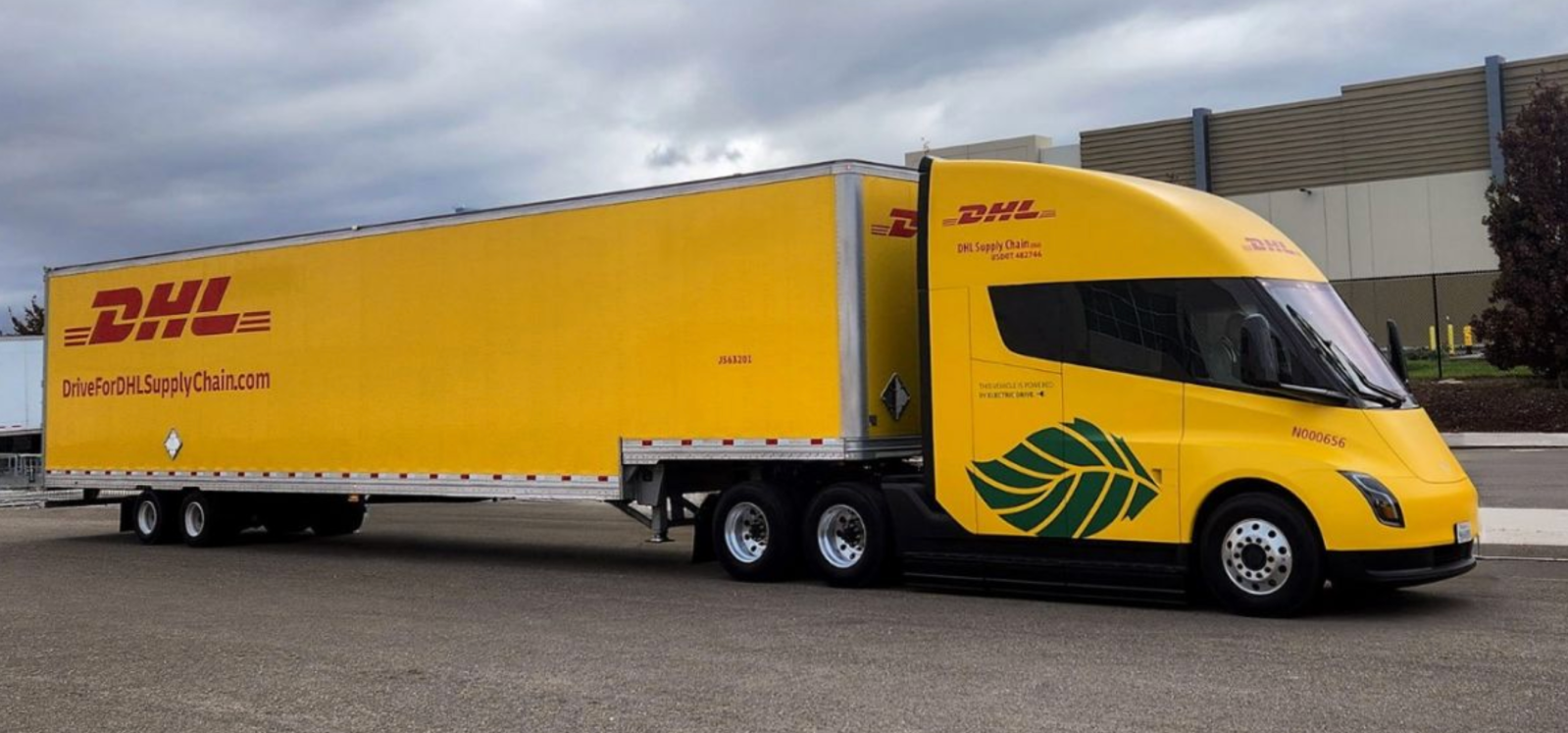
The Tesla Semi program is gaining momentum with another major logistics player officially joining the fleet. German logistics giant DHL confirmed that it has taken delivery of its first Tesla Semi.
For a long time, PepsiCo was the only company operating the Tesla Semi in any meaningful volume outside of the automaker itself. But as we move closer to volume production in Nevada, we are seeing more units land in the hands of major customers like Walmart, Costco, and Sysco.
Now, DHL is officially on board.
In a press release issued last week, the logistics giant confirmed the delivery of its first all-electric Tesla Semi to be integrated into its US operations. This follows a pilot program in Livermore, California, where DHL tested the truck’s capabilities on real-world routes.
According to the official announcement, during a 390-mile long-haul route, the Tesla Semi averaged 1.72 kWh per mile while hauling a gross combined weight of 75,000 pounds (34 metric tons). We previously reported on the successful pilot program last year.
Jim Monkmeyer, President, Transportation, DHL Supply Chain North America, commented on the performance:
“Our pilot of the Tesla Semi exceeded expectations, proving its ability to efficiently haul a typical DHL freight over long distances on a single charge. Integrating the Tesla Semi into our fleet is an important step toward achieving our decarbonization goals and delivering more sustainable solutions for our customers. With its range of up to 500 miles, the Semi unlocks opportunities that were previously beyond the limits of heavy-duty EVs, and we’re excited to partner with Tesla to make that a reality.”
This efficiency of 1.72 kWh/mile is critical. When Tesla first unveiled the Semi, they promised consumption of “less than 2 kWh per mile.” Many skeptics doubted this figure for a fully loaded Class 8 truck, but DHL’s real-world data confirms that Tesla is not only hitting that target but beating it significantly, even with a 75,000 lb load.
The truck is now operating out of Central California. Interestingly, DHL notes that for its current daily operations, the truck travels about 100 miles per day and only requires charging “about once per week.”
Dan Priestley, Director of the Tesla Semi program at Tesla, commented on the partnership:
“DHL has been a great partner to work with, and we appreciate their early and longstanding support for the Semi program. We are excited to support their deployment in North America, and their experience as a trusted logistics provider will help us make the product even better for future global markets.”
DHL says this delivery expands its fleet of Class 8 electric vehicles in North America to over 150 units. The company plans to add more Tesla Semi trucks in 2026 “as Tesla begins its volume production.”
After planning to start production in 2025 for the past 2 years, Tesla has recently delayed Tesla Semi production into 2026.
Electrek’s Take
Top comment by James McFarlane
For years, we’ve heard arguments from legacy truck makers and industry analysts claiming that battery-electric trucks can’t handle long-haul duties because the batteries are too heavy and the efficiency is too low.
Not quite true. Otherwise all those other heavy tractors (Class 8) wouldn't be being built and sold by Volvo and Freightliner, among others, while companies like Kenworth are building and doing more development. Tesla is just one of several now..
For years, we’ve heard arguments from legacy truck makers and industry analysts claiming that battery-electric trucks can’t handle long-haul duties because the batteries are too heavy and the efficiency is too low.
DHL just proved them wrong.
Getting 1.72 kWh per mile with a 75,000 lb gross combined weight is impressive. To put that in perspective, at typical commercial electricity rates, that’s a fuel cost of roughly $0.20 to $0.25 per mile. Diesel trucks often cost $0.60 to $0.80 per mile in fuel alone.
The economics are undeniable.


FTC: We use income earning auto affiliate links. More.




Comments