
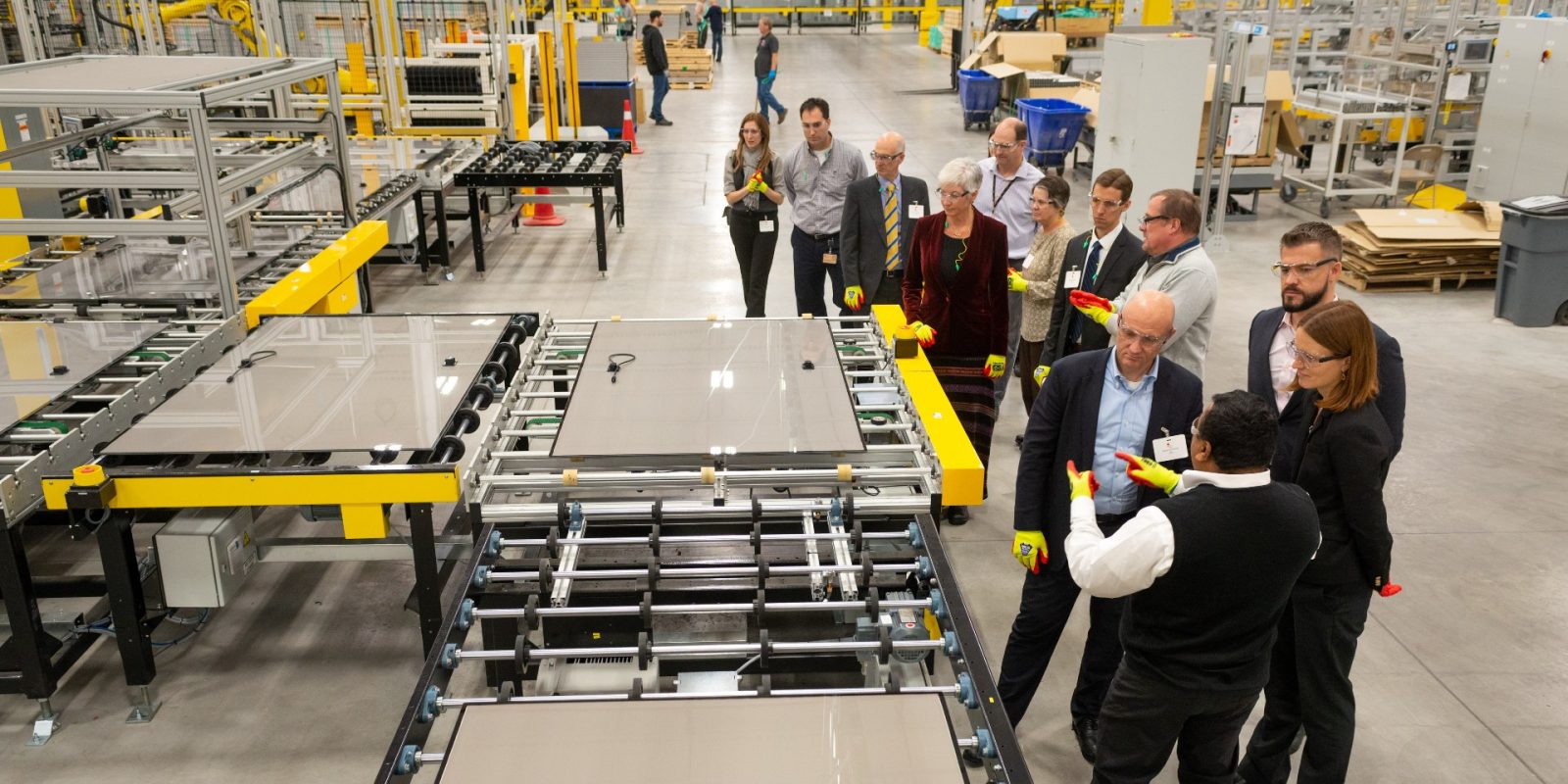
First Solar, the largest solar panel maker in the US, today announced that it will supply North American wholesale power producer Capital Power with 1 gigawatt (GW) of ultra-low carbon thin film solar modules.
Capital Power operates 7.5 GW of capacity across 29 facilities in the US and Canada. It has a US solar pipeline of about 2.4 GW DC.
First Solar will make Series 6 Plus modules for Capital Power. The up to 480-watt panels use the company’s thin-film cadmium telluride technology and have up to 19% efficiency and a 30-year warranty.
The Plus modules have a larger form factor, fewer connections and less mounting hardware per watt, and an overall lower levelized cost of energy. They’ll be delivered between 2026 and 2028.
For perspective, 1 GW of solar modules – over 3.1 million modules – would be enough to power around 800,000 homes in the US.
First Solar, the US’s largest solar panel maker, is unique among the world’s 10 largest solar manufacturers for being the only US-headquartered company and the only manufacturer of thin film PV modules.
The Tempe, Arizona-headquartered company uses cadmium telluride (CdTe) PV technology. Its ongoing investment in developing CdTe since 1999 has made it the second most common PV technology in the world after crystalline silicon. CdTe solar cells are known for their high efficiency and low cost.
First Solar is investing about $1.3 billion to expand its US manufacturing footprint from over 6.5 GW of annual nameplate capacity to around 10.9 GW by 2026. In addition to the $1.1 billion expected investment in a new 3.5 GW DC factory in Alabama, it’s also embarked on a $185 million expansion of its existing factory in Ohio. It’s also investing up to $370 million for an R&D innovation center in Perrysburg, Ohio, which is expected to be finished next year.
First Solar executed 9.9 GW of contracts and recognized 1.9 GW of volume sold in Q1 2023, resulting in a total backlog of 69.4 GW.
Top comment by OV
This is extremely interesting news. The technological comparison between monocrystalline silicon (Si) and cadmium telluride (CdTe) has not been flattering to CdTe so far. Si is extremely common in extremely high purity and, even though the physics of CdTe point to an efficiency advantage (don't get me started), it hasn't been able to match Si's efficiency or compete with the sheer scale and potency of the Si industry.
The fact that First Solar have had multiple orders from big-budget customers is very interesting, and 100% a consequence of the IRA and Biden's push to manufacture in the USA. The technology has only been slowly edging closer to profitability, but they're 100% made in the USA, which has given them a major advantage. As more orders come in, First Solar can hopefully scale up production like they're boasting they can - polycrystalline thin-film deposition on soda lime glass using metal refining byproducts is an intriguing and appealing proposition. If scale brings the cost of CdTe panels down, there might be a significant technological shift as CdTe becomes properly competitive with Si. And, as production volumes go up, so will R&D spending on that efficiency potential. It will be very interesting to see where we go from here.
Read more: Detroit is going to power 100% of its municipal buildings with solar
Photo: First Solar
To limit power outages and make your home more resilient, consider going solar with a battery storage system. In order to find a trusted, reliable solar installer near you that offers competitive pricing, check out EnergySage, a free service that makes it easy for you to go solar. They have hundreds of pre-vetted solar installers competing for your business, ensuring you get high-quality solutions and save 20-30% compared to going it alone. Plus, it’s free to use, and you won’t get sales calls until you select an installer and share your phone number with them.
Your personalized solar quotes are easy to compare online, and you’ll get access to unbiased Energy Advisers to help you every step of the way. Get started here.


FTC: We use income earning auto affiliate links. More.




Comments