
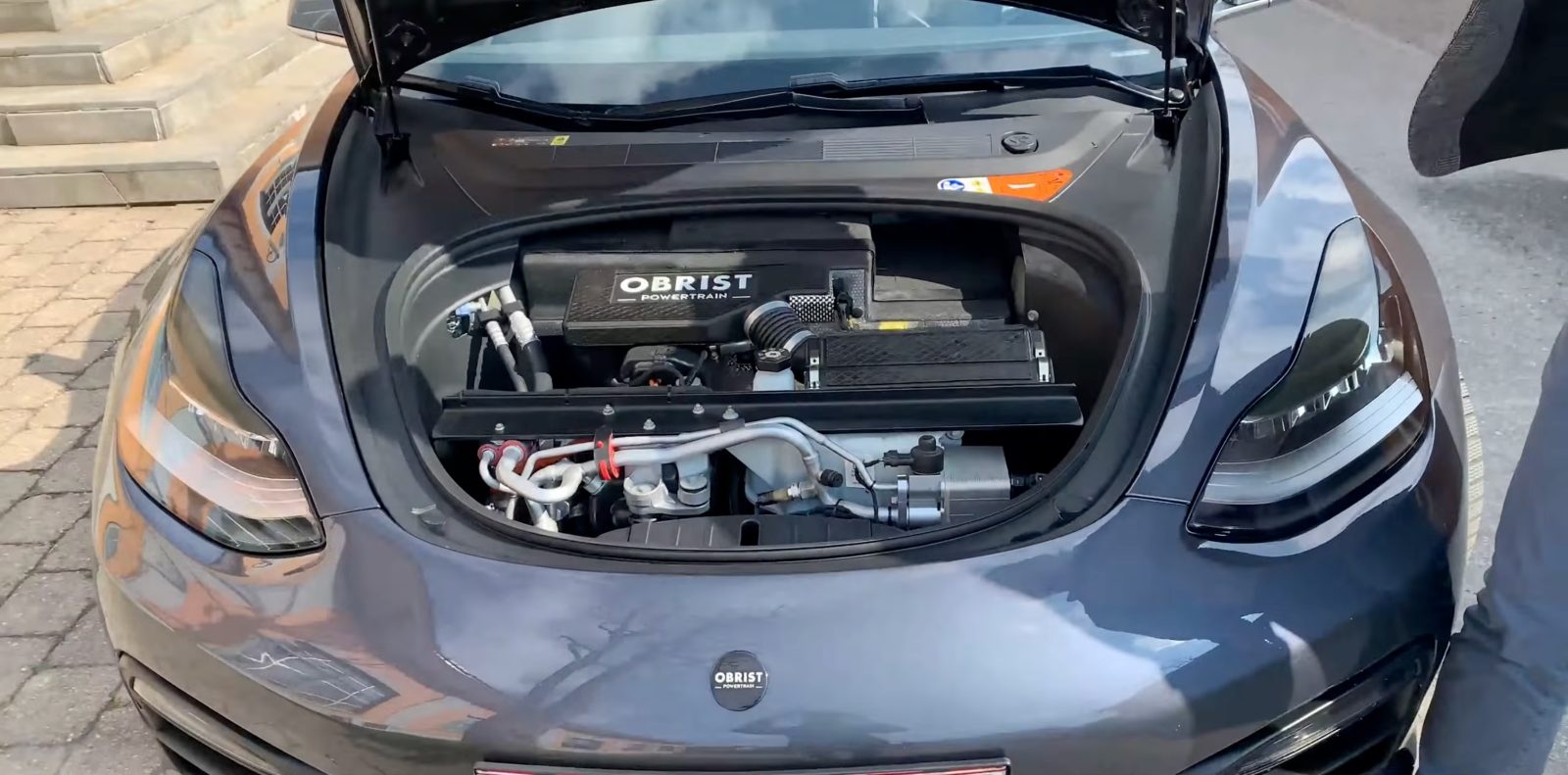
Obrist, the Austrian engineering firm famous for ripping battery cells out of a Tesla Model 3 and bolting a gas engine into the frunk, is bankrupt. Three companies in the Obrist Group are insolvent with combined debts of about €31.8 million, or roughly $37 million.
The company spent over a decade pitching its “HyperHybrid” range extender as the smarter alternative to battery-electric cars. It never got a single production vehicle out of it.
Two closures, no rescue
The Feldkirch Regional Court in Vorarlberg opened bankruptcy proceedings at the end of September for Obrist Powertrain GmbH and Obrist Technologies GmbH, both based in Lustenau. The companies filed the petitions themselves, according to Austrian creditor protection group AKV.
Obrist Powertrain, the unit behind the HyperHybrid, owes about €18.85 million to 34 creditors. It was down to nine employees. Obrist Technologies, which held the group’s patents for methanol production and CO2 capture, owes about €6.08 million to 10 creditors and had no staff left at all.
A third company, Obrist DE, the group’s German sales and development arm in Lindau, is also insolvent with about €6.8 million in liabilities, according to ORF Vorarlberg.
There’s no restructuring plan. Both Austrian companies told the court that neither continuing nor restructuring was possible, and they agreed to shut down immediately.
The parent company, Obrist Engineering, isn’t part of the filings. It makes air-conditioning and thermal management parts and has about 30 employees.
Founder Frank Obrist blamed years of high development costs, failed talks with investors, and the crisis in Europe’s auto industry. AKV listed one more reason: European automakers shifting to fully electric vehicles.
The “worst Tesla ever”
We first covered Obrist in early 2020, when it unveiled its Model 3-based “Mark II.” The company shrank the battery pack to 17.3 kWh, stuck a 40 kW two-cylinder gas generator in the frunk, and claimed 1,000 km (621 miles) of total range. We called it the worst Tesla ever.
At the time, Obrist claimed it had already licensed the powertrain to an unnamed “international partner” and that production cars with the system would arrive by 2023. It also claimed the system would cost about €4,500 at volume and could cut the price of a Model 3 by more than half.
That partner was never named. No car ever shipped. We kept seeing these guys at car shows across Europe, but they never seemed to have more than demos.
In 2022, Obrist came back with a Model Y prototype running on synthetic methanol it branded “aFuel.” The pitch evolved from cheap hybrids to “climate-positive” driving: the company claimed the car removed 24 grams of CO2 from the atmosphere per kilometer because part of the captured carbon used to make the fuel would be buried underground.
And the claims kept growing. In 2024, Obrist announced an alliance with an Abu Dhabi-based fund and said an investment “in the double-digit billion-euro range” was secured for methanol plants in Namibia, Egypt, Thailand, and the US. It then pitched “gigaplants” costing $18.6 billion each, claiming the world would need 2,700 of them, roughly $50 trillion, to replace fossil fuels.
Lobbying for the engine
Obrist also spent years lobbying Brussels to reconsider the EU’s 2035 ban on new combustion cars. In late 2024, it argued that a HyperHybrid would emit 85% less CO2 than a comparable battery-electric car and called the technology a potential “lifeline for the European automotive industry.”
The EU has already bent on combustion more than once, from the e-fuels exemption Germany secured in 2023 to the Commission’s proposal late last year to soften the 2035 target. Policy moved in Obrist’s direction. It didn’t help.
Electrek’s Take
Range extenders aren’t a dumb idea. EREVs are selling in big numbers in China, and several automakers are bringing them to North America. If you want to argue that a small battery plus a generator makes sense for some buyers, there’s a real case.
But Obrist was never that company. It was a licensing shop with no customer, built around a pitch that battery-electric cars were a mistake, and it kept escalating the claims every time the previous ones failed to materialize. Production by 2023 turned into climate-positive methanol, which turned into a $50 trillion plan to replace fossil fuels. At some point, that stops being engineering and starts being a press release machine.
And the thing Obrist was betting against just kept getting better. Battery prices fell, EV range went up, and the “range anxiety” problem it was designed to solve got smaller every year. Now its own bankruptcy filing cites automakers going fully electric as one of the reasons it failed.
If you’re driving an EV, charging it with rooftop solar can cut your fuel costs to nearly zero, no generator in the frunk required. With electricity rates up almost 10% last year and expected to keep climbing, going solar is one of the best ways to protect yourself against rising costs. And with lease and PPA options, you can do it with zero upfront cost and start saving immediately. If you want to find the best deal, check out EnergySage. It’s a free service with hundreds of pre-vetted installers competing for your business, so you save 20 to 30% compared to going it alone. No sales calls until you pick an installer. Get your free quotes here.


FTC: We use income earning auto affiliate links. More.



Comments