
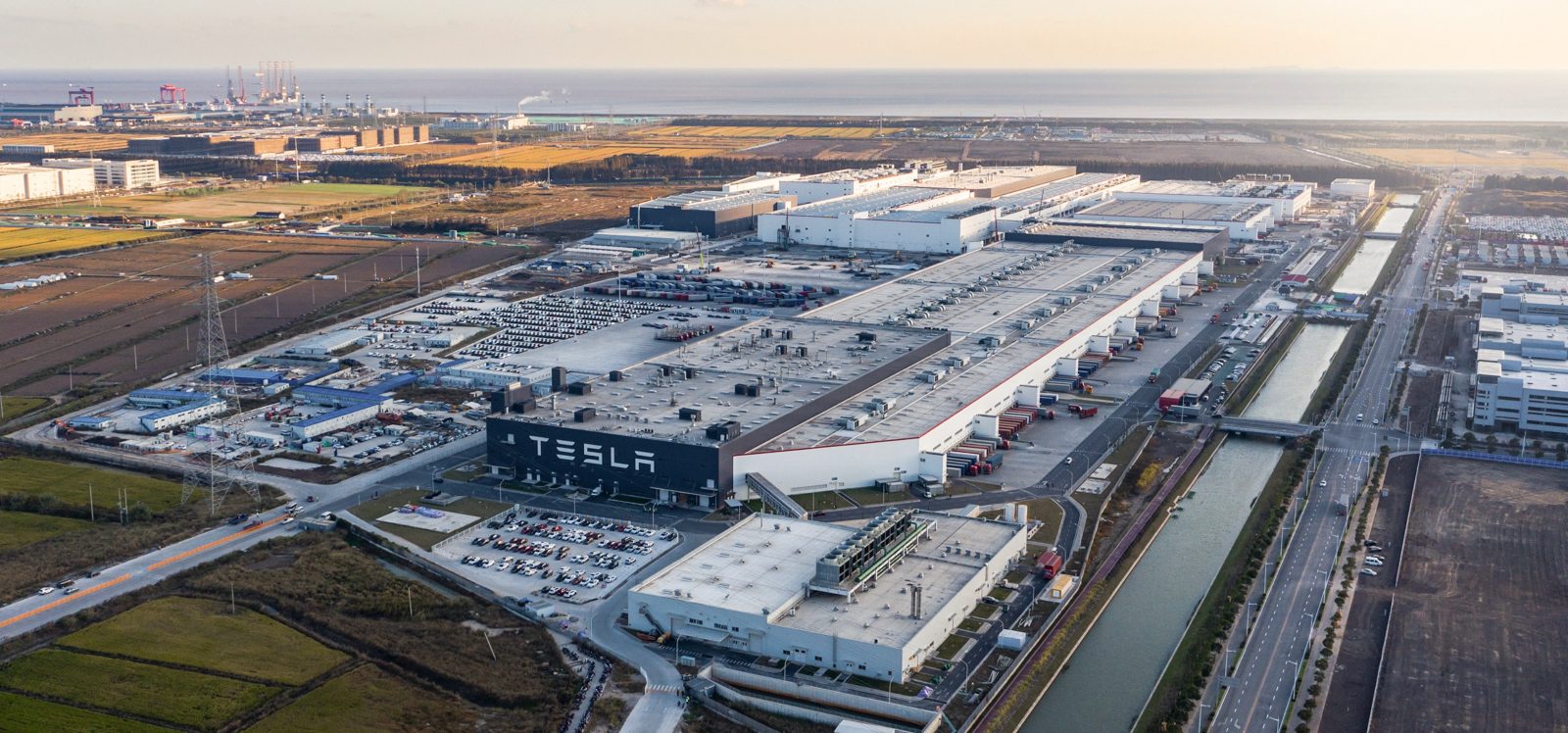
Tesla sold 381,088 cars to Chinese buyers through the first nine months of 2026, down 11.9% from last year, according to CPCA data. Over the same period, Giga Shanghai’s exports more than doubled to 361,972 vehicles.
Nearly half of what Tesla builds in China now leaves China. And Beijing just announced it will cut the tax rebate on EV exports next year.
“Affordable cars must be made on same continent as customers”
When Tesla broke ground on Giga Shanghai in January 2019, Elon Musk was clear about who the factory was for.
“Shanghai Giga will produce affordable versions of 3/Y for greater China,” Musk wrote at the time. He added that the Model S, Model X and “higher cost versions” of the Model 3 and Model Y would “still be built in US for WW market, incl China.” In another post that same week, he summed up the philosophy: “Affordable cars must be made on same continent as customers.”
That lasted about a year and a half. By late 2020, Shanghai was building right-hand-drive Model 3s for Australia and New Zealand and shipping Model 3s to Europe. Today it supplies Europe, Asia-Pacific and, since this year, Canada again under Ottawa’s new China EV import quota.
None of those customers are on the same continent as Shanghai.
Tesla’s China sales keep sliding
Here’s how Tesla’s China business looks through September, based on CPCA data:
| Tesla China | Jan–Sep 2025 | Jan–Sep 2026 | Change |
|---|---|---|---|
| Retail (domestic) | 432,704 | 381,088 | -11.9% |
| Exports | 173,660 | 361,972 | +108% |
| Wholesale (total) | 606,364 | 743,060 | +22.5% |
| Exports as share of wholesale | 29% | 49% | +20 pts |
The domestic number is the lowest first nine months Tesla has posted in China in at least four years. It’s down 17% from the 460,203 cars Tesla sold there over the same period in 2024.
Q3 was worse. Tesla’s Chinese retail sales fell 16% to 142,133 units, and July alone was down 33%. September (64,837 units, down 9.4%) was the best month of the quarter, but it was still a decline.
The whole Chinese EV market is shrinking this year, so some of this isn’t Tesla-specific. NEV retail sales in China are down 12.8% through September, according to the CPCA, after Beijing cut the purchase tax exemption in half on January 1. So Tesla is roughly tracking the market year-to-date. But in Q3, the market was down about 10% and Tesla was down 16%.
The wholesale numbers hide it
You wouldn’t know any of this from Tesla China’s headline numbers. Wholesale, which counts both domestic sales and exports, is up 22.5% this year, and July’s 93,579 units was the factory’s best July ever.
That’s all exports. Tesla has already shipped more cars out of China this year (361,972) than it did in all of 2023 (344,078), 2024 (259,548) or 2025 (226,034).
As we pointed out in our H1 analysis, Shanghai has become Tesla’s pressure valve. It can keep running near capacity even as Chinese buyers walk away, because the cars go somewhere else.
And it’s carrying the whole company. Shanghai’s wholesale volume in Q3 was 275,111 vehicles, equal to 57% of the 486,532 cars Tesla delivered worldwide. Chinese buyers accounted for just 29%.
Beijing is cutting the export rebate
On Monday, China’s Ministry of Finance and State Taxation Administration announced that the VAT export rebate on new energy vehicles will drop from 13% to 9% on April 1, 2027. It covers battery-electric and plug-in hybrid cars, and the rate is based on the export date on the customs declaration.
It’s part of a pattern. Beijing already eliminated the export rebate on solar panels in April, and the battery rebate was cut from 9% to 6% and goes to zero on January 1, 2027.
The mechanics are simple. Chinese exporters get the VAT they paid refunded when a product leaves the country. Whatever isn’t refunded becomes a cost. So starting in April, automakers eat an extra 4% of the export value on every EV they ship out of China.
For Tesla, that’s real money. Assuming an average export value of around ¥220,000 per Model 3 or Model Y, the cut costs about ¥8,800 ($1,235) per car. At this year’s export pace of roughly 480,000 vehicles a year, that’s around $600 million annually that Tesla either absorbs or passes on to buyers in Europe, Canada and Asia. That’s our estimate, not a Tesla figure.
Tesla isn’t alone. China exported more than 4 million NEVs in the first nine months of the year, more than double last year, according to the China Association of Automobile Manufacturers. Every Chinese automaker that’s been using exports to offset weak demand at home gets the same bill.
But few are as exposed as Tesla, with half its Chinese production going abroad and its domestic sales falling.
There’s one more effect to watch. Since the rate depends on the customs declaration date, expect automakers, Tesla included, to cram as many exports as possible into Q4 and Q1 before the deadline. That should make Tesla China’s wholesale numbers look great for two more quarters, before the cost shows up in Q2 2027.
Electrek’s Take
Musk said Giga Shanghai would build affordable cars for China. It did, for about a year. Then it became Tesla’s export hub, and now it’s more than that: it’s the thing propping up Tesla’s China numbers and a big chunk of its global deliveries.
That shift was a reaction to falling demand. Tesla’s lineup in China is still the Model 3 and Model Y, while BYD, Xiaomi, Xpeng and a dozen others launch new models every few months at lower prices. Chinese buyers have options, and fewer of them are picking Tesla. Exports let Tesla keep the factory busy without cutting production, and the “record” wholesale did the rest.
Top comment by Beario
Tesla has the 3 and the Y as their primary sellers. It will most likely stay that way. As long as Musk wants to have the flexibility to dabble in venture into things like cybercabs and robots, Tesla will only be limited to a few car models. I only say venture because the cybercab and Optimus are not large scale yet and there are other issues to work out before that happens. Also, as long as gas prices are high, the 3 and Y will sell well and it is actually not a bad thing that gas prices are helping EV adoption.
Beijing’s rebate cut makes that model more expensive. Tesla has three options, and none of them are good. It can raise prices abroad, in markets like Europe where its sales are already weak. It can eat a margin hit of roughly $600 million a year at a time when its automotive margins are already thin. Or it can build fewer cars in Shanghai.
Berlin could take on more Model Y volume for Europe, but that doesn’t help the Model 3, Canada or Asia-Pacific.
So the question for 2027 is this: what happens to Giga Shanghai when both its home market and its export valve shrink at the same time?
If you’re buying an EV, powering it with home solar can cut your fuel costs to nearly zero. With electricity rates up almost 10% last year and expected to keep climbing, going solar is one of the best ways to protect yourself against rising costs. And with lease and PPA options, you can do it with zero upfront cost and start saving immediately. If you want to find the best deal, check out EnergySage. It’s a free service with hundreds of pre-vetted installers competing for your business, so you save 20 to 30% compared to going it alone. No sales calls until you pick an installer. Get your free quotes here.


FTC: We use income earning auto affiliate links. More.


Comments