
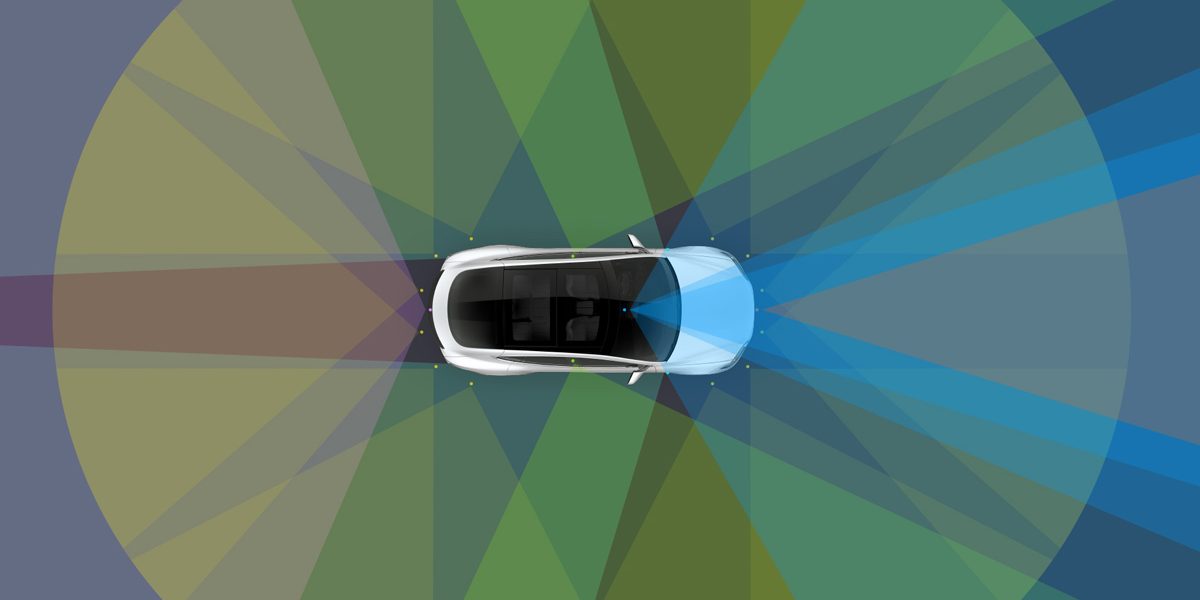
A 2024 Tesla Model Y ran off Interstate 35 in rural Missouri, struck a guardrail, and killed its driver, a 64-year-old woman from Raymore. Troopers reported a single-vehicle wreck and said the car “went off the road.”
What they didn’t say, and likely didn’t know, is that Tesla’s own report to federal regulators says the car’s driver-assist system was engaged. This is part of an ongoing Electrek investigation matching reported crashes to Tesla’s redacted NHTSA data.
What happened on I-35
Around 3 p.m. on Monday, April 14, 2025, a 2024 Tesla Model Y was heading south on Interstate 35 near mile marker 68, in Daviess County near Pattonsburg, Missouri. The car left the west side of the roadway and struck a guardrail, according to the Missouri State Highway Patrol.
The driver, a 64-year-old woman from Raymore, was pronounced dead at the scene. She was wearing a seatbelt. Her name was withheld pending notification of family.
Local coverage reported it as a woman who “veered off” the interstate for no stated reason. No report mentioned Autopilot, “Full Self-Driving,” or any driver-assist system. To the public, it was an ordinary run-off-the-road death.
What Tesla told the federal government
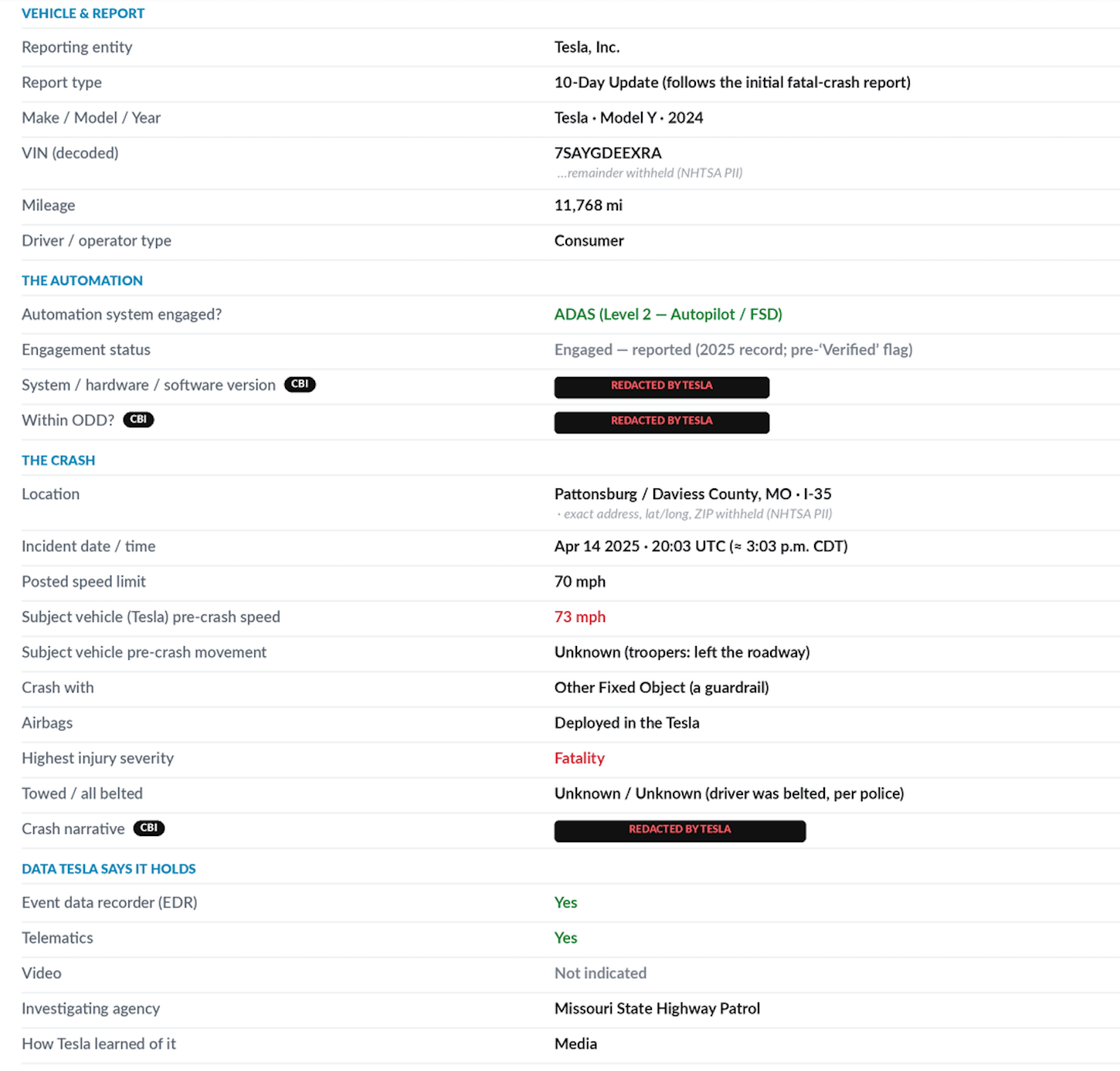
Under a NHTSA Standing General Order, automakers must report crashes where a Level 2 driver-assist system was engaged within 30 seconds of impact. Tesla filed a report on this one. The reason it exists is that Tesla’s own telematics flagged the system as on.
In it, Tesla identifies the car as a 2024 Model Y and logs a pre-crash speed of 73 mph in a 70-mph zone. It records the crash as a fatality, the impact as striking a fixed object, and says it holds the event-data recorder and telematics from the car.
Then it redacts the fields that would explain what happened. On this report, Tesla blacked out even more than usual: not just the crash narrative and the “operating domain” flag, but the system, hardware, and software versions all at once, as “confidential business information.” The same posture Tesla takes on nearly every report it files.
A road departure, the pattern that runs through the data
A car drifting off a highway and into a barrier is not an outlier in Tesla’s driver-assist reports. Electrek’s analysis of the full NHTSA dataset found that of the Tesla crashes where the pre-crash movement is disclosed, the single largest category is the car leaving its lane or the road. This crash is that pattern, at highway speed, with a driver dead.
On an interstate at 73 mph, the engaged system was either basic Autopilot or “Full Self-Driving.” Both hold a lane and a speed on a road like this, and both have documented failures where the car wandered out of its lane. Tesla redacted the software version, so which one was steering can’t be known from the record. That’s the field that would answer it.
One honest note: this April 2025 report predates the “Verified Engaged” confirmation flag Tesla now attaches to newer filings, so the record shows the system was engaged without that added verification. The engagement is why Tesla had to report the crash at all.
Why we keep doing this
Tesla is, more than ever, pushing owners to treat a Level 2 driver-assistance system as if it drives itself. It sells the software as “Full Self-Driving,” Elon Musk keeps promising unsupervised autonomy is close, and the branding invites drivers to trust the car.
But it’s still Level 2. The human is driving and responsible at all times, and Tesla’s own actions prove it: consumer FSD still requires supervision, and its robotaxi service is a small, closely watched fleet. That gap between the name and the machine breeds the complacency that gets people killed.
The redaction makes it worse. At the moment Tesla is telling owners to trust the car, it hides the records that would show how the system behaves when things go wrong. What’s on the record here is narrow and real: a driver-assist system was engaged when this car left the highway and a woman died. Everything that would explain how, Tesla sealed.
How we matched it: the NHTSA record is unredacted on location (Pattonsburg / Daviess County, Missouri), state, vehicle (2024 Model Y), the fixed-object impact, the fatality, and the month, and it names the Missouri State Highway Patrol as the investigating agency. Tesla logs the incident time as 20:03 UTC, which converts to about 3 p.m. local, matching when troopers worked the scene. It’s the only fatal Tesla crash on that stretch of I-35 that month. It’s the same crash. Electrek has requested the crash report and the vehicle data from the Missouri State Highway Patrol, and asked whether investigators received Tesla’s raw telemetry or only Tesla’s own interpretation of it.
Electrek’s Take
We are trying to match Tesla’s heavily redacted NHTSA ADAS crash data to publicly reported fatal crashes in order to paint a more accurate picture of what happens in those tragic crashes and what role Tesla’s ADAS systems, Autopilot and Full Self-Driving, might have played.
Top comment by BCGeiger
I know there will be Musk sycophants that will try to blame the driver. "She should have been paying attention". For a system that works ALMOST all of the time on an interstate on a nice spring day, your mind will wander. She may have even been keeping it in mind, but in a situation like that it would take a second or longer to refocus, assess what's going on before she could take any action. With the Tesla system, that's way too long to be able to do anything.
Strip the redaction away and this is a Tesla, running its driver-assist software, that left an interstate and killed the woman behind the wheel. Leave it in place, as Tesla did, and it’s a nameless single-vehicle wreck where a driver “veered off” for reasons no one can explain. Tesla can explain it. It has the EDR and the telematics, it filed the report saying the system was engaged, and it decided that what its car did in a fatal crash is a trade secret, down to hiding which software was even running.
We’re careful about the claim. The system being on doesn’t by itself prove it caused the crash, and we don’t know whether it was Autopilot or FSD. That’s the point. Tesla knows, and won’t say. A 64-year-old woman is dead on a clear afternoon on a straight interstate, and the one account that would show whether her car drove itself off the road is redacted in a federal safety file.
Tesla is already under NHTSA investigation over how it reports these crashes. We’ll keep matching them, one by one, until the record is whole.
If you’re driving a Tesla, powering it with home solar is one of the cheapest ways to cut your fuel costs to almost nothing. With electricity rates up almost 10% last year and expected to keep climbing, going solar is one of the best ways to protect yourself against rising costs. And with lease and PPA options, you can do it with zero upfront cost and start saving immediately. If you want to find the best deal, check out EnergySage. It’s a free service with hundreds of pre-vetted installers competing for your business, so you save 20 to 30% compared to going it alone. No sales calls until you pick an installer. Get your free quotes here.


FTC: We use income earning auto affiliate links. More.





Comments