
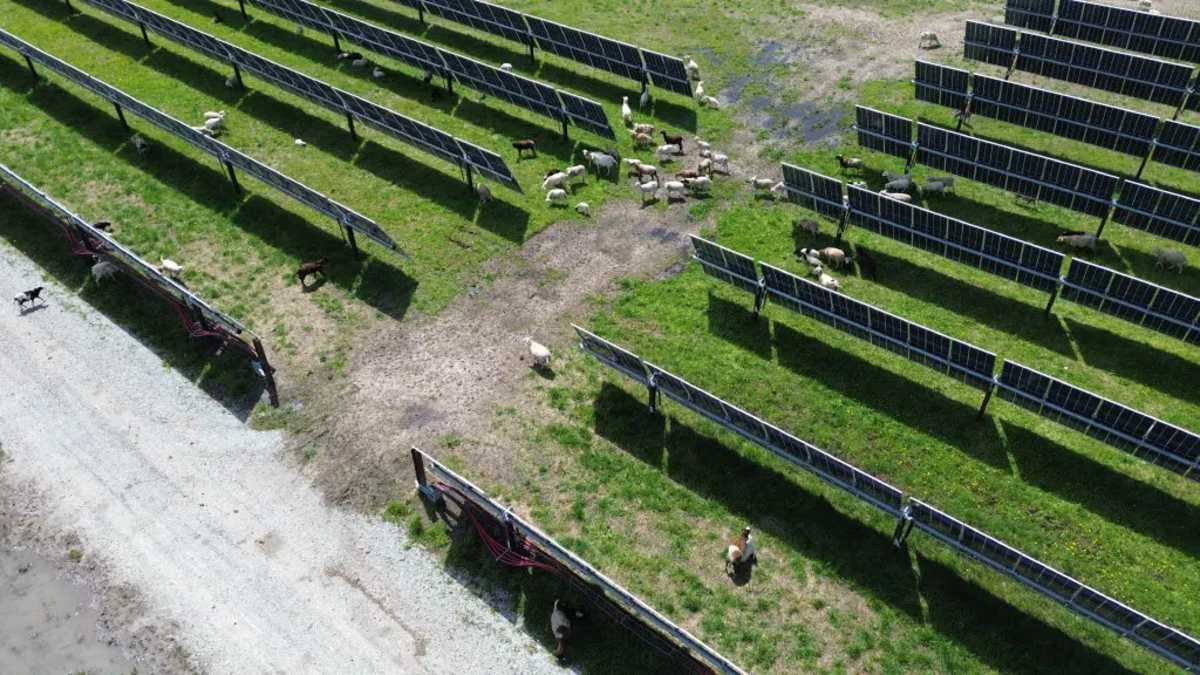
One of the most common arguments against a new wind or solar farm is that it will drag down nearby home values. A new Indiana study found no evidence that it does.
Researchers at Ball State University analyzed Indiana home sales from 2004 through 2024, comparing prices before and after large wind and solar projects came online. They also compared homes close to the projects with those farther away.
The researchers found no statistically significant negative effect on residential sale prices near either commercial wind turbines or utility-scale solar farms.
That doesn’t mean every home was unaffected. It means there was no widespread, measurable decline across the properties studied – an important distinction the researchers make in the report.
“This research provides Indiana-specific data on an issue that often arises when communities are considering renewable-energy projects,” said Dagney Faulk, director of research at Ball State’s Center for Business and Economic Research (CBER). “Property values are understandably an important consideration for homeowners and local officials. Our analysis allows those discussions to be informed by what we have observed in housing markets around existing wind and solar developments across the state.”
What the researchers found
For wind, researchers examined home sales near turbines in three Indiana regions: Northwest, North Central, and East Central. The analysis covered homes within five miles of turbines and found no statistically discernible negative effect on nearby sale prices.
Some models produced positive results, while others produced negative estimates. For example, one East Central model suggested that homes within one mile of a turbine sold for 11.5% less than comparable homes three to five miles away. But the finding wasn’t statistically significant, meaning the researchers couldn’t confidently distinguish it from normal variation in the housing market.
The solar study compared homes within four miles of utility-scale projects. Prices for homes within half a mile were estimated to be between 0.9% and 1.4% lower in one set of models, but once again, those results weren’t statistically significant.
Researchers also looked at project size, rural versus urban locations, proximity to brownfields, and the type of company supplying the power. None of those analyses showed a consistent negative effect on Indiana home prices.
There was one result worth noting: An initial model found that homes near larger solar farms sold for 6.2% less than comparable homes farther away. However, that result didn’t hold up when the researchers ran additional statistical tests, so the report describes it as inconclusive.
Homes within half a mile of solar projects owned by investor-owned utilities actually experienced a 7.9% increase in sale prices after the projects came online. The researchers said that could reflect better project design and maintenance, or the value of additional property tax revenue to the surrounding area, but they didn’t establish a cause.
The study’s longer-term analysis also found no sustained drop in prices after wind turbines or solar farms came online.
“The advantage of looking at many years of actual home-sale data is that we can examine what happened in communities before and after these projects were developed,” said Paul Niekamp, assistant professor of economics at Ball State. “Across the different approaches we used, the overall results do not indicate widespread negative effects on residential property values near solar projects in Indiana.”
The findings don’t prove that an individual property can never lose value because of a nearby renewable energy project. They show that across 20 years of Indiana sales data, any negative effects weren’t widespread enough to be statistically detectable.
The researchers also point out that Indiana’s permitting and siting rules, including setbacks and other measures intended to protect neighboring properties, may help explain the results. In other words, where and how a wind or solar farm is built still matters.
That’s especially relevant in Indiana, where local resistance has increasingly shaped clean energy development. As of September 2025, 40 of the state’s 92 counties had bans or other impediments affecting new wind development, while 24 had restrictions affecting solar, according to research cited in the Ball State brief.
Top comment by EricK
I'd like to see that same study for noisy, water and electric gobbling server / AI farms. I don't think that would fair quite so well.
The number one issue I could see from solar farms is glare if they are at the wrong angle to you.
For wind, how noisy are those? How far away do you need to be before you don't hear any mechanical noises. I'm guessing they can also cause a whoosh whoosh type noise from the blades but that would likely be way less intrusive than mechanical whining from the generators. Wind turbines are probably usually sited much further away from homes than solar farms.
The new findings don’t settle every local siting debate. But they do undercut the blanket claim that living near an Indiana wind or solar project automatically makes a home worth less.
Read more: Indiana brought a 150 MW solar farm online, and it’s just the beginning
If you’re looking to replace your old HVAC equipment, it’s always a good idea to get quotes from a few installers. To make sure you’re finding a trusted, reliable HVAC installer near you that offers competitive pricing on heat pumps, check out EnergySage. EnergySage is a free service that makes it easy for you to get a heat pump. They have pre-vetted heat pump installers competing for your business, ensuring you get high quality solutions. Plus, it’s free to use!
Your personalized heat pump quotes are easy to compare online and you’ll get access to unbiased Energy Advisors to help you every step of the way. Get started here. – *ad


FTC: We use income earning auto affiliate links. More.




Comments