
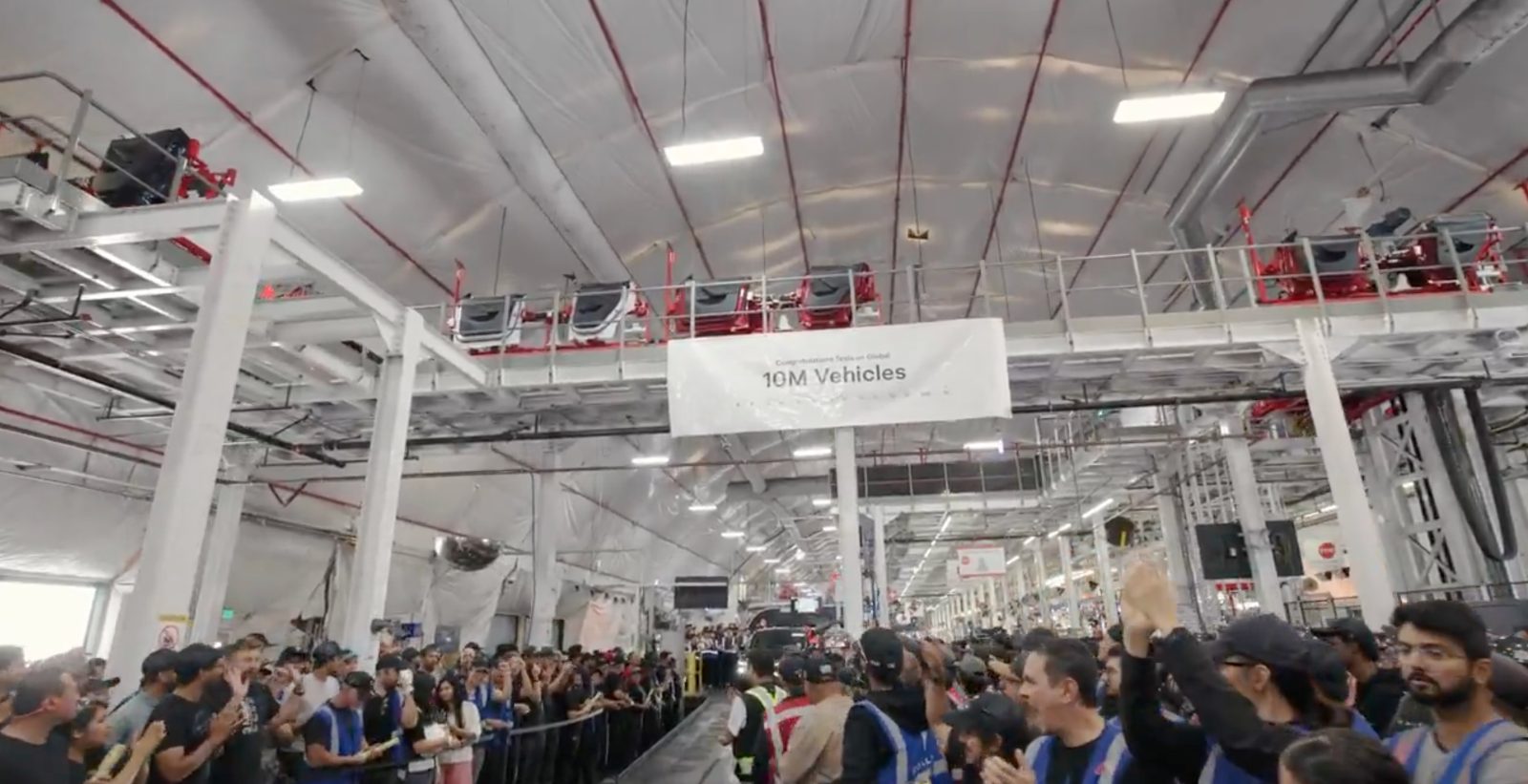
Tesla has built its 10 millionth vehicle, the company announced this week. Ten million all-electric cars is a real milestone, and no other automaker has done it.
But it’s arriving later than Tesla once promised, and the company is now building well under the capacity it already has.
The 50% growth that just stopped
For years, Tesla guided investors toward roughly 50% average annual growth in production and deliveries. Elon Musk repeated that target on call after call. And for a while, the numbers backed it up.
Then it stopped. Tesla peaked at 1.81 million deliveries in 2023. In 2024, it posted its first-ever annual decline, at about 1.79 million. In 2025, deliveries fell again to 1,636,129, down 9% year over year. That’s two straight years of decline, and 2026 is so far not much better.
So the 10 millionth car is an incredible milestone for Tesla, and those involved should be proud, but it should have happened a long time ago. It was announced today:
Tesla has an explanation for the delay. In its first-quarter 2024 shareholder update, the company said it was “currently between two major growth waves.” The first wave was the Model 3 and Model Y. The second was supposed to be a cheaper next-generation vehicle.
It’s now more than two years later. The second wave still isn’t here.
Tesla is running its factories well below capacity
Here’s the part that doesn’t get talked about enough. By Tesla’s own accounting, it has already built the factory capacity for a much bigger car company than the one it’s running.
Tesla’s own installed annual manufacturing capacity, from its latest figures:
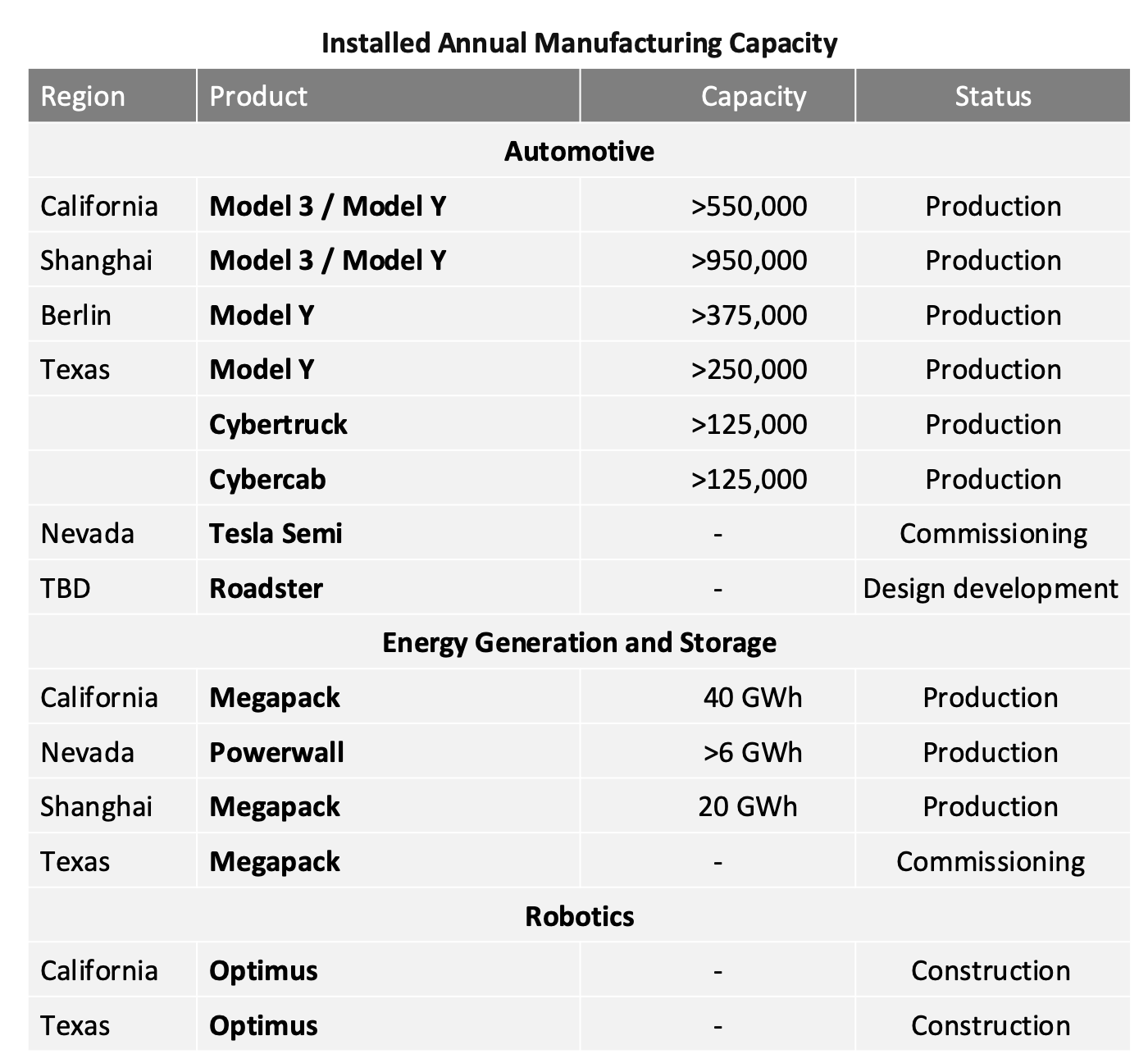
Add up the vehicle lines listed at “Production” status and Tesla claims more than 2.375 million units of annual capacity: over 950,000 in Shanghai, more than 550,000 in Fremont, over 375,000 in Berlin, and 250,000 Model Y plus 125,000 Cybertruck and 125,000 Cybercab in Texas.
Now compare that to what Tesla is actually building. In Q2 2026, Tesla produced 451,758 vehicles and delivered 480,126. At that quarterly rate, Tesla is on pace for roughly 1.8 million vehicles this year. That’s more than half a million units short of what its own plants can produce.
And demand is running below even that. Tesla delivered 1.636 million cars in 2025 while it had capacity for well over 2 million. The company isn’t supply-constrained. It’s demand-constrained, and it’s underutilizing manufacturing assets it spent billions to build.
The lineup problem
The reason is simple. The Model 3 and Model Y are the two best-selling EVs in the world, but they’ve been on sale since 2017 and 2020. The Cybertruck flopped. The Cybercab and Semi are still ramping. The Roadster is stuck in “design development,” where it has been for years.
Meanwhile, Tesla has pointed its energy and attention at robotaxis and Optimus. Its robotaxi fleet is actually shrinking, not growing, and Optimus keeps slipping. Neither sells a single extra car.
Electrek’s Take
Top comment by Beario
10 million cars is a great milestone, but Musk has stated that Tesla is not an automotive company anymore and is now a technology company. That conversion was a bit to hasty considering that cars are still the main money maker. If the goal was to transition the company, then it would have made more sense to have proven technology to work with and introduce it first and then slowly transition away from cars.
Ten million all-electric vehicles is a genuinely great milestone, and Tesla deserves credit for it. No legacy automaker is close. Tesla did more than anyone to prove EVs could be built at scale and sell in the millions, and 10 million cars carrying its badge is the receipt.
But this milestone is also a reminder that Tesla’s EV business has flatlined. The growth story that carried the stock for a decade ended in 2023, and we’ve been saying the growth story is dead for a while now. Two straight years of falling deliveries, on a lineup that’s mostly the same cars Tesla was selling five years ago, and factories running with hundreds of thousands of units of slack. That’s not a pause between two growth waves. That’s a company that stopped investing in the next EV and bet the future on robots and robotaxis instead.
My problem with it is simple: it was avoidable. Elon Musk lost his touch and pushed Tesla all-in on autonomy and robotics too early. The bets haven’t paid off, and there’s a chance they never will, as Musk’s approach to autonomy is getting surpassed by competition.
If you’re driving one of those 10 million Teslas, the cheapest way to fuel it is with your own electricity. With power rates up almost 10% last year and expected to keep climbing, going solar is one of the best ways to protect yourself against rising costs. And with lease and PPA options, you can do it with zero upfront cost and start saving immediately. If you want to find the best deal, check out EnergySage. It’s a free service with hundreds of pre-vetted installers competing for your business, so you save 20 to 30% compared to going it alone. No sales calls until you pick an installer. Get your free quotes here.


FTC: We use income earning auto affiliate links. More.


Comments