
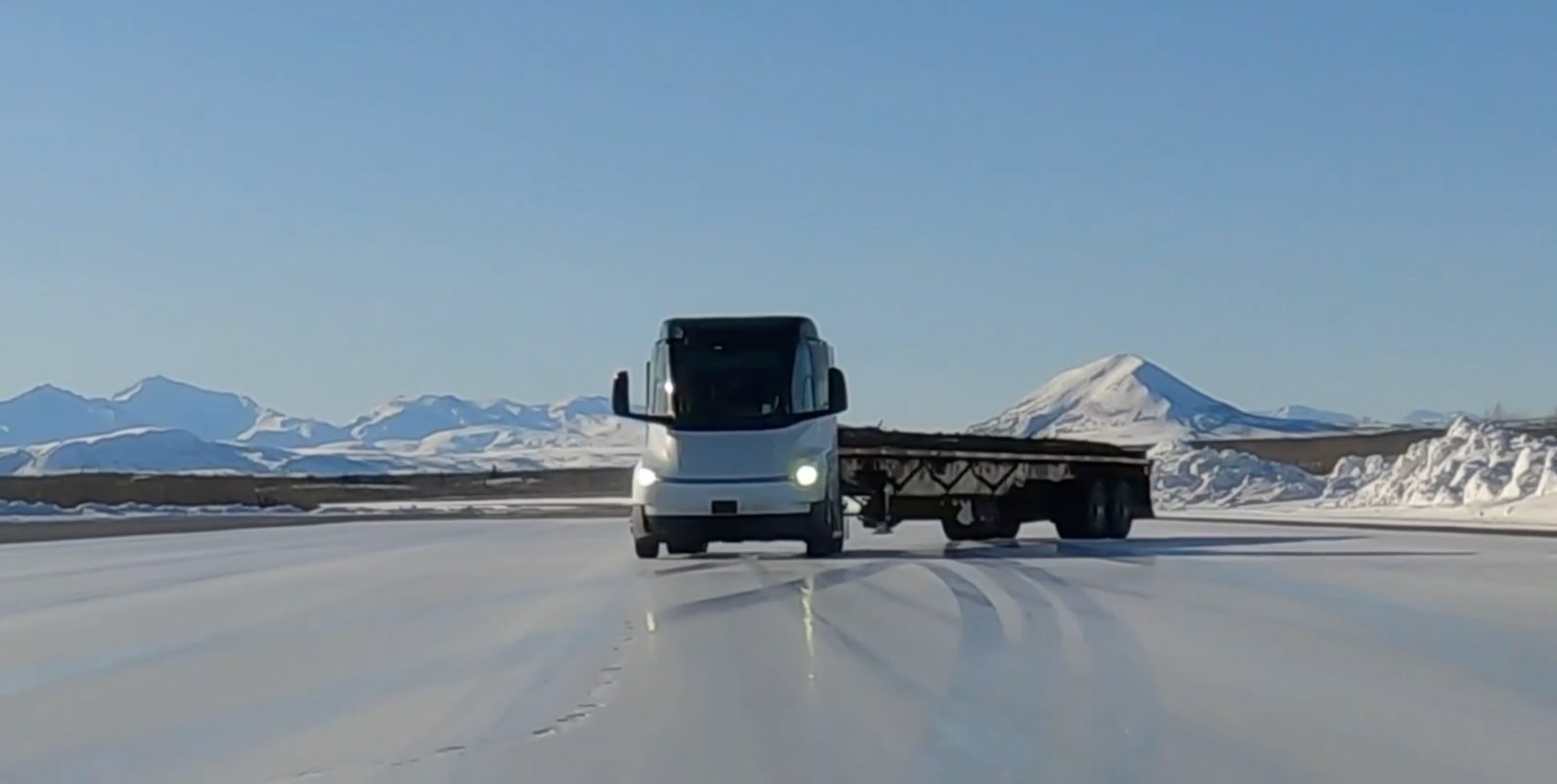
Elon Musk says Tesla expects to have self-driving working on the Tesla Semi “probably around the end of this year or early next year.”
Going by Tesla’s record on self-driving deadlines, it is: their jobs are safe for a long time.
Musk sells the autonomous Semi as a favor to truckers
The comment came on Tesla’s Q2 2026 earnings call on July 22, after LightShed analyst Walter Piecyk asked when Tesla would get around to autonomy for the Semi.
Musk opened with the labor shortage. “There just aren’t enough people around who want to drive trucks, which are crucial for transport throughout America,” he said.
Then he framed driverless trucks as a gift to the people who drive them: “making it easier on truck drivers to have a self-driving Semi is going to dramatically improve safety and comfort for truck drivers that use the Tesla Semi.”
These two statements sort of clash together because FSD won’t help with the shortage of truckers if you still need them inside the truck, just like FSD in consumer vehicles. Ultimately, Musk is talking about full autonomy inside Tesla’s semi trucks.
And the timeline: “We expect to get self-driving working on the Tesla Semi probably around the end of this year or early next year.”
In the same answer, he said Tesla is focusing its self-driving work on its high-volume vehicles — Model 3, Model Y, and Cybercab — and that Semi autonomy is “taking a bit of a backseat for the next six months or so.”
So it’s a year out, and nobody is really working on it for the next six months. Sure.
Thirteen years of self-driving deadlines, all missed
Here’s the problem with a one-year Musk timeline on autonomy.
We charted his prediction record earlier this year using data from MuskOmeter, which tracks 94 public Musk predictions. Eight of them were delivered on time. That’s 9%. Another 46 failed outright.
Self-driving is his worst category. We count roughly 10 self-driving and robotaxi deadlines since 2013, and every single one that has come due has been missed.
In October 2016, he said a Tesla would drive itself from Los Angeles to New York by the end of the following year. That was nine years ago and it still hasn’t happened. He said FSD would be “feature complete” by the end of 2019. He promised 1 million robotaxis on the road by 2020. In July 2020, he was “100% confident” Tesla would solve Level 5 autonomy the next year.
Last year it was robotaxi service for half the US population by December. This January it was Europe and China approving FSD “next month.”
The live promise right now is unsupervised FSD on customer cars in Q4 2026, which Musk repeated again in May and which we’ve gone through in detail.
If a year of Musk time on self-driving has historically meant closer to a decade, truck drivers are covered into the 2030s.
The Semi has its own history here
The Semi was supposed to have this already.
Tesla unveiled it in November 2017 with “Enhanced Autopilot” and a demo of convoy mode, where trucks follow each other autonomously down the highway. Production was promised for 2019.
It slipped to 2020, then 2021, then 2022. A handful of trucks went to PepsiCo at the end of that year, and at the delivery event, Tesla didn’t mention Autopilot or self-driving once. Convoy mode quietly came off the website.
The first Semi built on Tesla’s high-volume line at Giga Nevada rolled out in April. That factory is designed for 50,000 trucks a year. Tesla told investors this week that the Semi will still be “a very small percentage” of its total vehicle fleet by the end of 2026.
Electrek’s Take
The trucker-shortage framing is the part worth sitting with. In 2022, Tesla scrubbed every mention of autonomy from its Semi marketing, and the read at the time was that Tesla needed drivers and fleet managers to want this truck. Now the driverless version is back as a feature, and it’s being sold as safety and comfort for the driver whose seat it eliminates.
The companies actually running driverless trucks don’t bother with that pitch. Aurora has been hauling freight on Texas highways with nobody in the cab, crossing 250,000 driverless miles in March and targeting more than 200 trucks this year.
Top comment by CyanTrumpet
Unquestionably the most bulletproof career choice for the next decade and a half—completely untouchable by AI, robotics, or whatever futuristic tech we’ll be forced to pretend to care about.
Speaking of ground-breaking tech: 2027 is the 10th anniversary of the Roadster II! Fingers crossed for an Anniversary Edition. Maybe it'll come with upgraded hover capabilities, a built-in time machine, and a delivery date set for 2045.
As for Tesla, the company has racked up only 380,000 unsupervised miles in a year of testing unsupervised self-driving in its robotaxi service in Texas. And to limit the damage, the company has focused on a lower-speed, geo-fenced area.
I think it will be a while before it feels confident enough to increase the speed and the geo-fenced area to a degree that it makes sense for the Tesla Semi.
The honest read is that Semi autonomy is a line item Musk added because an analyst asked, then deprioritized in the same breath. It’s not a product timeline. It’s a mood.
If you drive an EV, or you’re thinking about it, the cheapest fuel you can buy is the electricity you make on your own roof. With electricity rates up almost 10% last year and expected to keep climbing, going solar is one of the best ways to protect yourself against rising costs. And with lease and PPA options, you can do it with zero upfront cost and start saving immediately. If you want to find the best deal, check out EnergySage. It’s a free service with hundreds of pre-vetted installers competing for your business, so you save 20 to 30% compared to going it alone. No sales calls until you pick an installer. Get your free quotes here.


FTC: We use income earning auto affiliate links. More.




Comments