
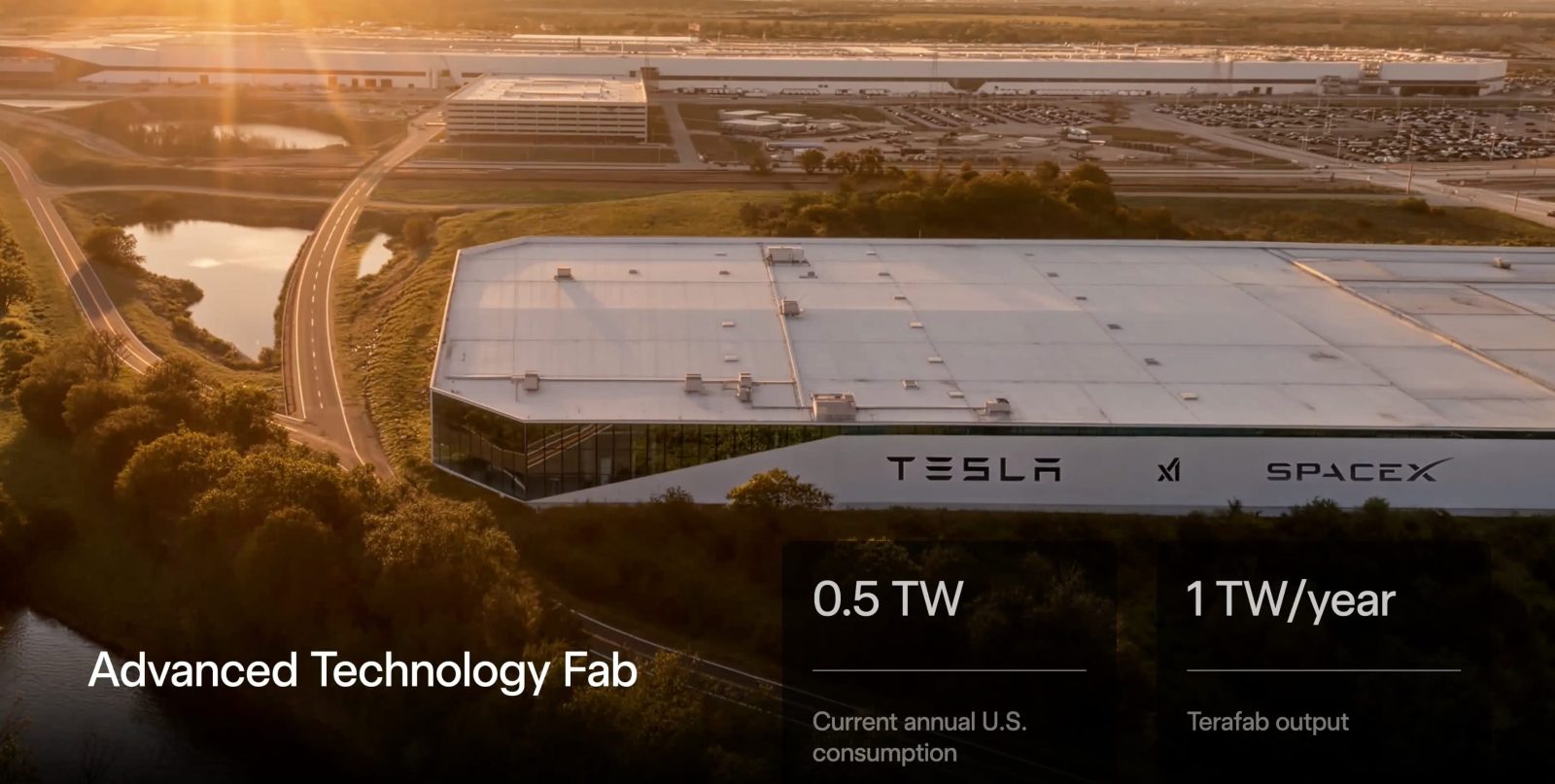
Tesla has hired a 17-year Intel manufacturing veteran, Gary Jiang, to serve as “Director, Terafab,” the first named leadership hire tied to the automaker’s ambitious Austin chip fab project.
The executive, who started at Tesla this month, most recently ran tool installation and ramp for Intel’s cutting-edge 18A process — exactly the experience Tesla lacks in-house.
An Intel fab veteran lands at Terafab
Electrek spotted Jiang’s verified LinkedIn profile listing his current role as “Director, Tera Fab” at Tesla, full-time and on-site in Austin, Texas, beginning in June 2026.
Before Tesla, he spent 17 years and 9 months at Intel, the most recent stretch as a Factory Manager from December 2024 responsible for “Intel 18A technology development transfer, construction / tool installation, and startup toward product certification, and high volume manufacturing capacity,” per his profile.
His earlier Intel roles were based at the company’s Ocotillo campus in Chandler, Arizona, and included department and area management positions across Fab 32 and Fab 12, covering 14nm and 22nm high-volume production. His listed competencies — “Technology Transfer, Fab startup, Strategic Planning, Cost reduction, Yield improvement” — read like the job description for standing up a semiconductor fab from scratch.
That matters because standing up a fab from scratch is precisely what Tesla says it wants to do.
The first hire behind the hiring push
Tesla began advertising for Terafab roles in Austin earlier this month, seeking program managers who have overseen more than $100 million in capital expenditures and can manage “factory design/construction from concept through execution, ramp-up, and production readiness.”
This appears to be the first senior fab-leadership hire to surface publicly, and it tells us where Tesla is fishing: Intel’s most advanced manufacturing operations.
Tesla and SpaceX announced the “Terafab” project in March, pitching a facility on the North Campus of Giga Texas that would consolidate chip design, lithography, fabrication, memory, advanced packaging, and testing under one roof. Musk has framed it as a $20 billion prototype targeting Intel’s 14A process node, scaling from 100,000 wafer starts per month toward an eventual 1 million.
The headline numbers have only grown since. SpaceX’s S-1 filing in May pegged the initial investment at $55 billion and total investment across all phases at up to $119 billion.
Tesla is buying the experience it doesn’t have
The problem we’ve flagged from the start is that Tesla has zero experience operating a semiconductor fab. Designing chips, which Tesla does, is a fundamentally different discipline from manufacturing them at scale.
When Intel formally joined the Terafab project in April, it confirmed what was already obvious: Intel brings the process technology, the equipment know-how, and the packaging that actually make a fab run. Hiring an Intel 18A factory manager directly into a “Director, Terafab” role fits the same pattern — Tesla is acquiring fab competence one Intel veteran at a time.
Electrek’s Take
This is a small data point, but a telling one. Tesla is clearly serious about staffing Terafab with real semiconductor manufacturing talent, not just slideware.
Top comment by HalfwitWizard
This guy is a genius. Worked his way close to the top of Intel manufacturing getting presumably very near retirement. Then gets poached by Tesla for an extremely high salary/stock/signing bonus. With Telsa and Elons strict adherence to timelines, he probably wont have to do anything except attend the few meetings a month that Elon actually attends and doesn't blow off. The man's probably going to retire before a single molecule of silicon is lasered.
The catch is that one director, even a very good one, doesn’t close the gap. Intel spent decades and tens of billions of dollars building the institutional knowledge this person represents, and Intel itself has stumbled badly on advanced-node execution in recent years. Tesla is trying to assemble that capability from a standing start, on a timeline Musk describes in terms of terawatts and millions of wafer starts.
It’s also worth remembering that, per SpaceX’s own S-1, Terafab and Macrohard remain in “very early stages” with no binding commitments, no finalized IP rights, and no firm financial terms. A leadership hire is real progress and a genuine signal of intent — but it’s the easy part. The hard part is everything that comes after, and the industry’s history is littered with well-funded fabs that never hit yield.
We’ll be watching to see how many more Intel and TSMC names show up on Terafab org charts in the coming months. That pace will tell us far more about whether this is a real factory or an expensive recruiting exercise.
If you’re charging an EV at home, powering it with rooftop solar is one of the smartest ways to lock in low fuel costs for the long haul. With electricity rates climbing nearly 10% last year, home solar protects you against future rate increases. And with lease and PPA options, you can go solar with zero upfront cost and start saving immediately. If you want to find the best deal, check out EnergySage. It’s a free service with hundreds of pre-vetted installers competing for your business, so you save 20 to 30% compared to going it alone. No sales calls until you pick an installer. Get your free quotes here.


FTC: We use income earning auto affiliate links. More.


Comments