
Slate Auto’s electric truck now starts at $24,950, but some buyers will still drive one home for under $20,000 thanks to state-level EV rebates.
The catch is that those discounts depend heavily on where you live and how much you earn — and several of them may not apply to Slate at all.
The $20,000 promise that didn’t survive
When Slate emerged from stealth in April 2025 with a sub-$20,000 electric pickup, that price was the entire story. The bare-bones, two-seat truck with hand-crank windows and no infotainment screen became an instant phenomenon, racking up more than 100,000 reservations within weeks.
But the “under $20,000” figure always carried an asterisk: it assumed the $7,500 federal EV tax credit. That credit was eliminated under the One Big Beautiful Bill Act, effective September 30, 2025, and the sub-$20,000 promise went with it.
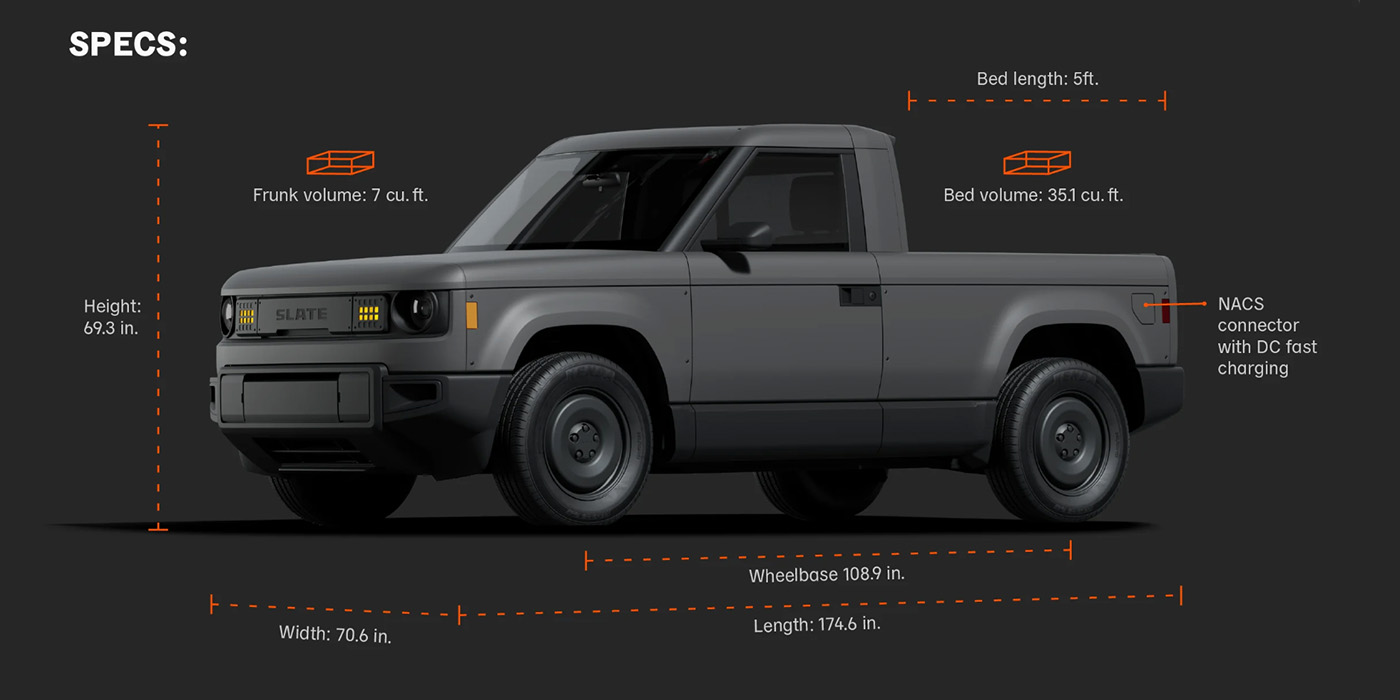
When Slate revealed final pricing this week, the truck started at $24,950, with the convertible SUV configuration at $29,950. The base model uses a single 65 kWh LFP battery pack feeding a rear motor with 181 hp and an estimated 205 miles of range.
How some buyers still get into the teens
Slate’s pitch is that the sticker price never changed — the federal credit did. The company is now leaning on state incentives to keep the under-$20,000 dream alive for a slice of its reservation holders.
“There are tons of people who already have reservations, who are still going to get a truck that’s in the teens because of state credits and rebates,” Slate chief commercial officer Jeremy Snyder told InsideEVs.
The math works in the most generous states, but almost always for income-qualified buyers. California is the extreme case: its general statewide rebate (CVRP) ended in 2023, so most California buyers now get nothing off the Slate. The only big money left is Clean Cars 4 All, which pays up to $12,000 — but only to households at or below 300% of the federal poverty line who scrap a running gas or diesel car. Maine gives up to $8,000 to its lowest-income buyers. And Oregon’s Charge Ahead program matches the old $7,500 federal credit for low-income households — though Oregon paused its rebates in December 2025 and isn’t expected to reopen until summer 2026.
Here’s the best-case state rebate in every state that still has a consumer EV program, and what it would knock the $24,950 Slate down to before taxes and fees:
| State | Best-case state rebate | Effective price* | Key conditions |
|---|---|---|---|
| California | $0 general / up to $12,000 | $24,950 / ~$12,950 | No general rebate left; $12,000 only via Clean Cars 4 All (income ≤300% of poverty line + scrap a running car) |
| Maine | up to $8,000 | ~$16,950 | Low-income only (+$1,000 bonus through Sept 30, 2026) |
| Oregon | $7,500 | ~$17,450 | Low-income (Charge Ahead) — program paused, reopens summer 2026 |
| Massachusetts | up to $5,000 | ~$19,950 | $3,500 standard + $1,500 income-qualified (MOR-EV+) |
| Vermont | up to $5,000 | ~$19,950 | Income-tiered (Drive Electric Vermont) |
| Rhode Island | up to $4,500 | ~$20,450 | $3,000 new BEV + $1,500 income adder (DRIVE+) |
| Connecticut | up to $4,250 | ~$20,700 | Income-qualified (Rebate+) — requires a licensed CT dealer |
| New Jersey | up to $4,000 | ~$20,950 | Charge Up NJ, plus state EV sales-tax exemption |
| Illinois | up to $4,000 | ~$20,950 | $2,000 + $2,000 low-income; open application cycles only |
| Colorado | up to $3,250 | ~$21,700 | MSRP under $35k (Slate qualifies); not income-limited |
| Pennsylvania | $3,000 | ~$21,950 | Income caps; price under $45k; limited funds |
| New Mexico | $3,000 | ~$21,950 | State tax credit through 2026 |
| Maryland | up to $3,000 | ~$21,950 | Excise-tax credit — closed to new applications (FY26 funds gone) |
| Minnesota | up to $2,500 | ~$22,450 | Limited funds, through June 2026 |
| New York | up to $2,000 | ~$22,950 | Drive Clean, point-of-sale |
*Before destination charge, sales tax, and registration. Assumes the buyer meets all income and program requirements.
Only a handful of states — California, Maine, Oregon, and the top income tiers in Massachusetts and Vermont — actually clear the under-$20,000 bar, and every one of them requires the buyer to qualify on income.
The caveats pile up fast
Here’s where the “under $20,000” headline gets complicated.
First, the biggest rebates are income-qualified. Oregon’s and Maine’s top-tier amounts go only to low-income buyers, and California’s enhanced rebates work the same way. A median-income buyer in those states won’t see anywhere near those numbers.
Second, the money runs out. State EV rebate funds are capped and frequently exhausted mid-cycle — Oregon paused its program in December 2025, Maryland closed to new applications in April 2026, and Minnesota’s funds are nearly spent.
Third, geography is everything. Only about 17 states still run consumer EV incentive programs at all. In the other 33, plus Puerto Rico, the Slate starts at $24,950 and goes up from there with sales tax, registration, and a destination charge.
And fourth — the one Slate hasn’t addressed — many state programs require the vehicle to be purchased through a licensed in-state dealer. Slate, like Tesla, Rivian, and Lucid, sells directly to customers with no dealership network. Connecticut’s CHEAPR rebate, for example, explicitly requires a licensed Connecticut dealer, which could disqualify Slate buyers there entirely.
Electrek’s Take
Top comment by Jack
While most people don't have access to state credits...millions still do and those savings can make a meaningful difference. Would be nice if this allows some low-income buyers to make the switch to an EV.
For most of Slate’s 100,000-plus reservation holders, this is a roughly $25,000 truck before taxes and fees, not a $20,000 one. The genuinely under-$20,000 outcomes are concentrated among low-income buyers in a handful of generous states, during the windows when those programs still have funding, and only if Slate’s direct-sales model qualifies for the rebate in the first place. That’s a lot of conditions stacked on top of each other.
None of this makes the Slate a bad deal. At $24,950 for a brand-new EV, it’s still cheaper than nearly every gas vehicle on sale and undercuts every other electric truck on the market by a wide margin. Slate also just closed a funding round that gives it runway to reach production, with first deliveries expected by the end of 2026.
But buyers should go in with clear eyes. The right question isn’t “can the Slate cost under $20,000?” It’s “can it cost under $20,000 for me?” — and for most people, the answer is no.
With EV prices climbing now that the federal credit is gone, locking in low home energy costs makes more sense than ever. With electricity rates climbing nearly 10% last year, home solar protects you against future rate increases. And with lease and PPA options, you can go solar with zero upfront cost and start saving immediately. If you want to find the best deal, check out EnergySage. It’s a free service with hundreds of pre-vetted installers competing for your business, so you save 20 to 30% compared to going it alone. No sales calls until you pick an installer. Get your free quotes here.


FTC: We use income earning auto affiliate links. More.


Comments