
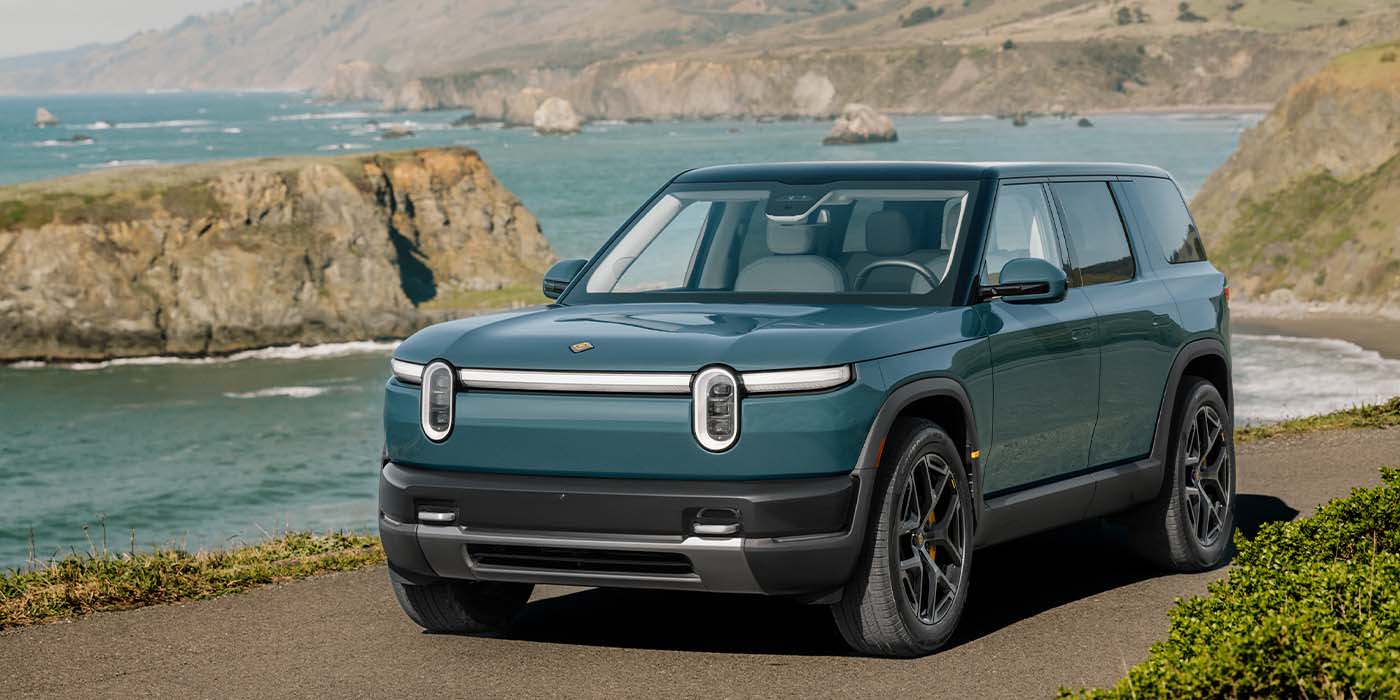
The Rivian R2 Performance’s final EPA ratings are now published, and the numbers confirm something impressive: the R2 Performance matches the Tesla Model Y Performance on efficiency at 105 MPGe combined and 32 kWh per 100 miles — while actually beating it on range with 330 miles versus 306.
What makes this particularly noteworthy is the R2’s form factor. The Rivian is a boxier, taller, more utilitarian SUV that weighs nearly 800 lbs more than the Model Y, yet it achieves identical efficiency.
The numbers
The fueleconomy.gov data breaks down as follows for the R2 Performance with 21-inch wheels and all-season tires: 105 MPGe combined (114 city, 96 highway) with an energy consumption rate of 32 kWh per 100 miles and 330 miles of total range.
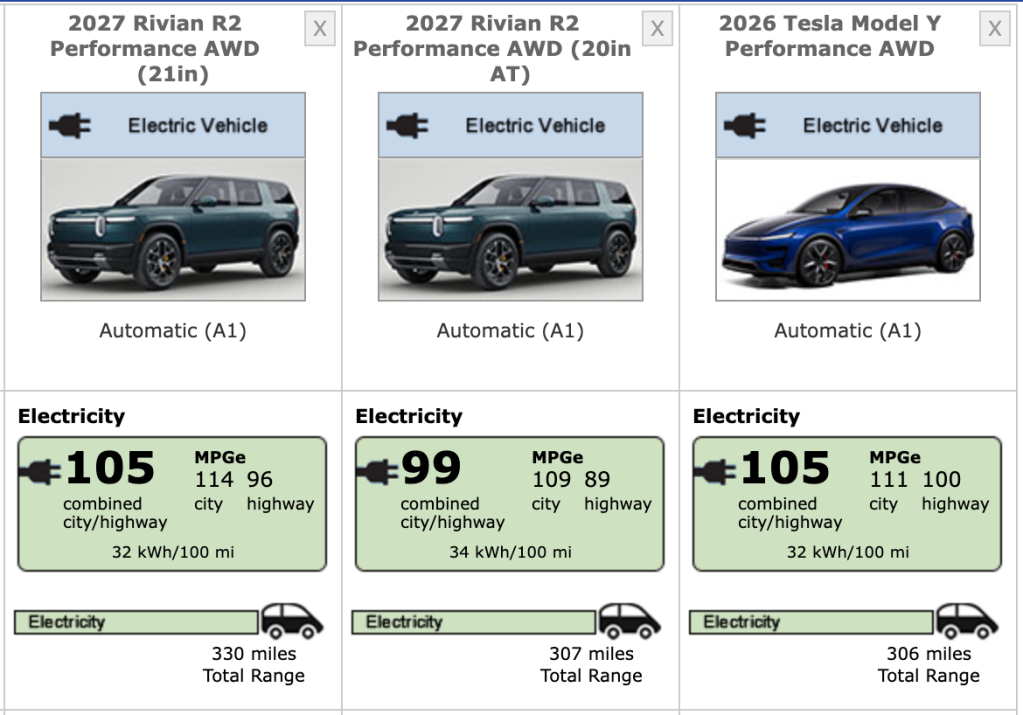
With the optional 20-inch all-terrain tires, efficiency drops to 99 MPGe combined (109 city, 89 highway) and 34 kWh per 100 miles, with range falling to 307 miles. That’s a meaningful penalty for the knobby tires, but still competitive.
It goes to show just how much of a difference tires have on efficiency.
For comparison, the 2026 Tesla Model Y Performance achieves 105 MPGe combined (111 city, 100 highway), 32 kWh per 100 miles, and 306 miles of range.
So on the standard 21-inch all-season setup, the R2 Performance and Model Y Performance are virtually identical on efficiency — and the R2 actually ekes out 24 more miles of range thanks to its slightly larger 86.8 kWh battery versus the Model Y’s 84 kWh pack.
Why this is impressive
The efficiency match becomes even more remarkable when you consider the physical differences between these two vehicles.
The R2 Performance tips the scales at approximately 5,250 lbs — nearly 800 lbs heavier than the Model Y. The Rivian is also noticeably taller with more ground clearance, has a boxier profile with a more upright windshield, and generally looks like the more traditional SUV of the pair. All of those characteristics typically kill aerodynamic efficiency.
Tesla has long been considered the benchmark for EV efficiency, and the Model Y’s sleek crossover shape is a big part of that. For Rivian to match it with a vehicle that prioritizes off-road capability and interior space is a significant engineering achievement.
Rivian’s new R2 platform benefits from dramatic cost and weight reductions compared to the R1, including die casting, a new drive unit, and simplified suspension. The R2 is roughly 1,300 lbs lighter than the R1S, and clearly, Rivian put that weight savings to good use.
Pricing comparison
The R2 Performance starts at $57,990 with the Launch Package, which bundles Autonomy+, the Tow Package, and a Launch key fob. The Tesla Model Y Performance starts at $57,490. Pricing is essentially a wash between the two performance trims.
With first R2 deliveries launching June 9, consumers will soon be cross-shopping these two vehicles in earnest. The R2 offers more interior space and a more rugged design, while the Model Y has Tesla’s Supercharger network advantage and a more established service infrastructure.
Although the Supercharger advantage is only a cost basis right now since Rivian owners have access to the network.
Electrek’s Take
The Rivian R2 matching the Tesla Model Y Performance on efficiency is one of the most impressive data points we’ve seen from a Tesla competitor. Efficiency has always been one of Tesla’s main advantages — the company’s vehicles consistently achieve better energy consumption than rivals, thanks to years of optimization on motors, inverters, heat management, and aerodynamics.
This is one of the main reasons Tesla has also been one of the few automakers capable of delivering EVs profitably at scale since it needs fewer battery cells per car to achieve range parity.
For Rivian to close that gap entirely with a vehicle that clearly prioritizes a more traditional SUV form factor is noteworthy. The R2 doesn’t look like a vehicle designed around a wind tunnel, it looks like a vehicle designed for adventure, with the efficiency to match the best in the business anyway.
We should note that real-world efficiency often differs from EPA ratings, and we’ll have to wait for independent testing to see how these numbers translate to actual driving.
Top comment by Hunter Spencer
I'll be very interested to see real-world tests on the R2's efficiency. Weighing more and being less aerodynamic should almost guarantee worse efficiency, unless Rivian has somehow figured out how to make motors that are far more efficient than just about anything else on the market currently.
With that being said, I don't think the R2 actually needs to match the Model Y's efficiency for it to sell well. People love their boxy/offroad-looking crossovers and SUVs. As long as the R2 is within the same ballpark as the Model Y on price (and it looks like it will be) and is at least fairly efficient (also looks like it will be), Rivian will sell as many as they can make.
It’s worth noting that the Model Y edges the R2 on highway driving, which is unsurprising since at higher speeds, drag becomes more important.
But on paper, the R2 Performance is positioning itself as the most compelling alternative to the Model Y Performance we’ve seen — matching it on efficiency and price while offering a more spacious, rugged package.
The bigger question is whether Rivian can ramp production fast enough to capitalize. Analysts estimate around 22,000-23,000 R2 units this year, a fraction of Model Y volume. But if the product is this competitive on paper, demand won’t be a problem.
If you’re considering an electric vehicle like the R2 or Model Y, charging at home with solar is one of the smartest ways to lock in low energy costs. With electricity rates climbing nearly 10% last year, home solar protects you against future rate increases. And with lease and PPA options, you can go solar with zero upfront cost and start saving immediately. If you want to find the best deal, check out EnergySage. It’s a free service with hundreds of pre-vetted installers competing for your business, so you save 20 to 30% compared to going it alone. No sales calls until you pick an installer. Get your free quotes here.


FTC: We use income earning auto affiliate links. More.




Comments