
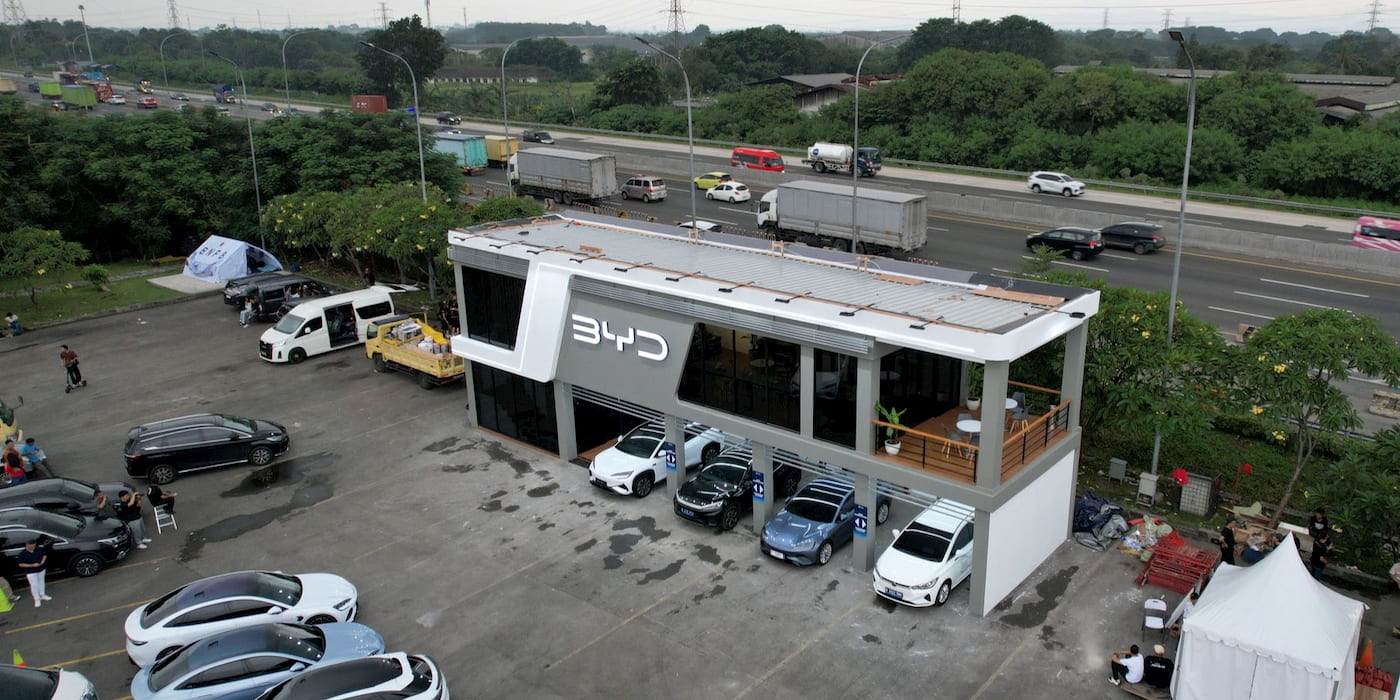
BYD is moving fast to establish a physical retail presence in Canada, with plans to open 20 branded dealerships within its first year in the market. The world’s largest EV maker is already scouting locations in the Greater Toronto Area.
The push comes just two months after Canada slashed its 100% tariff on Chinese-built EVs to 6.1%, a dramatic policy reversal that has unlocked the Canadian market for Chinese automakers for the first time.
From 100% tariff to 20 dealerships in under a year
According to The Globe and Mail, BYD has hired Dealer Solutions Mergers & Acquisitions, a Markham, Ontario-based automotive retail consultancy, to find dealership locations across the country. The firm’s CEO, Farid Ahmad, confirmed that BYD is targeting approximately 20 stores within its first year of Canadian operations.
“They’ve asked us to help them find as many of the 20 that they possibly can, but they’re out there doing that themselves, as well,” Ahmad told the newspaper.
Three potential locations in the Greater Toronto Area are already under discussion. After establishing a GTA footprint, BYD plans to expand into Vancouver, Montreal, and Calgary — covering Canada’s four largest metro areas.
BYD isn’t the only Chinese automaker eyeing Canada. Chery Automobile is also working with dealers to establish branded showrooms, according to Carscoops. Both companies plan independent dealership networks rather than sharing retail space with existing brands.
The tariff deal that made it possible
The dealership push is a direct consequence of the trade deal Canada struck with China in January, which cut the tariff on Chinese-built EVs from a prohibitive 100% down to 6.1% — but with strict limits.
The deal caps imports at 49,000 Chinese-made EVs in the first year, with a second application window from September 2026 to February 2027 allowing another 24,500 vehicles plus any unused permits from the first phase. The quota rises gradually to 70,000 units by 2030, and more than half of those vehicles are expected to carry import prices below $35,000.
In exchange, China reduced tariffs on Canadian agricultural exports including canola, lobster, crab, and peas. The deal also requires Chinese automakers to establish joint ventures for vehicles or batteries within Canada within three years — a provision designed to attract manufacturing investment alongside retail sales.
The 49,000-unit cap represents less than 3% of Canada’s annual new car market. That’s a tight leash, and it raises real questions about whether 20 dealership locations can sustain healthy volumes when the total available supply is capped at under 50,000 units split across multiple brands.
BYD arrives in a Canadian EV market that desperately needs competition
The timing of BYD’s Canadian entry is significant. The Canadian EV market contracted sharply in 2025, with battery-electric sales falling roughly 25% year-over-year to around 85,000 units, driven by the suspension of federal incentive programs and broader economic uncertainty.
Tesla, long the dominant EV brand in Canada, saw its Canadian sales collapse by more than 60% in 2025, dropping to roughly 18,000 units. GM overtook Tesla as Canada’s top-selling EV brand in early 2025, while Hyundai and Kia gained significant ground.
BYD enters this weakened market as the world’s largest EV manufacturer. The Shenzhen-based company sold 2.26 million battery-electric vehicles globally in 2025, crushing Tesla’s 1.64 million deliveries to claim the global BEV crown for the first full calendar year. BYD’s overseas sales alone surpassed 1 million units in 2025, up 150% year-over-year.
The company has not disclosed which models it will bring to Canada. Globally, BYD’s lineup spans compact hatchbacks under $15,000 to premium sedans and SUVs above $50,000. The trade deal’s emphasis on sub-$35,000 vehicles suggests BYD could prioritize affordable models like the Atto 3 compact SUV or the Dolphin hatchback — exactly the kind of affordable EVs the Canadian market lacks.
Top comment by Robert Lenoil
Planning twenty dealerships despite the tight import quotas means BYD intends to follow through on its stated goal of manufacturing cars in Canada.
BYD had originally planned to enter Canada in 2024 but shelved those plans after Ottawa imposed the 100% tariff on Chinese EVs in August of that year. The company also signaled it is open to building cars in Canada and acquiring a rival automaker, with Executive VP Stella Li telling Bloomberg that BYD would insist on owning and operating any Canadian factory outright.
Electrek’s Take
This is one of the most consequential developments for the Canadian auto market in years. BYD building out a 20-dealership network signals this isn’t a tentative toe-dip, it’s a full-scale market entry.
The 49,000-unit import cap is the key constraint here, and it applies across all Chinese automakers, not just BYD. With Chery also entering the market, Tesla wanting some of that capacity for Model 3s coming out of Shanghai, and potentially others, BYD’s actual allocation could be well under 10,000 units in year one. That’s thin volume for 20 stores. But BYD is clearly betting that the quota will expand — and that having physical retail infrastructure in place when it does will be a massive first-mover advantage over Chinese competitors who waited.
For Canadian consumers, this is unambiguously good news. The Canadian EV market has been crying out for affordable options. If BYD brings models priced in the $30,000-$40,000 CAD range, it will fill a massive gap and put real competitive pressure on every incumbent. The question isn’t whether Canadians want affordable EVs — it’s whether the quota system will let enough of them through the door.


FTC: We use income earning auto affiliate links. More.



Comments