

Donut Lab has now released five independent test reports from Finland’s VTT Technical Research Centre on its solid-state battery — and not a single one addresses the two claims that actually matter: the 400 Wh/kg energy density and the 100,000-cycle life.
The Q1 2026 deadline that Donut Lab set for delivering production batteries inside Verge Motorcycles is eight days away. The latest report, a cycling test dated March 13, adds another data point — but the overall picture remains unchanged.
What the latest test shows — and what it doesn’t
The newest VTT report (VTT-CR-00178-26), authored by Research Team Leader Ari Hentunen and reviewed by Research Professor Mikko Pihlatie, describes a 5C cycling test on a cell labeled DL2.
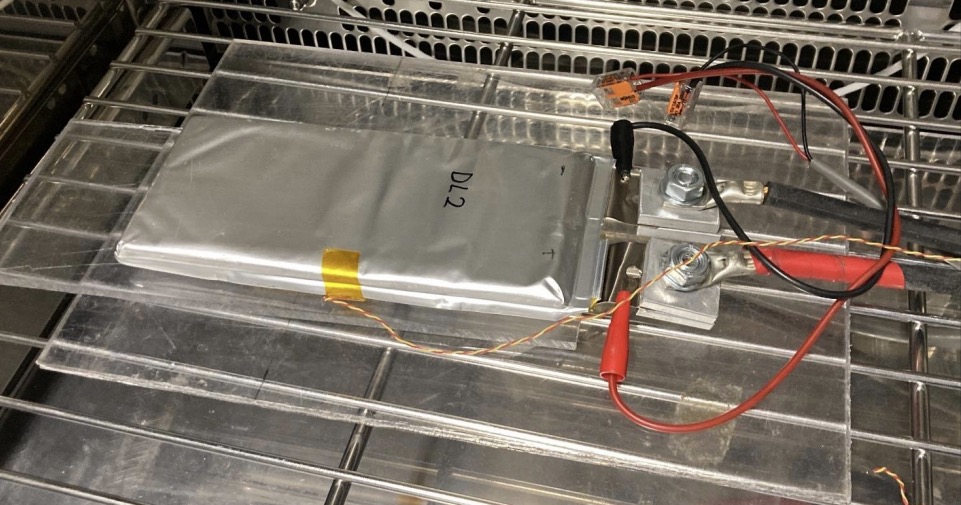
The critical context: this cell was already damaged. During a previous 100°C high-temperature discharge test, the cell’s pouch lost its vacuum — a significant structural compromise for a solid-state cell that relies on tight mechanical contact between layers. The purpose of this test was specifically to assess whether the damaged cell could still function under high charge and discharge currents.
The short answer: barely. VTT cycled the cell fifty times at 5C (130 amps) between 0% and 90% state of charge at room temperature. The initial 1C discharge capacity measured 24.689 Ah, close to the nominal 26 Ah rating. But after just six cycles at 5C, the capacity began dropping sharply. By the end of 50 cycles, it had fallen to 11.194 Ah — a 54.66% reduction. Energy efficiency dropped from 89.6% to 83.0%, and the cell swelled 17% in thickness.
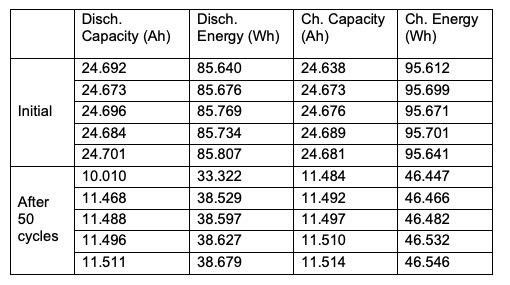
Given the damaged state of the cell, this result is not entirely surprising — and it would be unfair to treat it as representative of what a healthy Donut Lab cell would do under the same conditions. The lost vacuum almost certainly accelerated the degradation.
But the report highlights a more fundamental issue: this is the closest thing to a cycle life test that any independent lab has performed on a Donut Lab cell, and it was conducted on a compromised sample. No one has tested a healthy cell’s cycling durability.
The pattern of selective validation
Across five VTT reports, Donut Lab has built a careful case around its less controversial claims:
The first report confirmed fast charging — the cell reached 80% in 4.5 minutes at 11C, a genuine result. The second showed the cell survived a 100°C discharge, though the cell lost its vacuum in the process. The third demonstrated low self-discharge, retaining 97.7% charge after 10 days. The fourth moved to pack level, sustaining 100 kW charging in a Verge TS Pro motorcycle. And this fifth report tested cycling resilience of a damaged cell.
Each of these is a real engineering result. But none of them touches the two specifications that would validate the technology as truly revolutionary: the claimed 400 Wh/kg energy density and 100,000-cycle life.
For context, 400 Wh/kg would exceed the best commercial lithium-ion cells by a significant amount, and 100,000 cycles would represent approximately 270 years of daily charging — orders of magnitude beyond the 1,000 to 5,000 cycles that top cells achieve today. These are the claims that drew both excitement and heavy skepticism when we first covered Donut Lab in January.
Verifying energy density requires simply weighing the cell and measuring its output — a straightforward test. Yet five reports in, no independent party has done it.
Eight days to the deadline
CEO Marko Lehtimäki staked his personal reputation on having these batteries inside production Verge Motorcycles by the end of Q1 2026 — March 31. Verge Motorcycles CEO Tuomo Lehtimäki has said first deliveries would begin “in late March,” but EU and US safety certifications are still pending, and the company has limited 2026 production to approximately 350 motorcycles.
If production bikes do ship with Donut Lab cells inside them, the energy density and cycle life claims will eventually be testable by anyone with a scale and time. But “eventually” is doing a lot of heavy lifting for a company that promised to upend the entire battery industry this quarter.
Electrek’s Take
We want to be fair here. The damaged cell cycling result is not evidence that healthy Donut Lab cells degrade rapidly — the compromised vacuum makes that test unreliable as a measure of the technology’s true cycle life. And the other four VTT reports do show a battery that charges fast, handles temperature extremes, and holds its charge. Those are real results, not marketing slides.
But the pattern is hard to ignore. Five independent tests, and the two specifications that separate a good battery from a world-changing one remain completely unverified. Verifying energy density is trivial. Running even a few hundred cycles on a healthy cell would take days, not months. The fact that neither has appeared in any VTT report raises an obvious question: is the omission deliberate?
We said in January that this battery would either change the world or make Lehtimäki look like a fool. With eight days left on the clock, we still don’t have the data to call it either way — and the window for delivering that proof is closing fast.


FTC: We use income earning auto affiliate links. More.



Comments