
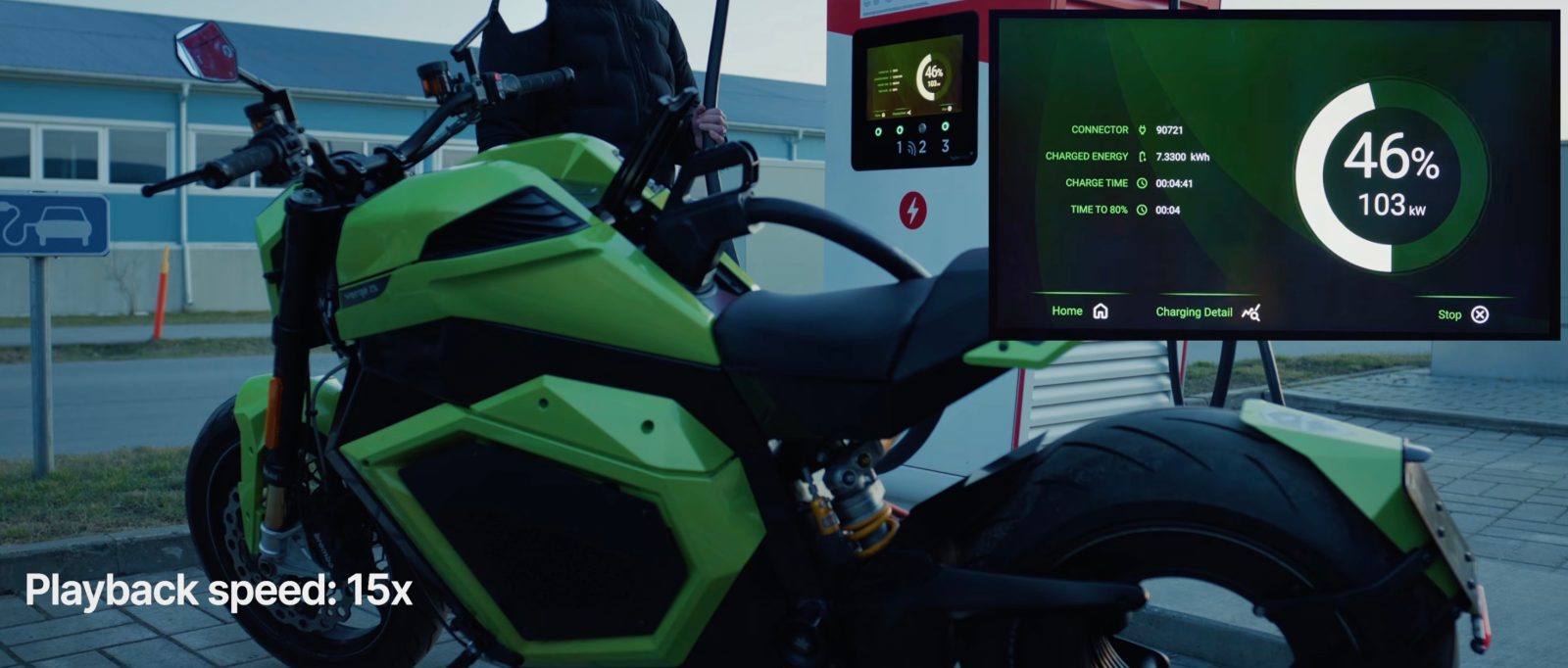
Donut Lab, the Finnish solid-state battery startup that has faced intense skepticism since its CES 2026 debut, released its first pack-level charging test results today. The 18 kWh battery pack sustained over 100 kW of charging power — a 5C rate — for five minutes straight inside a Verge TS Pro electric motorcycle.
The test marks the first time Donut Lab has demonstrated its technology beyond individual cells, moving to a full battery pack in what the company calls “a real vehicle environment.”
Pack-level charging results
The test used the standard 18 kWh battery pack designed for the Verge TS Pro. Starting at approximately 20°C, the pack charged from 10% to 50% in five minutes, reached 70% in just over nine minutes, and hit 80% in 12 minutes, all while using an air-cooled design rather than liquid cooling.
Donut Lab says the pack charges three times faster than Verge’s previous lithium-ion battery. The sustained 100 kW peak at a 5C rate is significant for an air-cooled motorcycle battery pack. For context, most EV car battery packs, which are four to five times larger, use liquid cooling systems to sustain comparable charging rates without thermal throttling – though charge rates can also be much highers in passenger cars.
Ville Piippo, CTO at Donut Lab, said the test demonstrates “multiple battery cells’ performance in a real vehicle environment,” adding that the “high energy density enables flexible pack design.”
Verge Motorcycles CEO Tuomo Lehtimäki called the charging performance a step toward building “the world’s fastest-charging motorcycle,” noting that the technology “complements our goal of optimal user experience.”
The company also confirmed that an extended-range version of the battery pack will offer approximately two-thirds more energy capacity — roughly 30 kWh — which would deliver up to 370 miles of range on the TS Pro according to Verge’s earlier claims.
The skepticism isn’t going away yet
Donut Lab has been one of the most polarizing companies in the battery industry since announcing a 400 Wh/kg solid-state cell at CES 2026 with claims of 100,000-cycle life and five-minute charging. Battery experts immediately pushed back. Shirley Meng, a professor of molecular engineering at the University of Chicago, visited Donut Lab’s CES booth and said bluntly: “They had zero demo, so I don’t believe it.” Yang Hongxin, CEO of Chinese battery giant Svolt, said “all the parameters are contradictory.”
Since then, Donut Lab has taken steps to build credibility. VTT Technical Research Centre of Finland conducted independent cell-level tests confirming that the battery maintained 107% of nominal capacity after multiple hours at 100°C — an impressive result if it holds at scale. The company also launched a transparency campaign called “I Donut Believe” to address doubts directly.
Today’s test is another step forward, but it still falls short of what skeptics need. A pack-level charging demo proves the cells work together and can sustain high power, but it does not address the most extraordinary claims around cycle life and energy density. Independent third-party testing of a complete pack — not just cells — under standardized conditions would carry far more weight.
As we covered in January, Donut Lab’s technology reportedly stems from research into amorphous titanium dioxide nanostructures developed at Tampere University, with manufacturing through a company called Nordic Nano. The chemistry allegedly uses a pseudocapacitance mechanism that allows rapid ion adhesion without the degradation typical of conventional lithium-ion cells.
Where this fits in the solid-state race
The timing is notable. The solid-state battery landscape has shifted dramatically in the first quarter of 2026 alone. CATL recently revealed ambitious solid-state patent filings ahead of China’s first national standard for the technology taking effect this summer. Changan plans to deploy 400 Wh/kg solid-state packs in vehicles before the end of Q3 2026. Factorial Energy went public after a 745-mile real-world test. And ION Storage Systems just became the first US company to qualify a solid-state cell with a customer.
But most of these players are targeting 2027-2030 for meaningful production volume. If Donut Lab can actually deliver production packs in the Verge TS Pro within Q1 2026, as both companies have claimed, it would represent a genuine first for the Western market.
The difference between Donut Lab and everyone else: Donut Lab claims to already be in production. That is either its greatest strength or the source of its eventual embarrassment.
Electrek’s Take
We have been following the Donut Lab story closely since CES, and our position remains the same: cautious skepticism with genuine curiosity. Today’s test is incrementally positive. Sustaining 100 kW charging at a 5C rate on an air-cooled pack is a real engineering result, not a slide deck. And doing it in an actual motorcycle chassis rather than a lab bench adds a layer of practical credibility.
But “incrementally positive” is the key phrase here. The gap between a charging demo and validated production remains enormous. We still do not have independent pack-level energy density measurements. We still do not have cycle life data beyond VTT’s cell-level thermal tests. And we still do not have a timeline for customer deliveries backed by anything more than promises.
Donut Lab said it would deliver the bikes with solid-state batteries in Q1 and we are just weeks away from that deadline.
It’s also worth noting that the two biggest claims made about the battery haven’t been tested. I don’t want to dismiss how cool it is to be able to have an 18 kWh battery pack in a motorcycle charging at 100 kW while only being air-cooled, but it’s also not even close to how revolutionary a 400 Wh/kg pack that is capable of 100,000 cycles would be, and those claims remain untested.
If Donut Lab had released this test with its 30 kWh battery pack, it would have been a bit more encouraging as it would have at least demonstrated volumetric energy density achievements to fit that inside a motorcycle.


FTC: We use income earning auto affiliate links. More.



Comments