
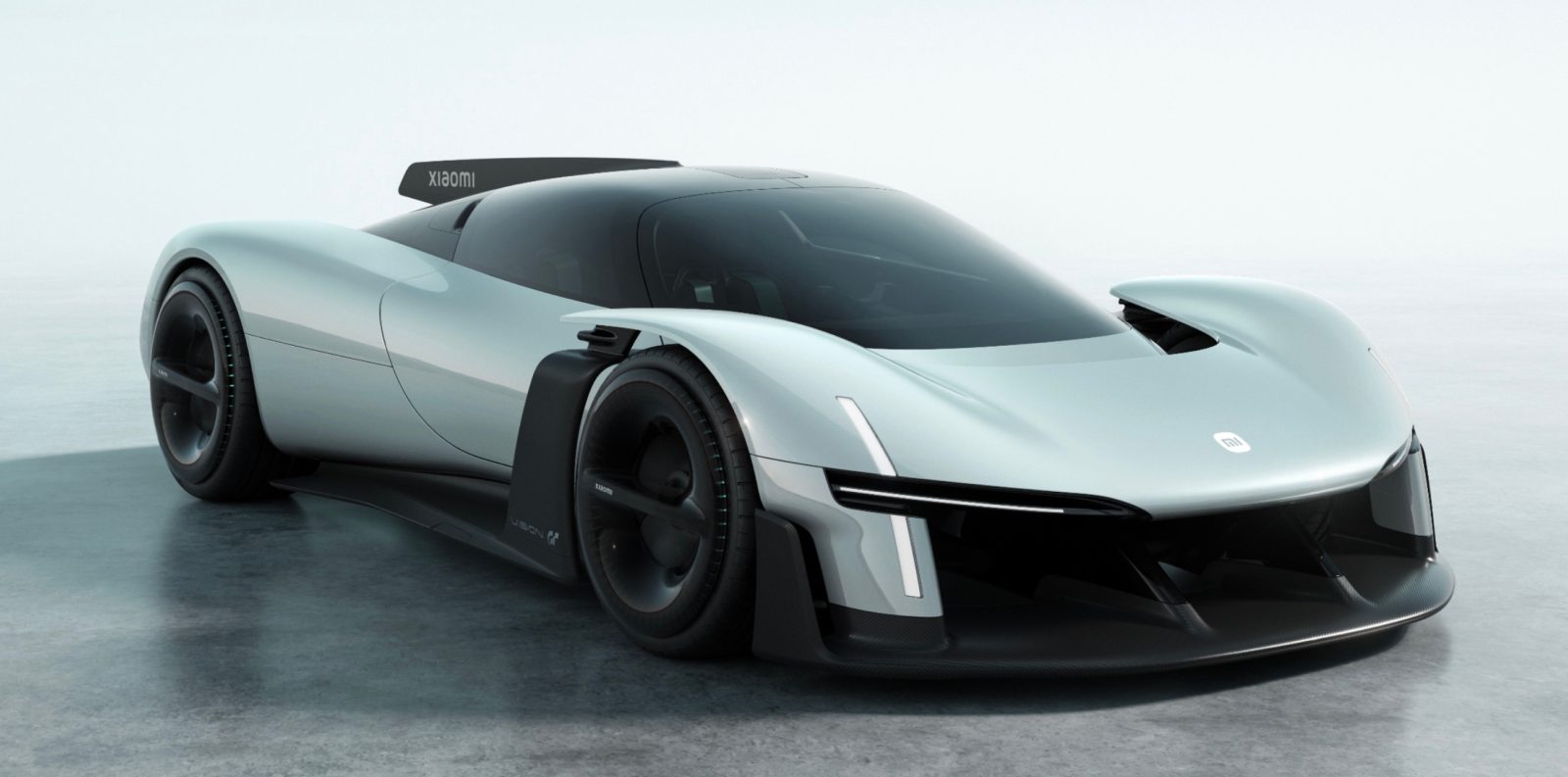
Xiaomi just revealed a Vision Gran Turismo concept supercar at MWC 2026 in Barcelona, making it the first Chinese automaker to participate in the iconic racing game’s concept car program in its 28-year history.
The electric supercar concept sits on Xiaomi’s own 900V Silicon Carbide (SiC) platform and features a radical low-slung design with scissor doors, a massive carbon fiber rear wing, and center-lock wheels hiding carbon-ceramic brakes.
A tech company plays in supercar territory
The Vision Gran Turismo program, created by Polyphony Digital in 2013, has historically been the playground of legacy automakers like Mercedes-Benz, Porsche, Ferrari, and BMW. Each brand designs a concept car unconstrained by production requirements or regulatory hurdles, a pure expression of design and engineering ambition that becomes playable in the Gran Turismo racing game on PlayStation.
Xiaomi is now the first Chinese brand to join that exclusive club, and it’s a statement about how far Chinese EV makers have come in just a few years.
The concept was spotted in Barcelona ahead of MWC and leaked online before Xiaomi CEO Lei Jun confirmed the reveal on Weibo on February 28, promising full specifications on March 1 ahead of the official MWC unveiling on March 2.


What we know about the Vision GT
The concept features an extreme low-slung posture consistent with a mid-engine or central-cockpit layout. The design is aggressive and aerodynamically driven, with multiple front air-channel intakes, a shark-fin roofline structure, T-shaped headlights, and an exaggerated rear diffuser with extensive ducting.
Xiaomi’s chief designer Li Tianyuan described the philosophy behind it: the goal was to achieve aerodynamic performance without relying on additional bolt-on components.
The interior features a butterfly-shaped steering wheel, a panoramic display screen, and what Xiaomi calls a “cocoon-shaped sofa” for the driver’s seat. The “XIAOMI”-badged wheel faces come in a blue finish, matching the light blue body wrap seen on the concept.
Under the skin, the Vision GT uses Xiaomi’s 900V SiC platform, the same architecture the company developed with a significant chunk of its $1.4 billion EV R&D budget. The center-lock wheels house massive carbon-ceramic rotors reportedly designed to handle the kinetic energy of a powertrain in the 1,900 hp range, though Xiaomi hasn’t confirmed final output figures.
For context, Ferrari’s Vision Gran Turismo concept produces 1,337 hp, and the Porsche Vision GT is a fully electric two-seater. If Xiaomi’s figures hold, it would make the Vision GT one of the most powerful concepts ever created for the program.
Xiaomi’s EV ambitions are accelerating fast
The Vision GT concept might be a virtual-only exercise, but it represents something very real: Xiaomi’s growing confidence as an automaker.
The company delivered over 410,000 EVs in 2025, smashing its original 300,000-unit target, and has set its sights on 550,000 deliveries in 2026. The SU7 sedan has already outsold the Tesla Model 3 in China, and the company is planning four new models this year, including two extended-range SUVs.
This also comes less than a year after the SU7 Ultra launched as a 1,500+ hp flagship that set the Nürburgring production EV lap record at 7:04.957 — the fastest ever for a production electric car. The SU7 Ultra was itself the first mass-produced Chinese vehicle to appear in Gran Turismo 7.
Perhaps most importantly, Xiaomi confirmed that 2027 will mark its “first year of overseas expansion,” with plans to enter the European market. The company has established an R&D center in Munich and is reportedly targeting 150 stores in the UK within four years. The Vision GT concept at MWC Barcelona — Europe’s biggest tech conference — is clearly part of that charm offensive.
Electrek’s Take
It’s easy to dismiss a Vision Gran Turismo concept as a marketing exercise, and it is one. But Xiaomi’s entry into this program carries more weight than the average VGT reveal.
When Mercedes-Benz or Ferrari design a concept for Gran Turismo, they’re reinforcing an existing reputation. When Xiaomi does it, they’re building one. Two years ago, this was a smartphone company. Now it’s delivering 400,000+ EVs a year, holding the Nürburgring EV record, and designing concept supercars that sit alongside the biggest names in automotive history.
It also positions the Chinese company as the leader in its domestic EV market built around drivers. We previously reported that Xiaomi has a program to encourage its execs to train as race car drivers, which they believe will reinforce their driver-centric culture.
Now, Xiaomi being in Gran Turismo is another step in that direction.
The timing matters too. Xiaomi chose MWC Barcelona, not a Chinese auto sho, to reveal this. With European expansion confirmed for 2027 and an R&D center already operational in Munich, the Vision GT is essentially a calling card for European consumers and regulators. It says: we’re not just making cheap EVs for China; we can compete at the absolute top.
Whether the 900V platform and 1,900 hp claims translate into anything production-relevant remains to be seen. But given Xiaomi’s track record of executing faster than anyone expected, 500,000 cars produced in just 602 days from launch, we wouldn’t bet against them.


FTC: We use income earning auto affiliate links. More.



Comments