

A week ago, Elon Musk announced that Tesla had started Robotaxi rides in Austin “with no safety monitor in the car.” The stock jumped 4%. Headlines celebrated the milestone. But since then, not a single rider has reported actually getting one of these unsupervised rides.
The announcement came on January 22, just days before a major ice storm hit Austin and, conveniently, less than a week before Tesla’s Q4 2025 earnings report today.
The service has started back since then, but no one is getting the “unsupervised” rides.
42 rides, zero unsupervised
David Moss, a Tesla enthusiast who gained notoriety for driving 10,000 miles on FSD v14 without interventions, traveled to Austin specifically to find and ride in an unsupervised Robotaxi. He’s been hunting for days.
His results? 42 rides. All 42 had safety monitors in the vehicle.
In a post on X, Moss wrote:
42 Tesla Robotaxi Rides, 42 L’s, 1 goal of finding an unsupervised Model Y. It’s tough to get a ride on the app & every ride I take one I see legitimately 4-5 cars mapping the area that could be on the app. This was also my 5th ride in a row with the supervisor in the driver’s seat.
Other riders have reported similar experiences.
Tesla VP of Software Ashok Elluswamy did acknowledge on January 22 that the company was “starting with a few unsupervised vehicles mixed in with the broader Robotaxi fleet with Safety Monitors” and that “the ratio will increase over time.”
Like Musk, Elluswamy also didn’t mention the trailing cars behind the supposedly “unsupervised Robotaxis.”
Either way, a week later, no one can find these “few unsupervised vehicles” despite the service restarting after the storm passed:
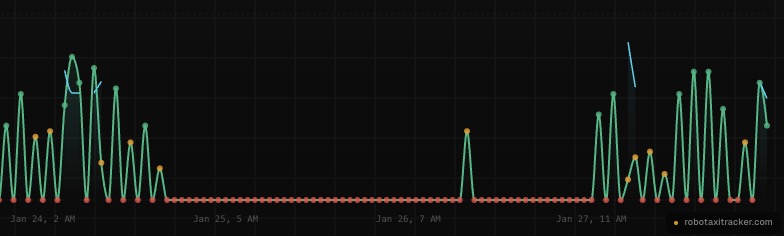
It’s worth noting that, prior to the 2-day service pause, data suggests Tesla’s Robotaxi fleet in Austin consisted of only a handful of vehicles in operation at the time.
The number of “new” Robotaxis reported is based on license plates, and it appears to be mostly due to Tesla updating its fleet with new Model Ys with added hardware.
A familiar playbook
This isn’t the first time Tesla has made a splashy autonomy announcement that was never repeated.
In June 2025, Tesla made headlines with its “first fully autonomous delivery”, a Model Y that drove itself 15 miles from Giga Texas to a customer’s home in Austin. Musk celebrated on X: “The first fully autonomous delivery of a Tesla Model Y from factory to a customer home across town, including highways, was just completed a day ahead of schedule!!”
The video went viral. Tesla fans hailed it as proof that “unsupervised FSD is ready for primetime.”
Then… nothing. Tesla never did another driverless delivery. Seven months later, customers still pick up their cars the old-fashioned way. If the system truly worked, why wouldn’t Tesla use it for every Austin delivery? The logistics savings would be enormous.
The answer, of course, is that it was a one-time demonstration, not a scalable capability.
The timing isn’t a coincidence
Tesla’s January 22 announcement about removing safety monitors came at a strategically perfect moment:
- Before the ice storm: Austin was hit by a major winter storm starting January 24, which significantly reduced Robotaxi operations and made it harder for people to verify Tesla’s claims
- Before earnings: Tesla reports Q4 2025 results today (January 28), and the stock needed a boost after another year of declining vehicle sales
- After Musk’s Davos appearance: Musk had just claimed at Davos that Tesla “solved autonomy” — again
This is the same CEO who has promised “full self-driving next year” every year since 2018. The pattern is clear: make bold announcements before major events, let the stock rise, and quietly move on when the reality doesn’t match the hype.
Electrek’s Take
Let’s call this what it is: another marketing stunt.
If Tesla truly had unsupervised Robotaxis operating in Austin, riders would be posting videos constantly. David Moss wouldn’t be 0-for-42. The evidence would be everywhere.
Instead, we have a single announcement, a 4% stock bump, and silence.
Top comment by taverngeek
I will treat all of Musk's and Tesla's robotaxi announcements to be hype until they apply for the California DMV permit to begin autonomous vehicle testing without a safety driver. That permit would indicate Tesla confidence in their autonomous driving package because it'd mean they are comfortable with releasing data on miles driven and critical interventions.
If Musk wants to claim that California has an impossible regulatory environment then that is contradicted by the 6 other companies with that permit and Tesla's running of a California taxi service. If the Tesla taxi service in California can never become autonomous due to the regulatory environment then why is it operating today with human drivers using Tesla's FSD as ADAS?
As we reported last week, the “unsupervised” Robotaxis spotted on January 22 were all being followed by trailing Tesla vehicles with safety monitors inside. Tesla didn’t remove supervision, it just moved it to a different car.
Now even that setup appears to have been scaled back or paused entirely. The vast majority of rides have safety monitors back inside the vehicle, sitting in either the driver’s seat or passenger seat.
This follows the exact pattern of the “driverless delivery” stunt from June 2025: a one-time demonstration for the cameras, timed for maximum stock impact, never to be repeated.
Tesla investors should ask themselves: if the technology truly works, why does it only appear for press releases?


FTC: We use income earning auto affiliate links. More.


Comments