
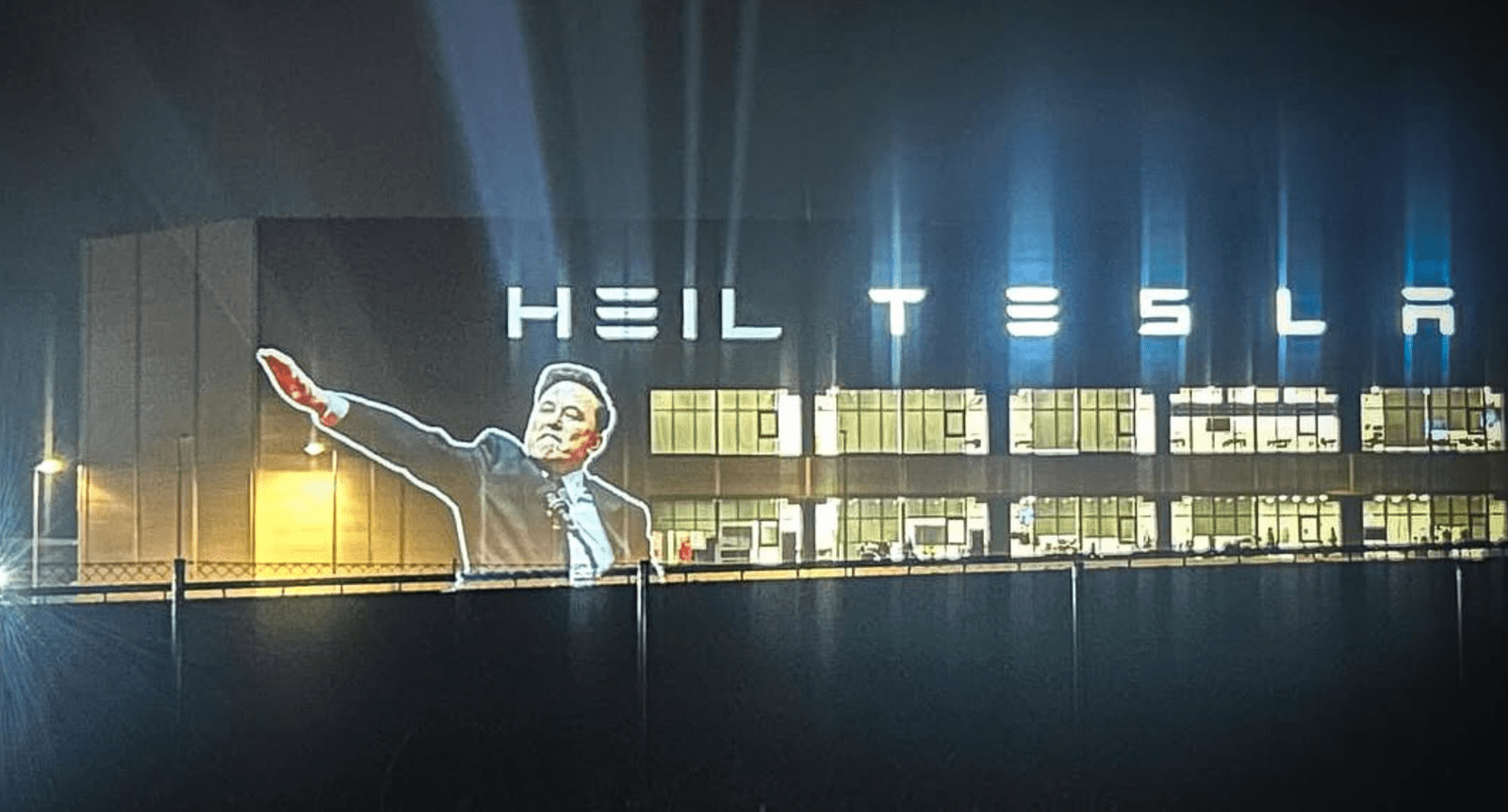
Is Tesla preparing to pull the plug on domestic production in Germany? It might sound crazy for a factory that just opened a few years ago, but when you look at the abysmal sales numbers in Europe and combine them with the latest threats from management against the union, the writing might be on the wall.
For months, we have been reporting on the demand issues Tesla is facing in Europe. Now, the situation has deteriorated to a point where the existence of Gigafactory Berlin itself seems to be in question.
The math doesn’t add up anymore
The rationale for Giga Berlin was simple: Tesla was selling so many cars in Europe that it made sense to build them there rather than ship them from Shanghai or Fremont. It was about localization, avoiding tariffs, and reducing logistics costs.
But that logic only holds if you are selling enough cars to keep the factory running efficiently.
New data from 2025 shows that Tesla’s sales in Europe have cratered. To put that in perspective, Tesla is now selling fewer vehicles in Europe than it did before Giga Berlin had even fully ramped up production.
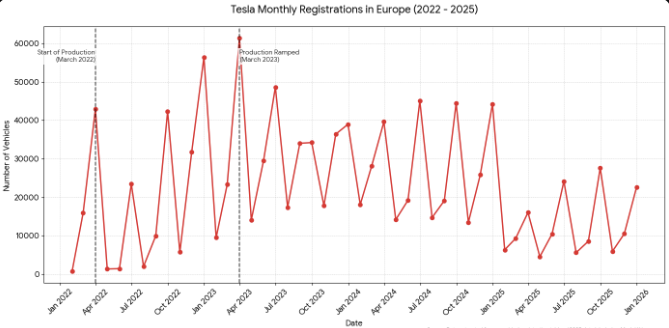
Back in 2022, when Tesla was relying entirely on imports to feed the European market, it was regularly moving significantly more metal than it does today. If the demand is now lower than it was during the “import era,” the primary justification for carrying the massive overhead of a German factory evaporates.
Based on this data, Gigafactory Berlin had virtually no positive impact on Tesla in Europe. Globally, it did help Tesla free up some supply produced in US and China for other markets. That’s about it.
The IG Metall “Excuse”
This brings us to the latest developments on the ground in Grünheide.
Tensions between Tesla management and the IG Metall union have reached a boiling point ahead of the upcoming works council elections. Tesla factory director André Thierig has reportedly drawn a “red line” regarding the union’s demand for a 35-hour workweek and has issued stark warnings about the facility’s future.
According to a report from Handelsblatt, Thierig and Tesla management are effectively threatening the workforce: if IG Metall gains control of the works council, future investments in the plant will be halted.
“If the German trade union IG Metall were to expand its influence in works council elections, investments would be halted.” — Handelsblatt citing management sentiments.
Thierig has been cited comparing Grünheide’s productivity unfavorably to U.S. and Chinese plants, suggesting that if the union, “hostile” to management, takes over, the corporation would prioritize other locations.
Electrek’s Take
This looks like a setup.
If you look at the sales chart, Tesla has a massive problem. They have a factory capable of pumping out 375,000+ Model Ys a year in a market that only bought ~235,000 Teslas total in 2025 (including Model 3s imported from China and a handful of Model S/X from the US).
Canada helped a little with its counter tariffs on the US, which forced Tesla to ship Model Ys from Berlin rather than the US, but it’s a drop in the bucket.
Mathematically, Giga Berlin is a financial bleed. Under normal circumstances, closing or severely downsizing a brand-new factory is a humiliating admission of failure. It signals to Wall Street that the “unlimited demand” growth story is dead.
But what if you could blame it on someone else?
Top comment by rgreen83
Do all the other car manufacturers have these union contracts? And 35 hour or similar work weeks? If so I can't see any reason Tesla shouldn't be able to compete on a level playing field, they shouldn't get special treatment and neither should their competition.
By drawing this “red line” with IG Metall, Tesla is positioning itself to use a union victory as a scapegoat. If IG Metall wins the works council election, which is a real possibility at this point, Tesla can turn around and say, “We cannot operate competitively in this labor environment. We are forced to redirect resources.”
It allows Elon Musk to spin a potential closure or massive downscaling not as a demand problem, but as a “woke union” problem – sending a message to the rest of Tesla’s workforce at the same time. It’s a perfect exit strategy. They get to reduce their overcapacity in Europe, go back to importing cheaper cars from China (tariffs notwithstanding, the margins might still be better than running a half-capacity German factory), and they get to do it while playing the victim of “anti-business” labor practices.
The sales numbers say Giga Berlin is redundant. The union fight might just give Tesla the excuse they need to admit it.
Meanwhile, this is happening while BYD is launching a new factory in Europe. Strange times. I don’t think many EV experts would have predicted this 5 years ago.


FTC: We use income earning auto affiliate links. More.



Comments