
CES 2026 in Las Vegas has been dominated by two things: the next generation of AI compute and a sudden explosion of credible humanoid robots.
While Tesla isn’t officially exhibiting on the floor, Elon Musk has been actively monitoring the event from X. His reactions, and lack thereof, to the major announcements give us a fascinating look into how Tesla views the rapidly crowding field of autonomy.
Musk was quick to comment on NVIDIA’s major push into embedded AI for autonomous systems, but he has been noticeably quiet regarding the masterclass put on by Hyundai and Boston Dynamics.
The NVIDIA “Alpamayo” Reaction
NVIDIA came to CES swinging with its new “Alpamayo” platform, essentially positioning itself as the go-to supplier for the “brains” of future autonomous robots and vehicles. It’s a direct shot at the integrated model Tesla is pursuing, where Tesla builds both the robot (car or humanoid) and the AI inference computer running it.
When asked on X if NVIDIA’s move into this space was a threat to Tesla’s Full Self-Driving (FSD) and robotics efforts, Musk offered a diplomatic, if slightly backhanded, response.
He made a point that has been known for years, but he often forgets when he shares ambitious timelines about Tesla achieving “unsupervised self-driving by the end of the year”: generalized autonomy is incredibly difficult because of the “long tail” of rare, real-world edge cases.
“Solving the long tail of real-world edge cases is incredibly hard,” Musk wrote. “I honestly hope they succeed.”
It sounds nice, but long-time Musk watchers know that “I hope they succeed” is often Elon-speak for “They are biting off way more than they can chew, and they aren’t a threat to us yet.”
Of course, NVIDIA is not only a competitor to Tesla, but also an important supplier, and a critical supplier to other Musk companies, such as xAI.
Musk ended up making several comments on NVIDIA’s autonomous driving announcement at CES, most of them meant to reassure Tesla shareholders that he doesn’t see this as a threat to Tesla, even though it clearly is a direct competitor to Tesla’s FSD.
The Sound of Silence on Atlas
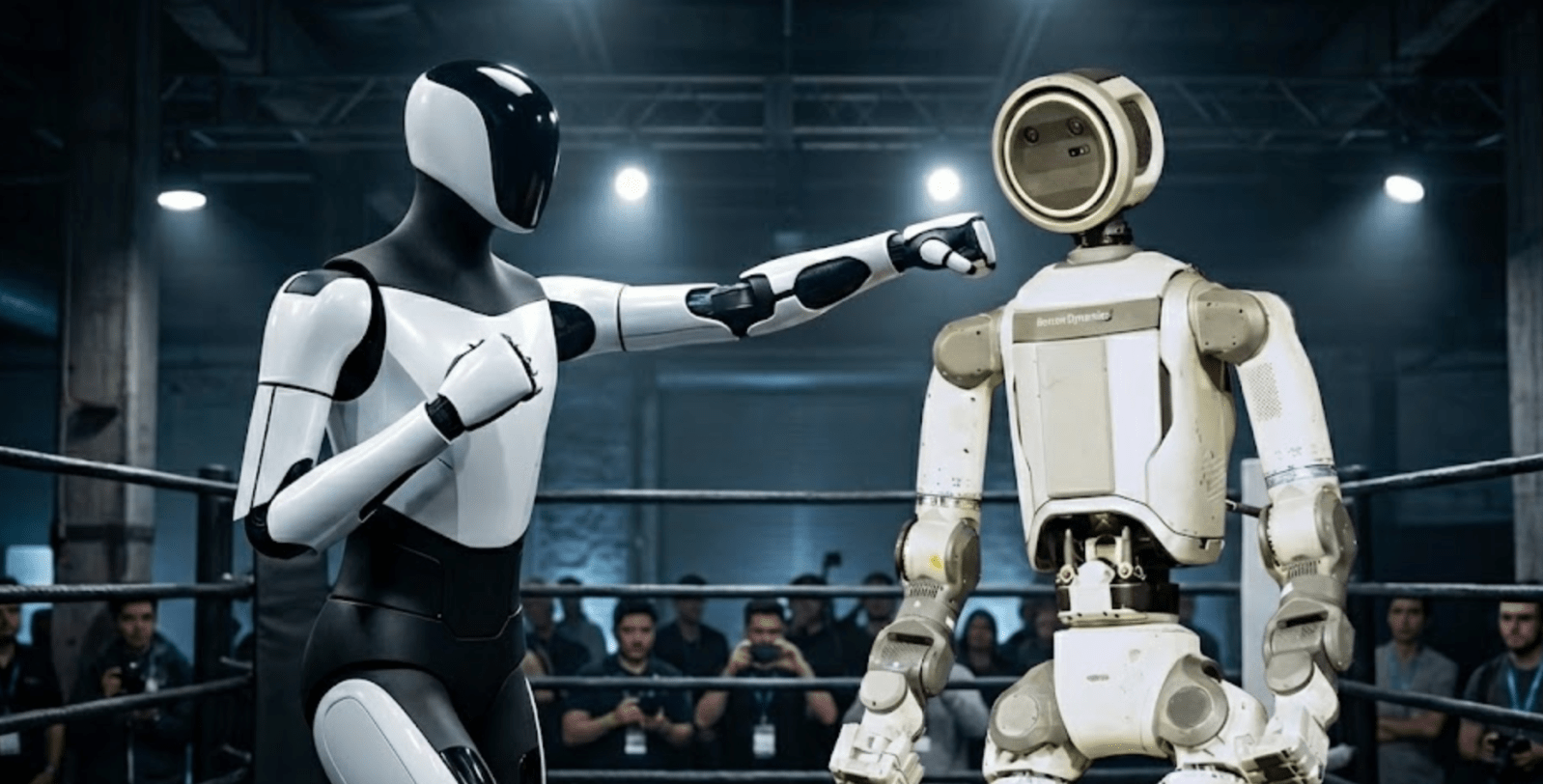
The undisputed star of the CES robotics floor is the public debut of Hyundai/Boston Dynamics Atlas humanoid robots.
We saw the teasers last year when they retired the old hydraulic model, but seeing the new electric Atlas moving in person is different. It’s fluid, incredibly quiet, and possesses a range of motion in its joints that frankly makes humans look stiff. The dynamism that Boston Dynamics is famous for is still there, but now it’s packaged in a sleek, commercial-looking design rather than a prototype lab experiment.
Not only that, it is being integrated with Google’s Deepmind and it is already operating autonomously in Hyundai’s factories.
It is a direct, credible competitor to Tesla Optimus.
Yet, as of Wednesday morning, Musk has not directly commented on the Atlas demos – even though as previously stated, he has been quite chatty about NVIDIA’s announcements at CES.
Atlas vs. Optimus:
| Feature | Tesla Optimus (Gen 2) | Boston Dynamics Atlas (Electric) |
| Height | ~5’8″ (1.73 m) | 6’2″ (1.9 m) |
| Weight | ~125 lbs (57 kg) | ~196 lbs (89 kg) |
| Actuation | Electric Actuators: Custom-designed by Tesla; focuses on efficiency and mimicry of human muscle capability. | Electric Actuators: High-torque, custom designs that allow for super-human strength and speed; replaced previous hydraulic systems. |
| Movement & Speed | Human-Like: Walks at ~5 mph (target), moves smoothly. Focus is on stability and safety. | Super-Human: Capable of ~2.5 m/s (~5.6 mph). Features 360° swiveling joints, allowing it to stand up from flat or turn without moving its feet. |
| Hands / Dexterity | 11 Degrees of Freedom: Designed to mimic human hands with tactile sensing for handling delicate objects (eggs, tools). | Simple Grippers: While improving, Atlas often prioritizes robust “pincers” or heavy-duty grippers for moving boxes and parts over fine manipulation. |
| Payload | ~45 lbs (20 kg): Good for carrying groceries, small parts, or tools. | 110 lbs (50 kg): Designed to lift heavy automotive parts. Exact payload varies, but built for “heavy” industrial tasks. |
| The “Brain” (AI) | “End-to-End” Neural Net: Uses the same AI stack as FSD. Learns by watching video (imitation learning). Can generalize to new tasks, but so far has only made demonstrations via human teleoperations | “Large Behavior Models” + Dynamics: Uses advanced control theory for balance combined with new AI for task planning. Focuses on “athletic” intelligence. Has been used autonomously in factory settings at Hyundai |
| Primary Goal | General Purpose Worker: A mass-manufacturable robot ($20k–$30k claimed) for factories and eventually homes. | Specialized Industrial Pro: A premium machine for high-intensity, unstructured environments (construction, disaster zones, heavy manufacturing). |
Hyundai is leveraging Boston Dynamics’ decades of experience in dynamic movement and hardware stability. The new electric Atlas is designed for agility, balance in unstructured environments, and high-end performance. It looks like a machine built to navigate a disaster zone or a complex construction site right out of the box.
It is humanoid in the sense that it has two arms and two legs, but it is superhuman in its capabilities.
Meanwhile, Tesla appears to be obsessed with making Optimus as human-like as possible, with human-like hands and legs that add complexities.
Electrek’s Take
If Elon hadn’t commented on NVIDIA, his silence on the new Atlas unveiled at CES wouldn’t have been as strange.
His entire thesis for Tesla’s trillion-dollar valuation and his own trillion-dollar compensation package is that Tesla is about to dominate the nascent humanoid robot market with Optimus.
Our stance has always been that:
- Maybe, maybe not, but it’s not worth neglicting Tesla’s very important EV business to make that happen.
- There’s no evidence that Tesla has any lead whatsoever over competition in the humanoid robot space.
This couldn’t have been made clearer than with Boston Dynamics, which has been working in this space for three decades, unveiling the new all-electric generation of Atlas.
The company is now owned by Hyundai, a direct Tesla competitor in the EV space, and it is putting its own manufacturing expertise behind the robot.
Top comment by Damon Ekstrom
As the saying goes, "the proof is in the pudding".
For all of the falsehoods that Elon is known for, having Tesla not be present at CES 2026 was rather telling. If Tesla is indeed a "AI/Robotics company" as Elon now claims them to be, then prove it. Show us live displays that aren't being shown at Tesla only facilities, and that aren't being controlled behind the scenes by human engineers.
Between Hyundai’s manufacturing expertise, Boston Dynamics’ robotics expertise, and the integration of Google Gemini, Atlas is emerging as the leader in humanoid robots.
While Tesla’s Optimus is falling over trying to give out water bottles under human teleoperation, Atlas is already doing useful work inside Hyundai’s EV factory in Georgia.
Furthermore, Hyundai and Boston Dynamics have already started production of the new Atlas. All the capacity is going to Hyundai this year and it will ship to other customers in 2027.
Meanwhile, Tesla is missing Elon’s always-aggressive goals regarding Optimus production.


FTC: We use income earning auto affiliate links. More.



Comments