
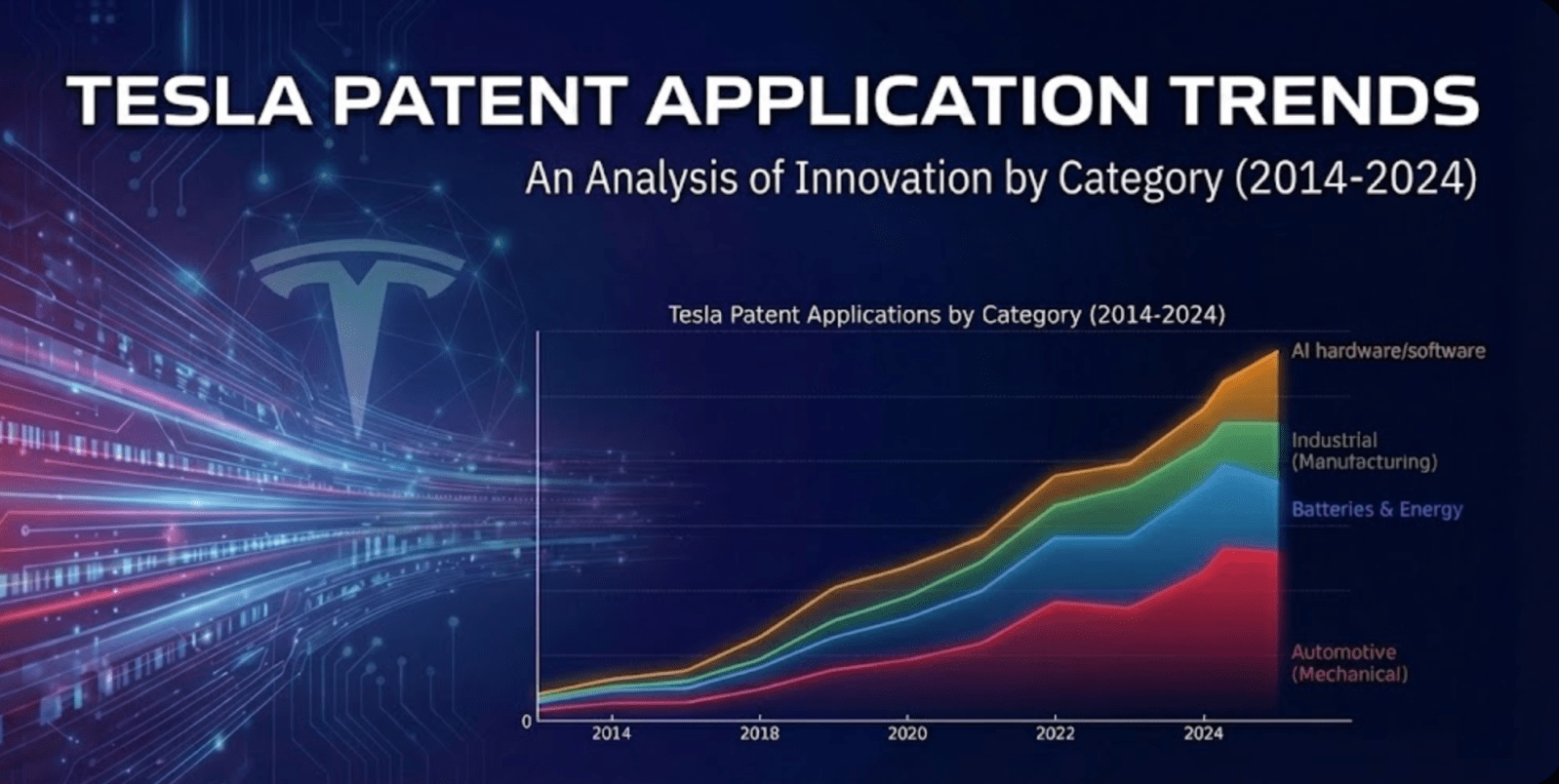
An analysis of Tesla’s patent applications shows a slower pace of innovation in the last 2 years and a shift toward AI hardware and software as Elon Musk is betting the house on autonomous driving and robots.
We have long debated whether Tesla (TSLA) should be valued as an automotive manufacturer or a technology company. While bears point to declining car deliveries and margins, bulls point to autonomous driving and robots as the next phase of growth.
The bears are right. Car sales still account for the majority of Tesla’s revenue and profits, and they have been steadily declining over the past 2 years.
A bullish future in which Tesla’s AI bets replace its declining auto business remains hypothetical, but there is at least some data supporting Tesla’s investments in this shift.
Now, a new analysis of Tesla’s patent filings over the last decade by Electrek gives us perhaps the most objective look yet at where the company is actually putting its R&D efforts.
The data reveals a massive shift. The “car” part of Tesla is shrinking in the patent logs, first replaced by a surge in manufacturing innovations, then by patent applications linked to AI hardware and software.
Here’s a look at the data (important to note that there’s a 12-18 month lag in patent application data and therefore we are not up to 2024 for the most up-to-date data):
The ‘Twin Peaks’ of Tesla Innovation
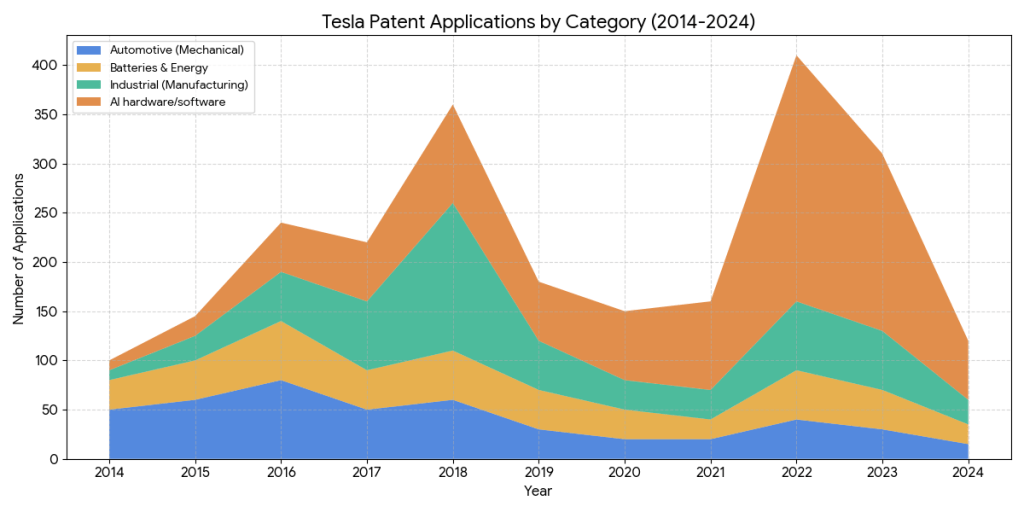
We obtained a dataset breaking down Tesla’s ~4,200 patent applications from 2014 through 2024. When you map them out, two distinct peaks emerge, telling the story of the company’s pivot to AI.
The first peak hit in 2018, right in the middle of the “Model 3 Production Hell.” At the time, Elon Musk was supposedly sleeping on the factory floor, and the patent filings reflect that desperation. We saw a massive spike in “Industrial” patents, most of which were related to manufacturing.
Tesla was clearly trying to find ways to build vehicles in high volumes for the first time.
Then, filings dipped as Tesla focused on profitability in 2019/2020.
But look at 2022. We see a second, even larger peak. This time, the composition is entirely different. The “Industrial” slice is still there (thanks to innovations such as gigacasting), but the “Automotive” slice has become a sliver.
The new dominant category: AI hardware and software.
In this category, you have everything from new theories and processes for autonomous driving to new AI computing hardware that became Tesla’s AI4 computer inside its vehicles.
We can see that “AI” contributed to the first peak in 2018 as Tesla was expanding work on Autopilot and FSD, but only started to represent a majority of Tesla’s patent applications in the 2020s.
Tesla is Becoming Less of an Automaker
Here is the wildest stat from the research: Less than 10% of Tesla’s total patents are now classified as “Automotive.”
For comparison, if you look at legacy automakers like Toyota or VW, their portfolios are dominated by mechanical engineering patents: chassis, suspension, and combustion efficiency.
Tesla’s portfolio is now 40% AI-related. We are seeing a flood of filings related to:
- Neural Network training (Dojo).
- Vision-only distance estimation (replacing LiDAR).
- Data labeling and simulation.
This confirms what we have been saying for a while: Tesla CEO Elon Musk has completely shifted the automaker to AI at the detriment of its auto business.
The 2023 and 2024 data (which is still trickling in due to publication lags) show the next pivot.
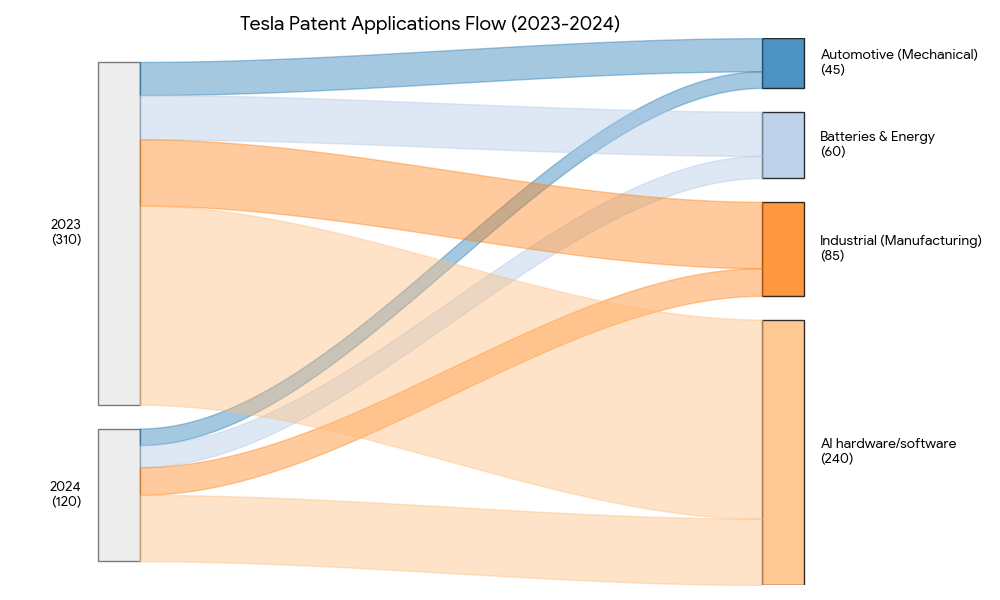
While there are still a few patents related to the auto business, such as regarding wireless charging, they now represent a small minority.
But even then, things like wireless charging for EVs fall into the automotive category; you could argue that Tesla is doing it for the AI category, since the idea is that autonomous vehicles will need wireless charging if there are no humans to plug them in.
As you can see from the chart above, since 2023, the majority of Tesla’s patent applications have been related to AI hardware or software – even though many of them are still in mechanical and electrical engineering, they are no longer about the automotive business.
We are seeing a lot of filings for “electromechanical joints” and “linear actuators,” which are clearly related to humanoid robots.
Electrek’s Take
There’s a little something for both sides of the Tesla spectrum in this one.
Bears can feel vindicated that Tesla’s shift to AI is indeed coming with less spending on automotive R&D. We have seen Tesla’s pace of innovation in EVs slow down in the last few years, and I think we can expect that trend to continue.
Meanwhile, bulls can now visualize Tesla’s shift to AI through these patent application trends.
This reflects a bit of why I sold my Tesla shares last year. I invested in Tesla because I believed in its mission to accelerate the advent of electric transport, and I saw the company as being the most innovative in the space.
It’s no longer the case, and Musk has now unofficially shifted the mission to accelerating the advent of the “age of abundance.”
Call me a skeptic, but my spidey sense always starts tingling when billionaires who buy elections start talking about utopias.
For example, Musk recently said that charity will not be necessary because AI will “end poverty” and deliver “universal high income”:
The most absurd aspect of this statement is the context: it was a criticism of a charitable donation, specifically Dell’s.
Effectively, he is discouraging billionaires from philanthropy under the pretense that AI will eventually ‘end poverty,’ rendering charity obsolete. But the mechanism for this end to poverty is missing.
If AI generates massive wealth, that capital will initially concentrate in the hands of the billionaires who own the models and the data feeding them. How does that wealth translate into ‘Universal High Income’? It won’t magically trickle down. We know that by now.
With the political landscape captured by ultra-high-net-worth individuals who consistently block higher taxation, the only path to redistribution is through the very thing he is dismissing: charity.
Top comment by Michael
Tesla's problem with AI is that they aren't an AI research powerhouse. For a long time, Tesla was pretty focused just on AI engineering, and trying to build good implementations of AI advances that came from other sources. Tesla has put more effort into hiring researchers in recent times. But the lag far far behind the companies that have had a long term commitment to AI research. Tesla had the financial resources to make a deep AI research investment, but they chose not to. And now that they're putting more attention into hiring for AI research, they seem to be struggling with the reputation that Musk has established for himself.
If it does happen, and I have serious doubts as you can probably tell, one way or the other, it will go through charity from the ultra-wealthy. Either directly or through allowing their captured political class to increase taxes on themselves or their corporations.
The argument boils down to, ‘There is no need to be generous now; wait until we have accumulated even more wealth.’ It exposes a fundamental contradiction in the promised ‘age of abundance.’
I think AI has a lot of potential to be a positive for humanity, but the risk is also insanely high – hence why it attracts insane risk takers such as Musk.
The way I see it, there are going to be a few winners in this AI race and a lot of losers, and it’s still up for debate whether Tesla will be in the former or latter category.


FTC: We use income earning auto affiliate links. More.


Comments