
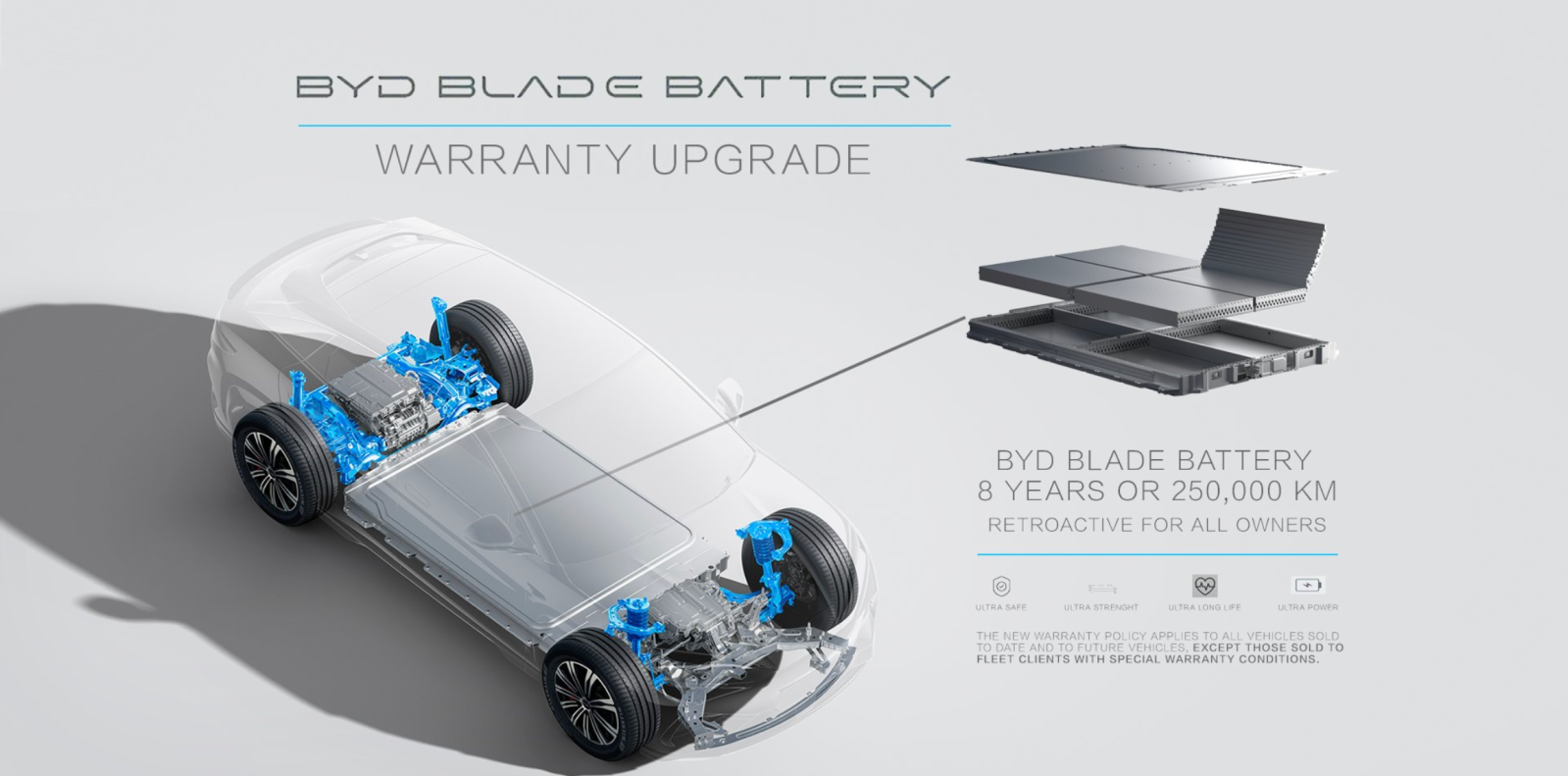
BYD is making a significant move to boost confidence in its electric vehicles in Europe. The Chinese automaker has announced a major update to its warranty terms, extending the battery coverage to 8 years or 250,000 km (approx. 155,000 miles), whichever comes first.
This new policy significantly outpaces the industry standard and puts pressure on competitors like Tesla and Volkswagen to follow suit.
The announcement was made via BYD Europe’s official channels today, confirming that the new warranty terms apply to its lineup of “New Energy Vehicles” (NEVs) in the region:
Previously, BYD offered a warranty that was more in line with the industry average, typically around 8 years or 160,000 km (100,000 miles), with some variations like 200,000 km in specific markets. This bump to 250,000 km is a massive increase in mileage coverage, effectively targeting high-mileage drivers, taxi fleets, and Uber drivers who might be wary of long-term degradation.
For context, here is how the new BYD warranty stacks up against the main competition in Europe:
- BYD (New): 8 years / 250,000 km
- Tesla (Model 3/Y RWD): 8 years / 160,000 km
- Tesla (Long Range/Perf): 8 years / 192,000 km
- Volkswagen (ID. Series): 8 years / 160,000 km
- Hyundai/Kia: 8 years / 160,000 km
As you can see, BYD is now offering nearly 60% more mileage coverage than the standard warranty provided by Volkswagen and the base Tesla models. Even compared to Tesla’s Long Range battery warranty, BYD offers an additional 58,000 km of protection.
The move is enabled by BYD’s confidence in its Blade Battery technology, which is interestingly used by competitors, such as Tesla.
The Blade Battery uses Lithium Iron Phosphate (LFP) chemistry, which is known for having a longer cycle life than the Nickel Cobalt Manganese (NCM) cells traditionally used in long-range EVs.
BYD has often claimed that the Blade Battery can sustain over 3,000 charge cycles while maintaining reasonable capacity. Even when accounting for linear degradation to 70% capacity over that lifespan, 3,000 cycles on a vehicle with a 400 km starting range would still result in roughly 1 million kilometers of total service life. Consequently, a 250,000 km warranty remains quite conservative for the chemistry, even if it is aggressive for the market.
This comes as BYD continues to expand aggressively in Europe, having recently launched the Sealion 7 and updated versions of the Seal and Atto 3.
Electrek’s Take
This is exactly the kind of competition we like to see.
Top comment by Michael Frank
Tesla started offering extending the battery warranty for $2000. That gives you 24 months/30,000 miles. Looks like they just want to make more money. Seems expensive for just the battery being covered.
It’s great to see BYD using the inherent durability of LFP cells to offer a tangible benefit to consumers rather than just cutting costs.
I’m looking at Tesla here. Tesla has been a pioneer in battery longevity, and we know their packs can last a very long time, especially the LFP packs in the standard range Model 3 and Y.
In fact, Tesla even used BYD’s blade batteries in some of the vehicles it sells in Europe.
It would be great to see Tesla follow BYD here.


FTC: We use income earning auto affiliate links. More.



Comments