

Tesla’s ‘Supervised Full Self-Driving’ (FSD) in customer vehicles hasn’t improved all year, based on the best available data previously praised by CEO Elon Musk.
Now Musk points to having to wait until later this year, but wait for what?
Tesla’s last major FSD update, v13, was released in December 2024.
Musk had previously claimed that v13 would enable “a 5 to 6x increase in miles between disengagements compared to v12.5.”
The automaker never released any disengagement data to prove any improvement. Therefore, we have had to rely on crowdsourced data. There is a particular dataset that Musk himself previously shared positively, suggesting that the limited dataset is somewhat reflective of what Tesla is seeing in its own data.
Based on this dataset, v13 on Tesla’s HW4 vehicles was a real improvement, but it only brought a 2x improvement in miles between critical disengagement – nowhere near the claim “5 to 6x” increase.
As we previously reported, HW3 vehicles are still stuck on v12, and Musk has admitted that the hardware will never support the promised unsupervised self-driving capability, with no plans to rectify the situation in sight.
Now, six months after Tesla released v13, the program has stagnated as the automaker shifted all its efforts to a “robotaxi” pilot program in Austin, Texas.
Tesla has released a new version, v13.2.9 (left), but it has been performing worse than the previous update (v13.2.8 – right) after over 5,000 miles of data:
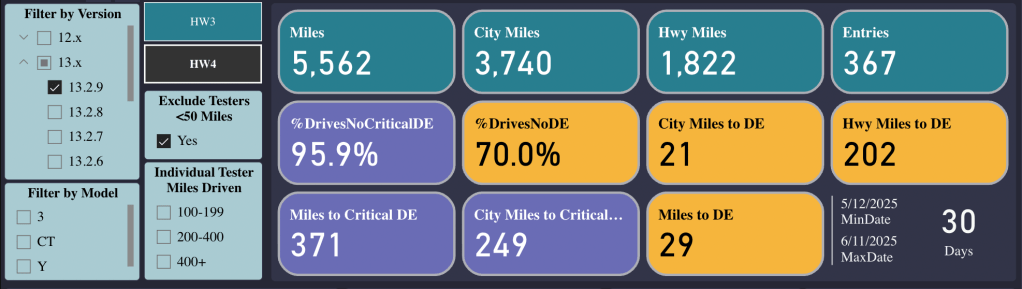

The latest data on Tesla FSD v13.2.9 points to 371 miles between critical disengagements.
As we previously reported, the robotaxi pilot program in Austin is a moving of the goalpost for Tesla, which has been promising that all its customer vehicles built since 2016 would become capable of unsupervised self-driving with future software updates.
It operates only in a geo-fenced area of Austin, where Tesla is specifically training its neural nets to be optimized for the area. Furthermore, it is using “plenty of teleoperation” to support the fleet, something that can’t scale to customer vehicles.
The hope is that Tesla’s optimization and focus on this pilot project in Austin will ultimately result in Tesla improving FSD in customer vehicles.
Musk has now commented on this effort:
It’s a new version of software, but will merge to the main branch soon. We have a more advanced model in alpha stage that has ~4X the params, but still requires a lot of polishing. That’s probably ready for deploy in a few months.
Quickly after claiming a 4x increase in parameters, Musk said that this would be coming “later this year”:
~4.5X increase in params should be ready for wide release later this year. Super frugal use of memory bandwidth, caching exactly what is needed & squeezing microseconds out of everything are needed to maintain the frame rate. And the whole system needs to be retrained.
It’s worth noting that Musk’s timelines for FSD releases have historically been extremely late.
The better question is what this long-awaited update will bring to Tesla owners?
Electrek’s Take
The promised and paid-for unsupervised self-driving? No. The “unsupervised” self-driving that Tesla is launching as part of the pilot program in Austin is not transferable to the customer fleet. It is geofenced in a small area around Austin, Texas, and it relies on teleoperation, which doesn’t scale to millions of vehicles like Tesla promised.
It’s also important to note that it’s not the first time that Musk has promised a significant increase in parameters. The CEO said that FSD v12.5 on HW4 was a “5x increase in parameters” and that was quite disappointing.
FSD v12.5 on HW4 (left) only brought a 22% increase in miles between critical disengagement compared to v12.3 (right):


In fact, the miles between critical disengagements plummeted with other v12.5 point updates, and it ultimately ended at 184 miles between critical disengagements, significantly below v12.3:

Therefore, it’s hard to get too excited about a new “~4.5x increase in parameters” when that’s what happened the last time Musk called for it.
Additionally, at that time, Musk stated that HW4 could support an “8x increase in parameters,” and it was around this time that he began to express less confidence in his comments about HW3.
It took another 6 months before he finally admitted that HW3 would not support unsupervised self-driving, and Tesla basically stopped making any significant updates on the hardware since.
Top comment by Luke
Elon thought he has an edge if he goes vision-only. Turns out, that a multi-sensor setup isn't that much more expensive than vision-only after a couple of years. But the vision-only seems to require so much compute. The additional cost of that is much more than it would be for additional sensors. On top of that Tesla lost its lead in AV completely and is now a distant laggard.
Tesla is trapped in a dead-end, and without a new CEO it will not get better
Tesla is also quickly approaching the limits of HW4 with recent updates.
I think it’s becoming clear that the robotaxi launch in Austin is just another distraction from the fact that Tesla can’t deliver on its promise of making millions of vehicles delivered since 2016 capable of “unsupervised self-driving.”
I’m sure that the effort is going to result in improvements in FSD in customer vehicles later this year, but it won’t be to the level needed to achieve unsupervised self-driving without teleoperation, which again is not scalable.
If Tesla can get closer to 1,000 miles between critical disengagements, it would be nice, but 99% of the value of FSD lies in level 4-5 unsupervised self-driving, and we won’t be even close to that. And that’s what people paid for.


FTC: We use income earning auto affiliate links. More.


Comments