
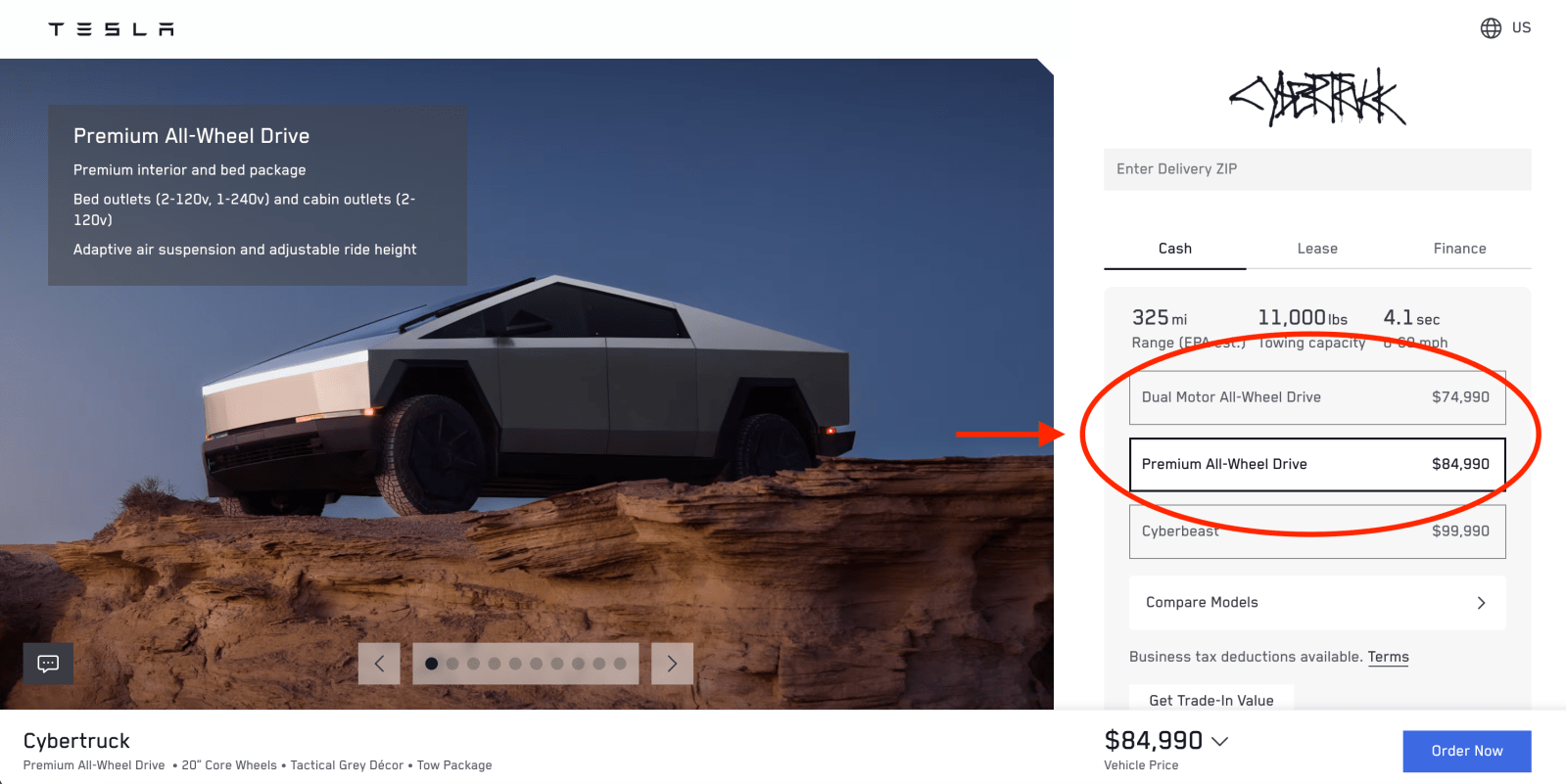
Tesla raised the price of the Cybertruck by $5,000 on Monday night, quietly updating its online configurator without changing a single spec.
The Dual Motor all-wheel drive now starts at $74,990, up from $69,990. And it comes while Tesla is running the Cybertruck line at roughly 10% of its planned capacity.
What actually changed
Tesla updated the Cybertruck configurator on the night of August 24. Two of the three trims went up by $5,000 each.
The Dual Motor AWD climbed from $69,990 to $74,990, a 7.1% jump. The Premium AWD went from $79,990 to $84,990. The Cyberbeast held at $99,990.
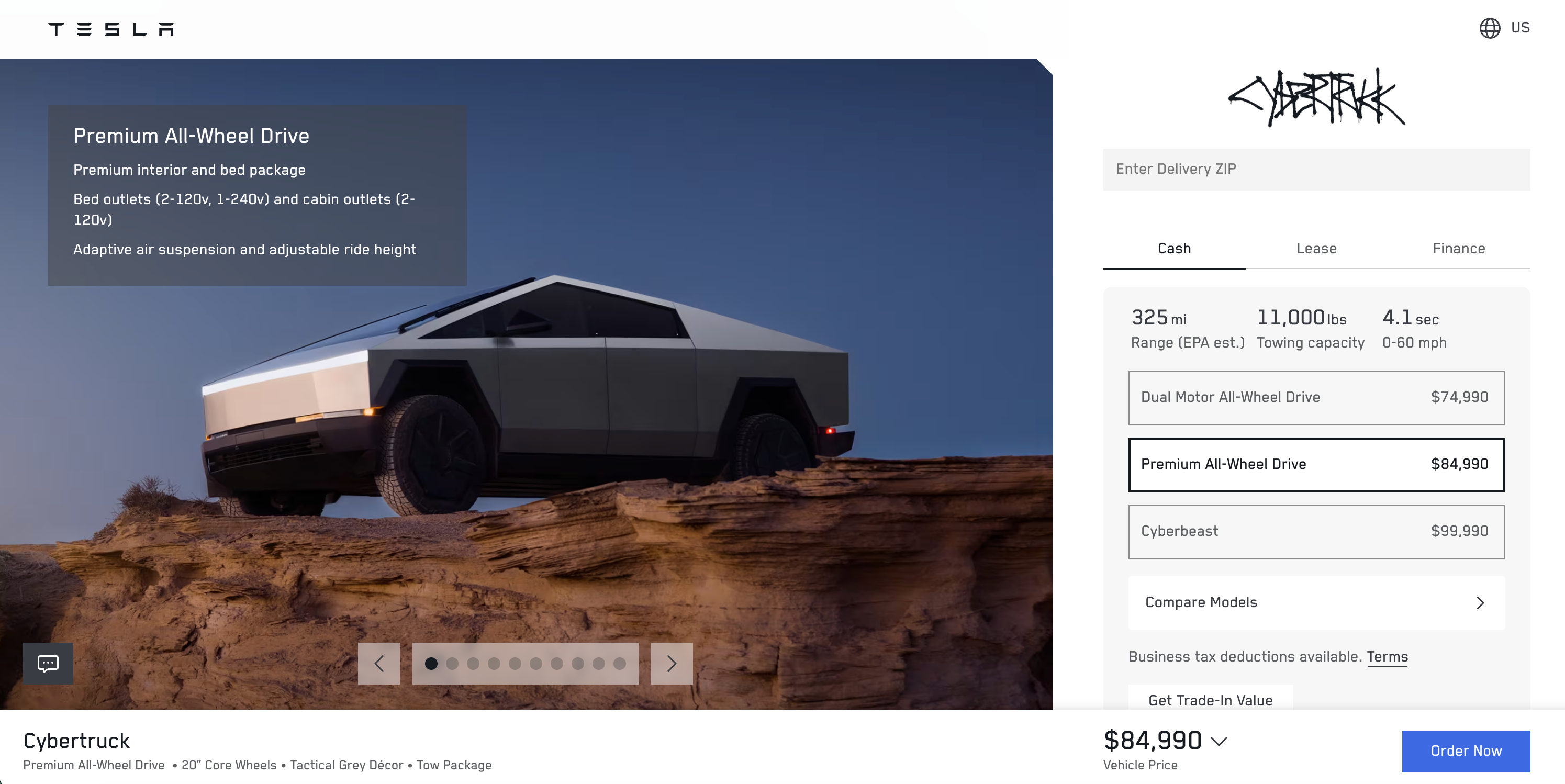
None of the specs moved. The Dual Motor still lists 325 miles of range, 7,500 lbs of towing, and a 4.1-second 0-60 mph time. Same truck, $5,000 more.
The increase also narrows the gap between the Premium and the Cyberbeast from $20,000 down to $15,000.
A truck almost nobody is buying
Here’s the problem: Tesla built the Cybertruck line at Gigafactory Texas for up to 250,000 units a year. It’s currently selling less than 20,000 per year.
That’s less than 10% of capacity. Tesla has been throttling Cybertruck production to avoid piling up inventory, and it still has roughly 3,000 trucks sitting in US inventory.
Actual demand looks even worse once you strip out Elon Musk’s own companies. In Q4 2025, SpaceX alone bought 1,279 Cybertrucks, and Musk-controlled entities took 1,339 of the 7,071 units registered in the US. Without those purchases, Cybertruck registrations would have fallen 51% year-over-year.
For context, Ford sold more F-150 Lightnings than Tesla sold Cybertrucks — and Ford canceled the Lightning for not selling enough.
A pricing rollercoaster with no logic
The strangest part is what Tesla’s pricing has done over the past year. The truck launched well above its promised numbers, and it’s been bouncing around ever since.
Tesla briefly sold a single-motor Long Range RWD version at $69,990, then killed it after just 173 sales. In February, it dangled a $59,990 dual-motor AWD variant, told buyers it was “only for the next 10 days,” and pulled it almost immediately.
That same dual-motor truck settled back at $69,990. Now it’s $74,990. That’s a $15,000 swing on essentially the same vehicle in a matter of months.
Electrek’s Take
None of this makes sense. Tesla is running its Cybertruck factory at roughly 10% of capacity because it can’t find enough people who want to buy the truck. The logical response to weak demand is to cut prices, not raise them. Tesla just did the opposite.
Top comment by Yaroslav Nechaev
They either plan to sell more trucks to other Elon’s companies, thus subsidizing Tesla or they just realised that Cybertruck demand is inelastic and people who really want it will buy it anyway at any price. On the other hand, decreasing the price doesn’t bring in new customers because it just a very niche product that very few people want.
And the pricing history makes it worse. This is the same dual-motor Cybertruck that Tesla briefly offered for around $60,000 earlier this year. There was clearly some demand at $60,000. At $70,000, that demand thinned out. At $75,000, with no changes to the truck, it’s hard to see who’s left to buy one.
We don’t know what Tesla is doing here, but it can’t be good.
During an earnings call earlier this year, Musk put aside the idea of shutting down Cybertruck production. He even suggested that Cybertruck could be used commercially for cargo if consumer demand really dried out. It sounded more like someone who didn’t want to admit defeat rather than someone with a plan.
If you’re buying an EV, powering it with home solar can cut your charging costs to nearly zero. With electricity rates up almost 10% last year and expected to keep climbing, going solar is one of the best ways to protect yourself against rising costs. And with lease and PPA options, you can do it with zero upfront cost and start saving immediately. If you want to find the best deal, check out EnergySage. It’s a free service with hundreds of pre-vetted installers competing for your business, so you save 20 to 30% compared to going it alone. No sales calls until you pick an installer. Get your free quotes here.


FTC: We use income earning auto affiliate links. More.





Comments