
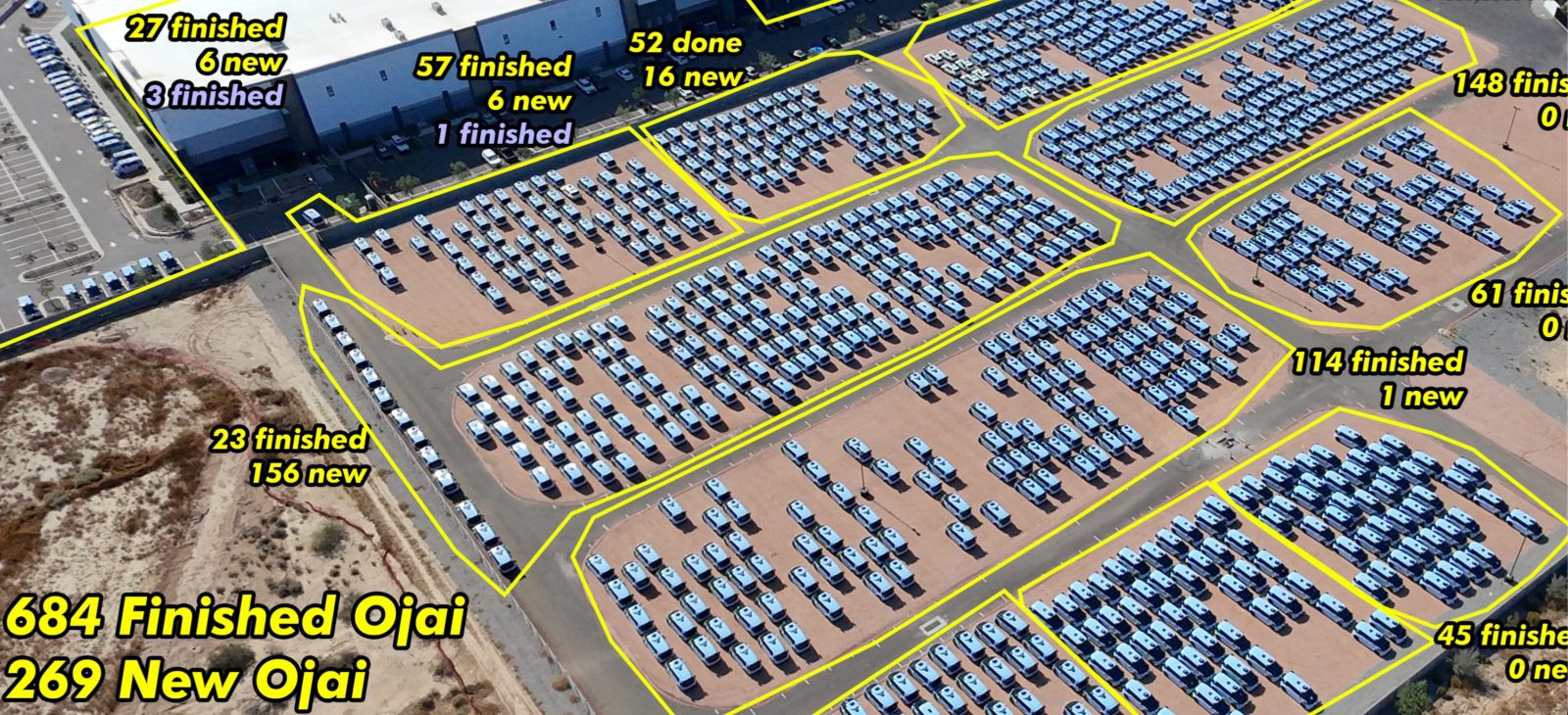
Waymo has 684 of its new Ojai robotaxis finished and ready to deploy at its factory in Mesa, Arizona, according to the latest aerial count of the site.
That’s out of 953 Ojai vehicles on the lot in total, or 72% already converted. It’s the clearest sign yet of how much driverless capacity Waymo is stockpiling.
A monthly count from the sky
Every month, a watcher on the r/waymo subreddit, jjricks_, posts an annotated aerial photo of the Waymo Magna factory in Mesa and tallies the robotaxis sitting on the lot. The August update counts 953 Ojai units: 684 finished, meaning fully retrofitted with sensors and ready to ship, and 269 still new and waiting for conversion.
There’s a new detail this month too. The count found 12 finished Hyundai IONIQ 5 robotaxis on the lot, the first time Waymo’s second purpose-built vehicle has shown up finished at the factory.
This isn’t official Waymo data. But the monthly series has been a consistent window into the ramp, and the trend is steep: the same tracker counted roughly 500 Ojai units back in early June.
What the Ojai is, and why Magna matters
The Ojai is Waymo’s first purpose-built robotaxi. The base vehicle is built in China by Zeekr, shipped to Mesa, and retrofitted by supplier Magna with Waymo’s sixth-generation Driver system.
That sixth-gen hardware is the whole point. It runs 13 cameras and four lidars, 42% fewer sensors than the previous generation, and Waymo has said the suite costs under $20,000 per vehicle. Cheaper sensors on a cheaper base vehicle is how Waymo builds a fleet it can actually afford to scale.
And scaling it is.
The Ojai is replacing the aging Jaguar I-Pace fleet, which was never designed for the job and costs far more to run. Waymo started offering paid rides in the Ojai in San Francisco, Los Angeles, and Phoenix earlier this year.
Why ~700 finished robotaxis is a big deal
Waymo is already doing about 500,000 paid rides a week across roughly a dozen cities, and it’s targeting one million weekly rides before the end of the year. The company operated in the low thousands of vehicles earlier in 2026.
Against that base, a reserve of 684 finished robotaxis sitting ready to go is huge. If Waymo puts even a chunk of them on the road quickly, it’s one of the biggest single additions to its fleet ever.
And this isn’t a pile of unfinished cars stuck in a queue. At 72% converted, the retrofit line is keeping pace with the Zeekr deliveries. Production isn’t the bottleneck, and neither is the conversion. The only question left is how fast Waymo turns finished inventory into paying rides.
The 12 IONIQ 5s point at what’s next. Waymo is adding a second vehicle to the same factory, which is how you scale past one supplier.
Electrek’s Take
This is a lot more exciting than watching Tesla try to deploy Cybercabs, and the reason is simple.
Top comment by Beario
It is good to see Waymo adding to their fleet. The robotaxi industry is still currently really small so in a few years the market should scale significantly in size. Each company has advantages and disadvantages. Waymo has the fast start, but they do not control their own means of production and instead rely on suppliers for vehicles. Tesla has the advantage in producing their own cars, but lack a working system that is not yet fully autonomous like Waymo. It will be interesting to see how things work for both Tesla and Waymo in the coming years though and there is bound to be a lot more competition for robotaxi's as well.
Waymo has already solved the hard part. It runs a real, fully driverless service at scale, no human in the car, half a million paid rides a week and climbing toward a million. That’s a solved Level 4 problem being scaled up. So when close to 700 finished robotaxis show up ready at one factory, it maps directly onto more rides, more cities, more revenue. The tech works. This is just adding units to it.
Tesla is not there. Its unsupervised “Robotaxi” service is still a couple dozen Model Ys in Austin after more than a year, and it’s still proving it can run without a safety monitor at all. One factory lot with 684 finished Waymos on it holds more driverless capacity than Tesla has put on public roads, period.
So the number to watch now is deployment, not production. Waymo clearly knows how to build and convert these things fast. If it can push finished cars into service at the same pace, the one-million-rides-a-week goal stops looking aspirational and starts looking conservative. And there’s a second vehicle already stacking up behind the Ojai. How fast can they flip the switch?
If you’re charging an EV at home, powering it with solar is one of the best ways to cut your fueling costs to nearly zero. With electricity rates up almost 10% last year and expected to keep climbing, going solar is one of the best ways to protect yourself against rising costs. And with lease and PPA options, you can do it with zero upfront cost and start saving immediately. If you want to find the best deal, check out EnergySage. It’s a free service with hundreds of pre-vetted installers competing for your business, so you save 20 to 30% compared to going it alone. No sales calls until you pick an installer. Get your free quotes here.


FTC: We use income earning auto affiliate links. More.




Comments