
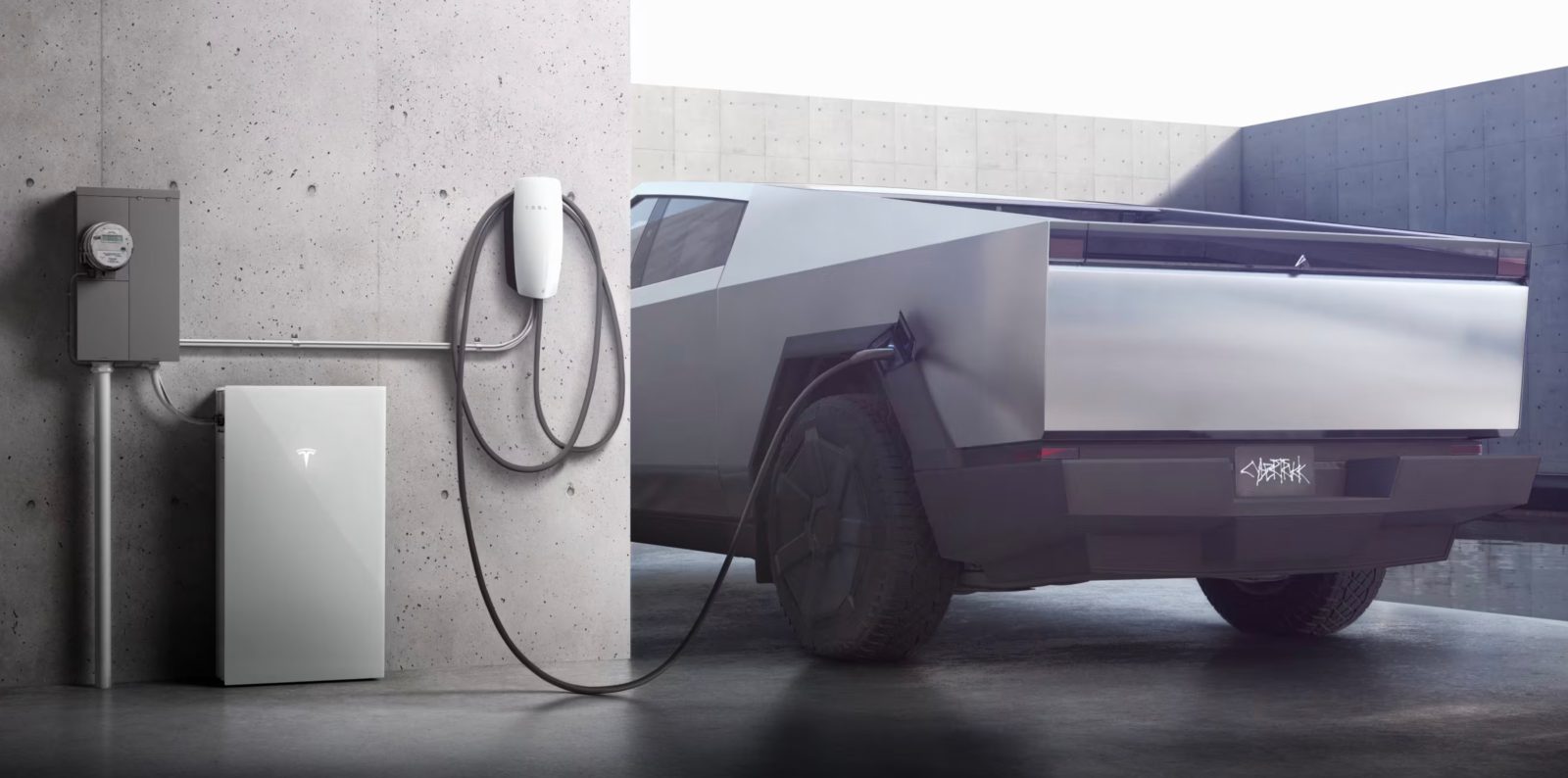
Tesla has launched its first vehicle-to-grid (V2G) program in the United States, starting in select Texas markets. The “Powershare Grid Support” program allows Cybertruck owners to discharge their truck’s massive 123 kWh battery, equivalent to roughly nine Powerwalls, back to the grid during high-demand events and earn bill credits in return.
The announcement, made by Tesla Energy on social media, marks a significant milestone for a company that has been promising bidirectional charging capabilities for years but has consistently delayed delivering them across its vehicle lineup.
How the Powershare Grid Support Program works
The program is currently limited to Cybertruck owners in areas served by CenterPoint Energy and Oncor, two of Texas’s largest transmission and distribution utilities covering the Houston and Dallas metropolitan areas. To participate, owners need a Cybertruck equipped with a Powershare Gateway and Universal Wall Connector, which together enable vehicle-to-grid capability.
Once the hardware is installed, owners enroll through Tesla’s Electric Drive plan in the Tesla app and opt in to Powershare Grid Support. During high-demand grid events, the Cybertruck automatically discharges excess energy back to the grid, and participants receive credits on their energy bills.
Tesla noted that grid events “may occur with little notice,” encouraging participants to keep their Cybertrucks plugged in when at home. Owners retain control through discharge limits, reserving energy for driving or home use as needed, similar to how Powershare’s vehicle-to-home feature already operates.
The program is currently invitation-only through an early adopter phase, with Tesla stating it plans to expand access after initial testing. For early adopters, the company says using Powershare Grid Support through Tesla Electric will not impact the Cybertruck warranty.
Why Texas first and what comes next
The choice of Texas is no accident. The state’s isolated grid, operated by ERCOT, is notorious for volatility and has experienced several high-profile near-failures during extreme weather events. Tesla has been building its virtual power plant presence in Texas since 2022, starting with a 200-Powerwall demonstration and eventually securing approval from the Public Utility Commission of Texas for two VPPs in August 2023.
The company paid Powerwall owners $9.9 million through its VPP programs in 2024 and has been expanding the model aggressively. Adding Cybertrucks to that grid support network makes strategic sense, each truck packs 123 kWh of capacity, dwarfing the 13.5 kWh in a single Powerwall.
California is next in line, with expansion planned for areas served by PG&E, Southern California Edison, and San Diego Gas & Electric.
Tesla is late to the V2G party
Tesla is entering a V2G race that competitors have been running for some time. Ford’s F-150 Lightning has offered full vehicle-to-home capability since its 2022 launch and already powers the first residential V2G power plant in the US, a pilot program with Baltimore Gas and Electric that dispatches energy from privately owned Lightning trucks to the grid.
Meanwhile, General Motors has committed to making every new EV bidirectional-capable by 2026, with its Ultium platform vehicles already shipping with 19.2 kW hardware. Hyundai Motor Group is running V2G pilots across Korea, Europe, and the US with the Ioniq 5, Ioniq 6, Kia EV6, and EV9.
The Cybertruck remains the only Tesla vehicle with official bidirectional charging support. Tesla confirmed in late 2025 that the new Model Y Performance would support bidirectional charging, but the feature has not yet rolled out broadly. And the Powershare with Powerwall integration, which would allow the Cybertruck’s energy to flow through a home battery system, has been delayed again and is now scheduled for mid-2026, after initially being promised for late 2024.
That delay pattern is central to the story. Drew Baglino, Tesla’s then-VP of energy, said in March 2023 that Tesla could have bidirectional charging in two years. Three years later, it’s available on exactly one vehicle, and even that implementation is missing originally promised features. Frustrated Tesla owners have turned to third-party solutions like Sigenergy, which built a universal bidirectional DC charger that works with most Tesla vehicles, something Tesla itself has failed to deliver.
Electrek’s Take
This is a genuinely important step for Tesla Energy, and we should give credit where it’s due. Enabling the Cybertruck’s 123 kWh battery to support the Texas grid during peak demand events is exactly the kind of distributed energy innovation that the industry needs. ERCOT’s grid has proven fragile, and every additional megawatt of flexible capacity helps.
Top comment by Philip234
Well let's see. If the pack has a 1,000 cycle life that is 123,000 kwh. If the cost of the pack replacement is $15,000 then the degradation fee alone is 12 cents / kwh. Higher because of losses. That is just for giving it to Tesla at break even. So what is a reasonable minimum fee for this? 20 cents? 30 cents? what is Tesla paying? (Less than 5 cents?) Let's see if Cybertruck owners can do math.
But Tesla should bite the bullet and roll this out across the entire lineup.
Tesla first released Powershare as a concept with the Cybertruck in late 2023, promising V2L, V2H, and eventually V2G. More than two years later, V2G is finally arriving in a single market, on a single vehicle, through an invitation-only early adopter program.
The Powershare-Powerwall integration that was supposed to be the cornerstone of the system keeps getting pushed back. Meanwhile, Ford had V2H working on the F-150 Lightning from day one, and GM is about to standardize bidirectional charging across its entire EV lineup.
I understand Tesla’s reticence for battery warranty reasons, but there are ways to work that into the warranty, and if you own an electric car, you should be able to do what you want with your battery pack.


FTC: We use income earning auto affiliate links. More.




Comments