
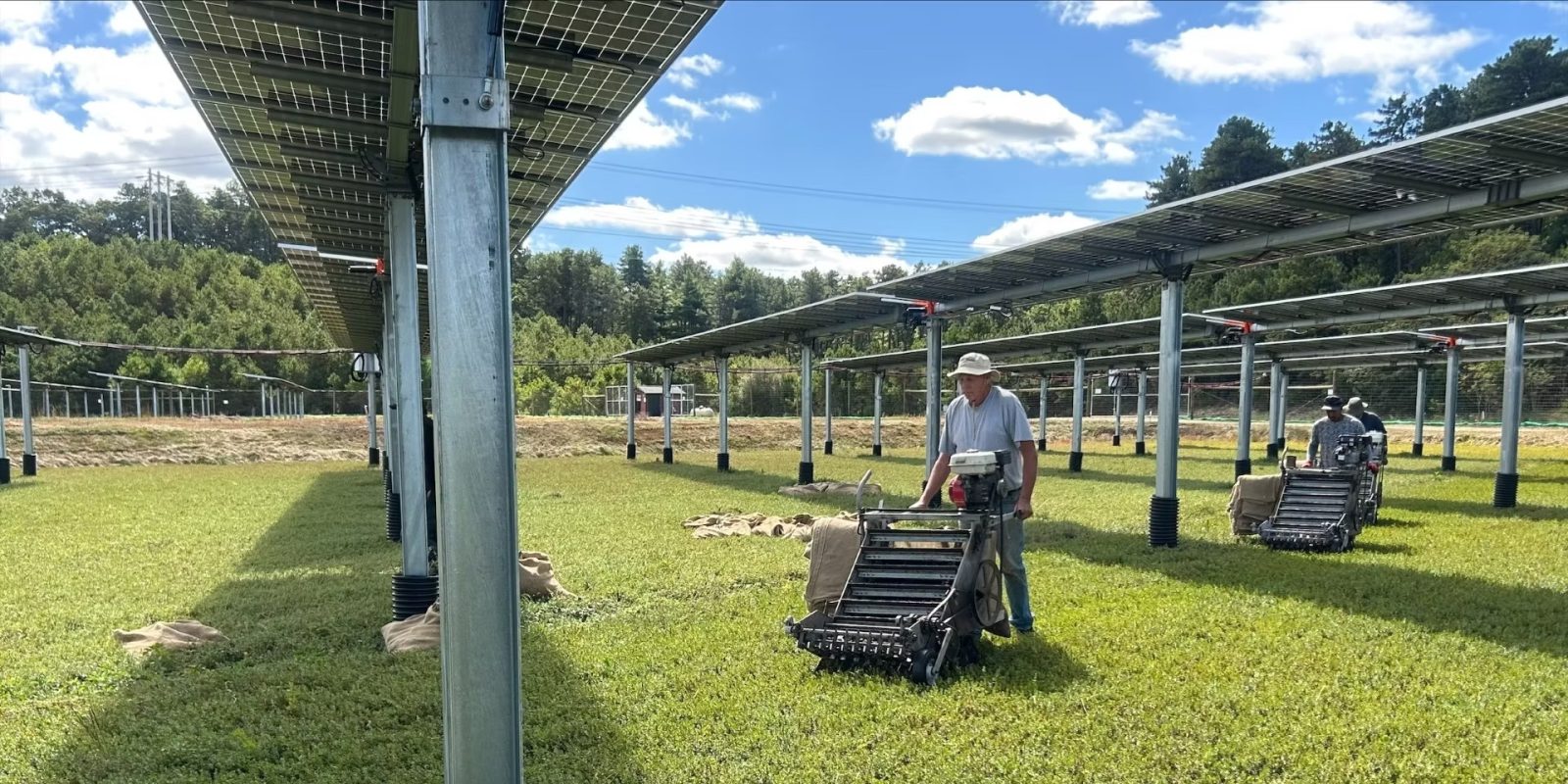
Two Massachusetts cranberry bogs that had stopped making financial sense to farm are growing berries again – with solar panels overhead helping pay the bills.
The Black Cat project in Plymouth and the Ring Road project in Kingston combine cranberry farming, community solar, and battery storage. Distributed Energy Infrastructure (DEI), which built the projects, says income from leasing the land for solar has made it viable to cultivate the long-idle bogs again.
It’s a particularly challenging form of agrivoltaics because cranberry bogs have soft, peaty soil and established vines that need to survive construction. You can’t just roll in with heavy equipment and start installing panels.
So the solar had to fit the farming. In a September article in North American Clean Energy, DEI cofounder and executive vice president Prateek Tare described panels raised 10 feet above the ground, leaving room for farm machinery underneath. Rows have more than 18 feet of clear space between them, and solar panel angles let sunlight reach the cranberry bogs.
Farmer Iain Ward helped work out those details, along with how construction could proceed without damaging the bogs. Even the protective mats needed changing: Black ones absorbed too much heat, so crews used white ones instead.
That care added time. Tare said construction took around eight months – roughly twice as long as a comparable conventional solar project.
“The DEI team was phenomenal at understanding and adapting solar construction so that energy production could coexist without damage to the perennial cropping system,” Ward said.
Greenbacker Renewables owns both sites. Black Cat pairs 1 megawatt (MW) of solar with 2.7 megawatt-hours (MWh) of battery storage, while Ring Road has 4.4 MW of solar and a 13.5 MWh battery.
The money reaches both sides of the farming arrangement, too. The landowner receives solar land lease income, and Ward is paid to manage the bogs, in addition to his earnings from selling the berries.
DEI’s October announcement celebrates what it calls the first-ever agrivoltaic cranberry harvests, which Tare’s earlier account dates to fall 2025.
Top comment by Mckillio
Considering how tough farming is in general for independent farms, they're in huge debt on average, getting renewables on their properties for another income stream seems like a no brainer in general. If having panels can help their plants grow better and/or reduce water usage, even better. With that amount of renewable onsite electricity, and the wild cost of diesel, switching to EV equipment also seems like a no brainer if they have to get new equipment anyway.
The announcement doesn’t say how many cranberries were picked or how yields compare with growing them without panels. Those numbers might help other farmers decide whether solar could help keep their own bogs in business.
Read more: Tesla’s next big clean energy source is rising in the Arizona desert

If you’ve ever considered going solar, make it easy by finding a trusted, reliable solar installer near you that offers competitive pricing by checking out EnergySage. It has hundreds of pre-vetted solar installers competing for your business, ensuring you get high-quality solutions and save 20-30% compared to going it alone. Plus, it’s free to use, and you won’t get sales calls until you select an installer and share your phone number with them.
Your personalized solar quotes are easy to compare online, and you’ll get access to unbiased Energy Advisors to help you every step of the way. Get started here.


FTC: We use income earning auto affiliate links. More.


Comments