
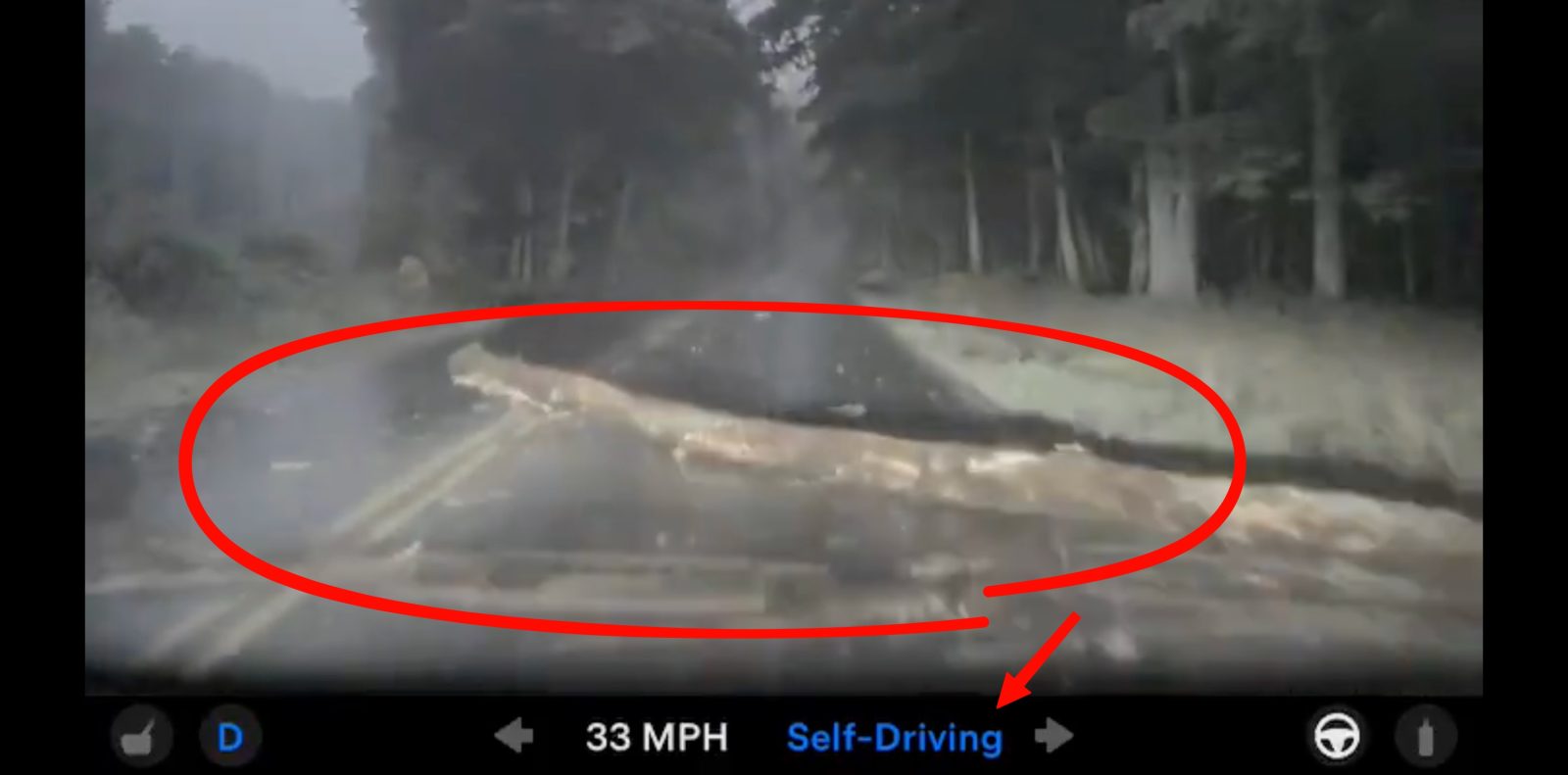
A Tesla owner posted dashcam footage of his car driving straight over a log lying across the road while running Full Self-Driving (FSD) v14.1 Lite, without braking or slowing down.
The clip has more than 800,000 views, and it adds to a growing list of problems we’ve documented with Tesla’s “Lite” version of FSD on older Hardware 3 cars.
In the video, posted by X user @donvarri on August 21, the car is on a wet, foggy rural road with the “Self-Driving” visualization active at 32 mph. A log sits across the lane. The Tesla runs right over it. No braking, no swerve.
“Mine drove over a log in the road it def wouldn’t have stopped,” the owner wrote. He later confirmed the car is a Hardware 3 vehicle running the latest v14.1 Lite build.
The problems with v14 Lite keep stacking up
FSD v14 Lite is a compressed version of the HW4 v14 model, squeezed onto HW3’s memory-constrained AI3 computer, which has 8GB of RAM and roughly one-eighth the bandwidth of the newer hardware. Tesla started rolling it out to Hardware 3 cars in June.
Since then, the reports haven’t been good.
Owners have documented HW3 computers overheating under the extra processing load, triggering an APP_w141_ECU_Thermal_Issue fault above 90°C, with some temperatures hitting 96°C. In several cases the system threw “red hands” and forced a disengagement, and a few computers shut down entirely and needed replacement. On top of that, drivers reported phantom braking, hesitation, and brake stuttering.
Tesla shipped v14.1 Lite partly to address the overheating. This log incident is on that supposedly improved build.
And the bigger issue hasn’t gone anywhere. HW3 simply can’t deliver the unsupervised autonomy Tesla sold, the company has admitted it has no clear plan to get there, and it sold roughly 4 million cars as “full self-driving capable” for as much as $15,000.
The complacency problem, in the driver’s own words
The replies quickly turned into a fight about whose fault it was. Several people told the owner he should have been watching the road and intervened.
His answer is the whole story: “2 things can be true I should have been paying attention but the car definitely should have stopped.”
That’s the trap with a Level 2 system that’s good most of the time. One commenter put the blame squarely on the driver: “No, YOU allowed that to happen for the opportunity to post a video, by failing to properly supervise.” The owner pushed back that he’s no Tesla hater, that he’s driven 70,000 miles, and that it’s the best car he’s ever owned.
But here’s the problem. The better FSD gets at routine driving, the more the driver relaxes. And that’s exactly when it plows over an obstacle a human would have caught from a hundred feet away. The system trains its own supervisor to stop supervising.
Electrek’s Take
Both things are true. He should have been paying attention, and the car should have stopped for a log in the middle of the road at 32 mph. Blaming the driver lets the system off the hook, and blaming the system ignores what supervision is for.
Top comment by Beario
I paid for autonomy on the two cars that we have with FSD. What we have is a system that we use sparingly on the highway on long trips. It CANNOT be trusted because it is not capable of doing what it was intended to do. The hardware just can't and now we are just shy of a hardware 5 which is 2 full hardware upgrades ahead. I fully do not expect Tesla to do anything as they will wait for the cars to disappear with time. The lawsuits pending in Europe are the right move and it most certainly should be done the same here. Tesla should be held accountable yesterday with lawsuits, not tomorrow.
I’ve been on the wrong end of this. Almost a decade ago I had a similar but less severe accident in a Model 3, and it still cost my insurers around $15,000 in suspension and frame repair. Hitting a solid log at 32 mph is a lot more violent than what I went through. I wouldn’t be surprised if this car ends up totaled once someone looks at the underbody.
To think that the driver would have done it on purpose is ridiculous.
The complacency issue is real, but it’s a design problem as much as a driver problem. Tesla keeps pushing more capable software onto hardware it already admitted can’t do the job, and the result is a system smooth enough to lull you and brittle enough to run over a log. HW3 owners paid for autonomy. What are they actually getting?
If you’re driving an EV, powering it with home solar can cut your fueling costs to nearly zero. With electricity rates up almost 10% last year and expected to keep climbing, going solar is one of the best ways to protect yourself against rising costs. And with lease and PPA options, you can do it with zero upfront cost and start saving immediately. If you want to find the best deal, check out EnergySage. It’s a free service with hundreds of pre-vetted installers competing for your business, so you save 20 to 30% compared to going it alone. No sales calls until you pick an installer. Get your free quotes here.


FTC: We use income earning auto affiliate links. More.


Comments