
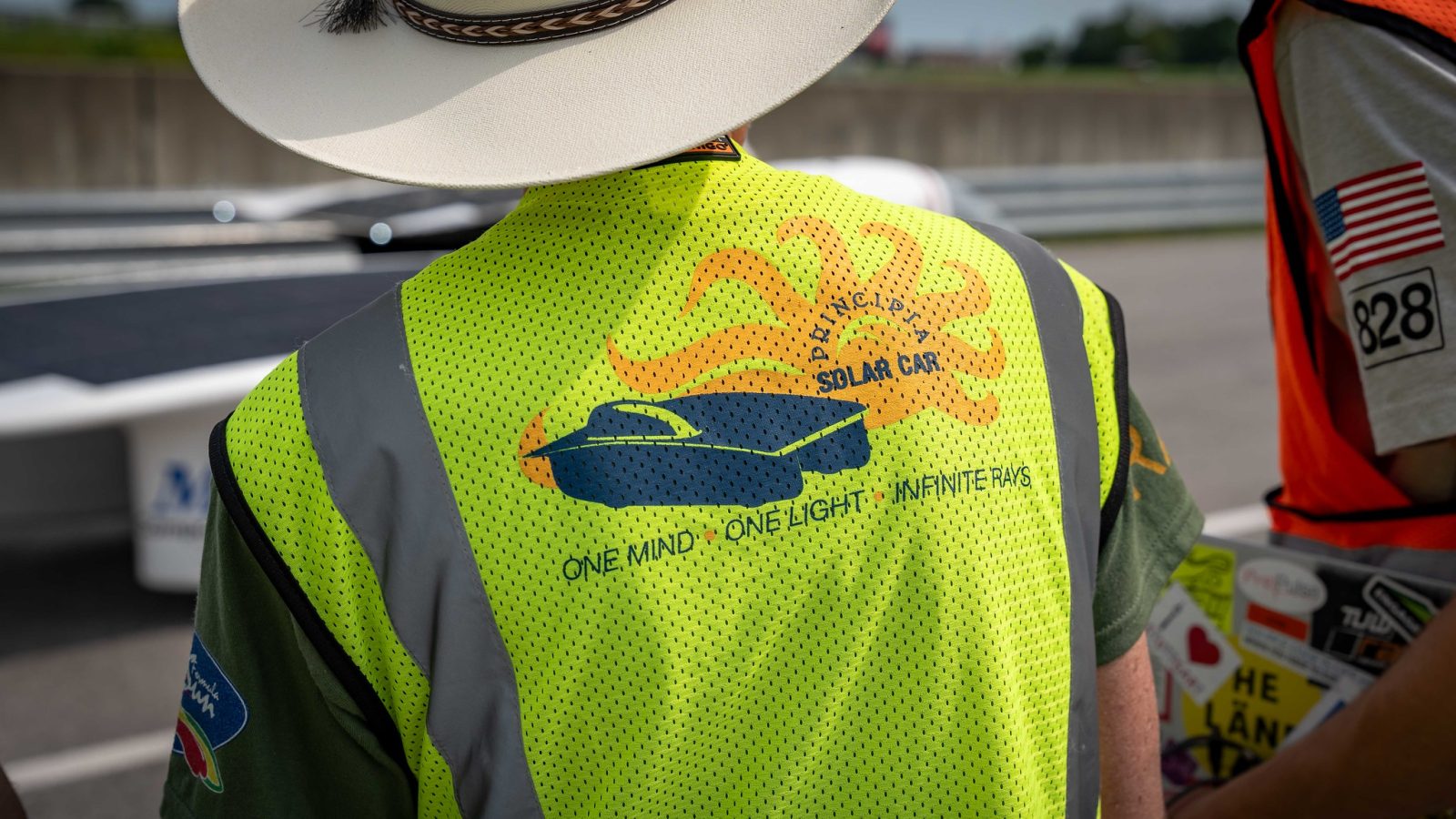
The sun has just about risen on this year’s Electrek Formula Sun Grand Prix (FSGP), the pre-qualifying race before the renowned American Solar Challenge. FSGP officially kicks off tomorrow morning for the teams that have passed rigorous safety and quality checks, known as “scrutineering.”
Over the past few weeks, I’ve had the privilege of speaking directly with teams from around the world, including the Delft Solar Team from the Netherlands and ÉTS Éclipse from Montreal. But for my final profile, I sat down with students from a small liberal arts school just outside St. Louis, right along the Mississippi River. Principia College has a long-running solar car program, which is astonishing considering the school is in the middle of phasing out its only engineering program.
So it was no surprise that after a few minutes speaking with the team’s leadership, I realized the car might end up being the least interesting thing about them.
A 31-year underdog story
The program dates all the way back to 1995, when Dr. Joe Ritter, a chemical engineer on the chemistry faculty, got the first car rolling. “To him, the emphasis was on collaboration, on innovation, on safety,” said Greg Bruland, who directs the center that houses the program today. Greg was actually a student at Principia when that first car hit the road.
Eleven generations of cars later, every one of them named Ra after the Egyptian sun god, the team has stacked up first, second, and third place finishes over the years, including second at FSGP 2024.
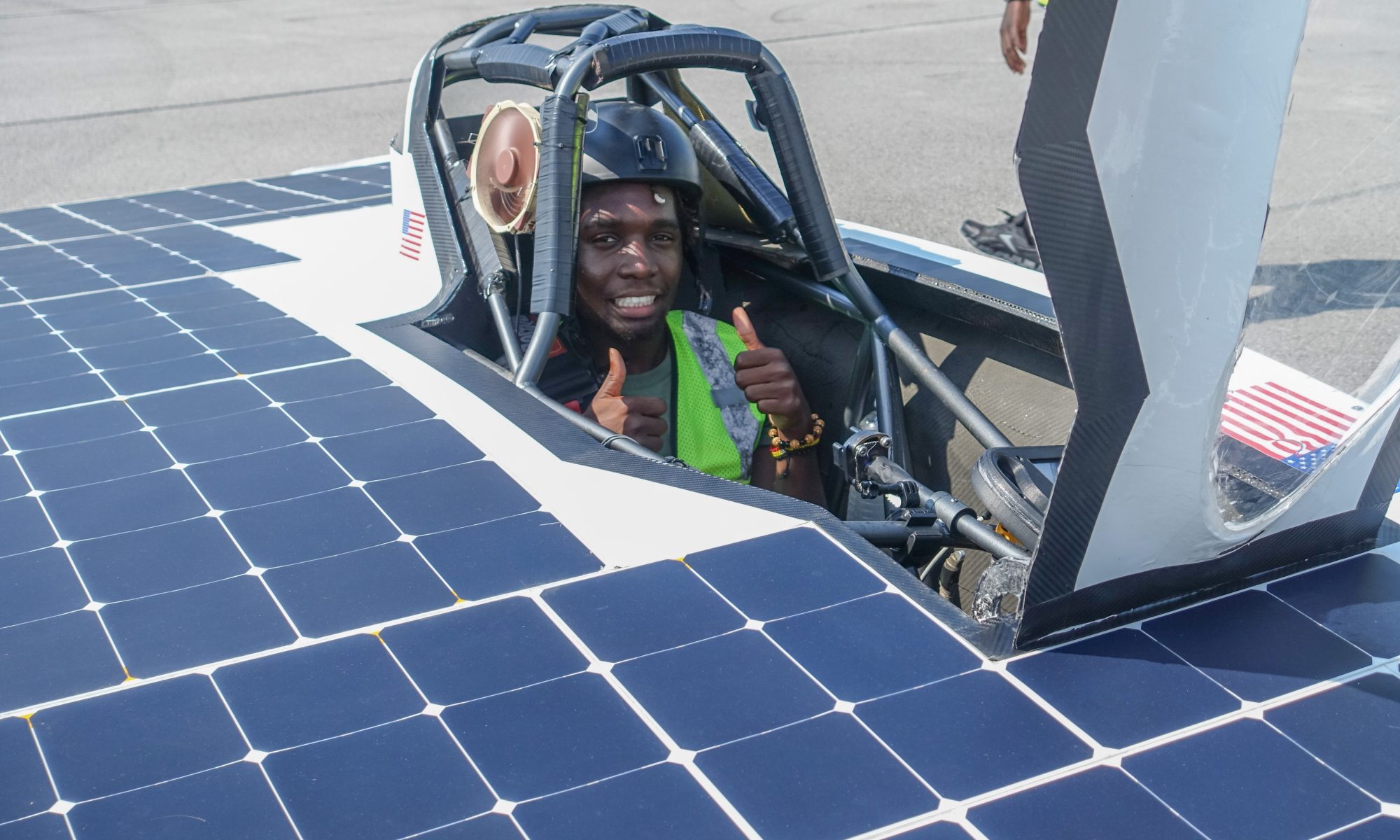
“They’ve just been incredible ambassadors for Principia College with their excellent performances, their sportsmanship, their generosity,” Greg said.
So what’s the secret sauce? I asked, and nobody said a word about aerodynamics.
“We have a very good support system with our faculty,” said Hamza Njuba, a chemical engineering senior and the team’s outgoing lead. “For us as students, it’s more of a learning environment. I wouldn’t say we always know everything we need to do on the track, but we have a very good support system.”
The school puts real weight behind that, too. Students can earn course credit for solar car work through dedicated classes. And there’s zero gatekeeping on who joins, engineering background or not.
“If you feel like you want to hold a wrench and bolt something down, go for it,” Hamza said. “If you think you want to take pictures of the team and run our Instagram, go for it.”
The other pillar is alumni. If there’s one thing I’ve learned in three years of covering this sport, it’s that graduation is the quiet killer of student teams. Seniors walk out the door with years of hard-won knowledge, and the rebuild starts all over. Principia leans on its graduates to break that cycle.
“Maybe you’re trying to do something one way, and you find out they already tried it and it didn’t work,” said Lawrence Wontumi, the team’s lead mechanical engineer, who graduated this spring. “There’s always information sharing so we ensure there are no knowledge pitfalls.”
Alumni mentor from afar, donate to the program, and two or three usually tag along for race week itself.
Principia is rooted in collaboration
All of that explains how the program has survived 31 years. It doesn’t explain its reputation…
Here’s the thing about FSGP and the American Solar Challenge (ASC): for all the trophies on the line, this has always been a weirdly collaborative sport. Teams loan out spare parts, share hard-won engineering lessons, and pitch in on each other’s cars during scrutineering, then head right back out and try to out-lap one another. And no team I’ve met embodies that spirit better than Principia.
Around the paddock, they’re known as the team that helps everybody else, including the schools they’re actively trying to beat. When I asked where that comes from, Hamza didn’t hesitate.
“It’s rooted in our school culture, which is very much built on love, on helping your neighbors and being supportive of all people,” he said. “As much as it’s a race and a competition, we still have our values from our school.”
And these aren’t just feel-good talking points.
At the 2024 event, the University of Michigan crashed and destroyed a motor. Principia handed over its spare, along with a motor controller. Michigan went on to run the cross-country road race on borrowed Principia hardware, in a year when Principia itself only entered the track event.
“Without that, they wouldn’t have been able to drive at all,” faculty advisor Brian Kamusinga told me. Greg added that Michigan later said it wouldn’t have been able to finish the race without Principia’s help.
That same week, another team was stuck in scrutineering because its battery management system wouldn’t trip under an overcurrent condition. Cassiana “Kes” Beresi, Principia’s software and electrical lead and a recent computer science and math grad, sat down with Brian and the stranded team to debug the issue and write firmware to get the pack faulting correctly.
The year before, Principia loaned its motor controller to yet another team.
Kes rattled these off so casually, like they’re just a normal part of race week for them.
Brian has a simple explanation for why.
“You want to do well because everybody tried their best and you still came up on top. You don’t want to do well because someone had bad luck,” he said. “If a team needs aid, we will render aid. But we still want to win.”
Greg ties it back to how the college thinks about education in the first place, pointing to founder Mary Kimball Morgan’s idea of developing the whole person. “It’s not just the engineering skills,” he said. “It’s the teamwork, the collaboration, the unselfishness.”
One last hurrah for Ra 11
Principia’s next-generation car is still under construction, so the crew is campaigning Ra 11 for a fourth season. That’s a bigger deal than it sounds. As I covered in my Éclipse profile, new rules bumped the solar array limit from four square meters to six, so most teams will run six square meters of cells to Principia’s four.
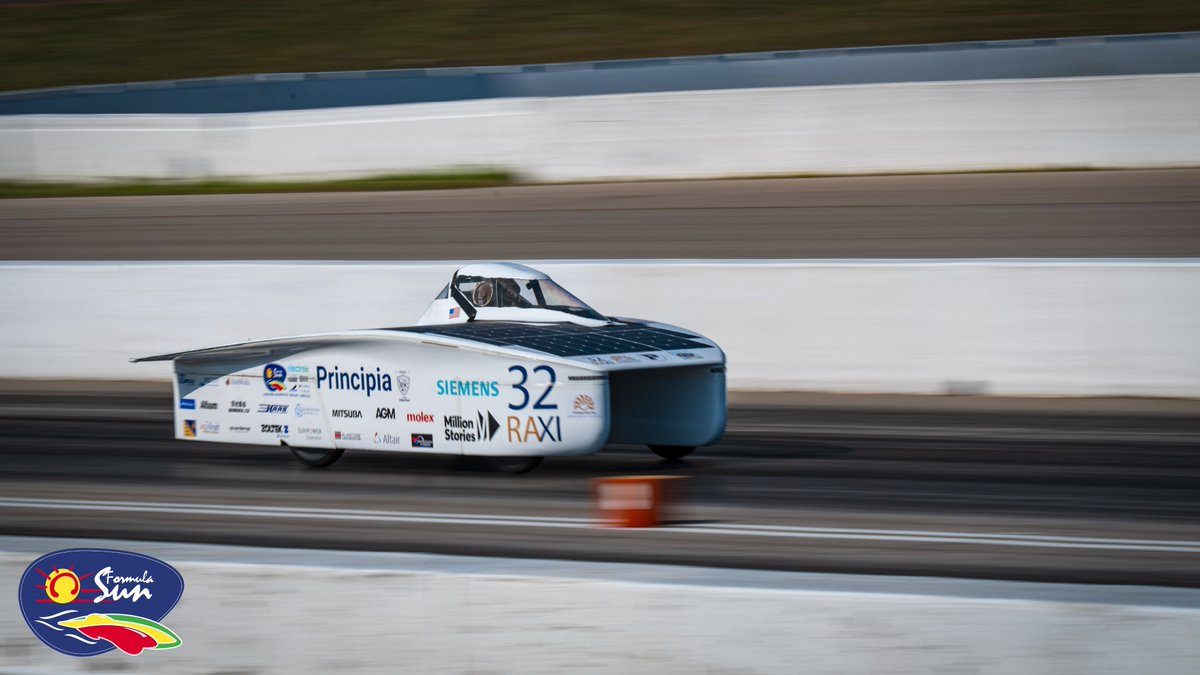
Brian isn’t sugarcoating it. “I think it’ll be one of the harder races we’ve run,” he admitted. “The strategy for this race is to be reliable. To not stop. To always be moving.”
And if a solar car breaks down at the Brainerd International Raceway this week, don’t be surprised if the first people to show up are wearing Principia Solar Car shirts.
Special thanks to Kesiena “Kes” Berezi (Principia Solar Car software and electrical lead), Lawrence Wontumi (mechanical lead), Hamza Njuba (driver training and outgoing team lead), Brian Kamusinga (faculty advisor), Greg Bruland (center director), Allex Jesper (PR), and the entire Principia Solar Car team for sitting down with me, albeit over video call.
Come watch!
The 2026 Electrek FSGP runs July 21 through July 23 at Brainerd International Raceway, where teams will race to compete and to prequalify for the cross-country American Solar Challenge on July 25 out of the Twin Cities.
Both events are open to the public and free to attend!
You can find more details and the full list of schools competing on the official event website.
Learn more about the races in Electrek’s previous coverage here.
Images used in this article are provided by Cora Kennedy for the Formula Sun Grand Prix.


FTC: We use income earning auto affiliate links. More.


Comments