
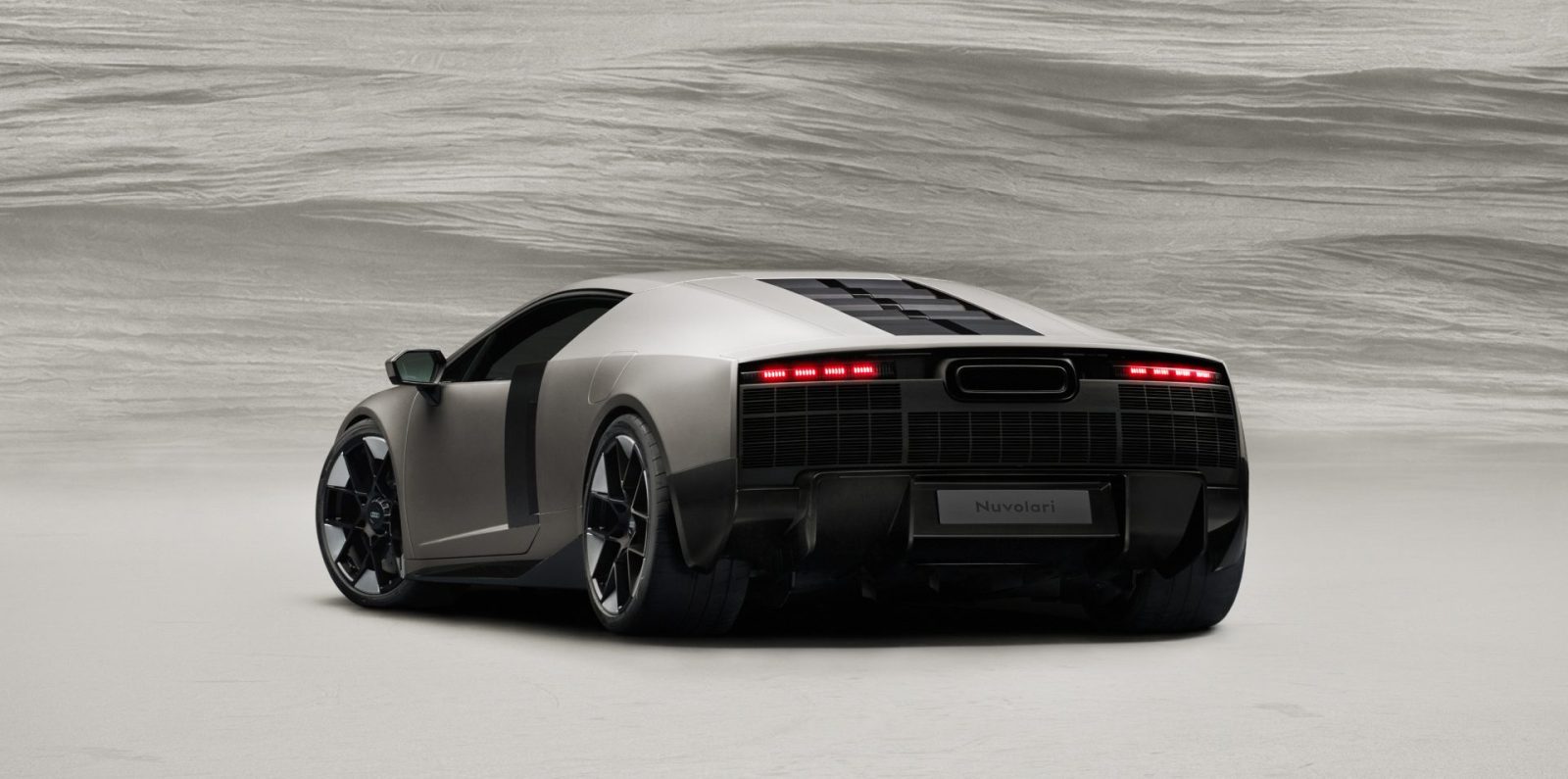
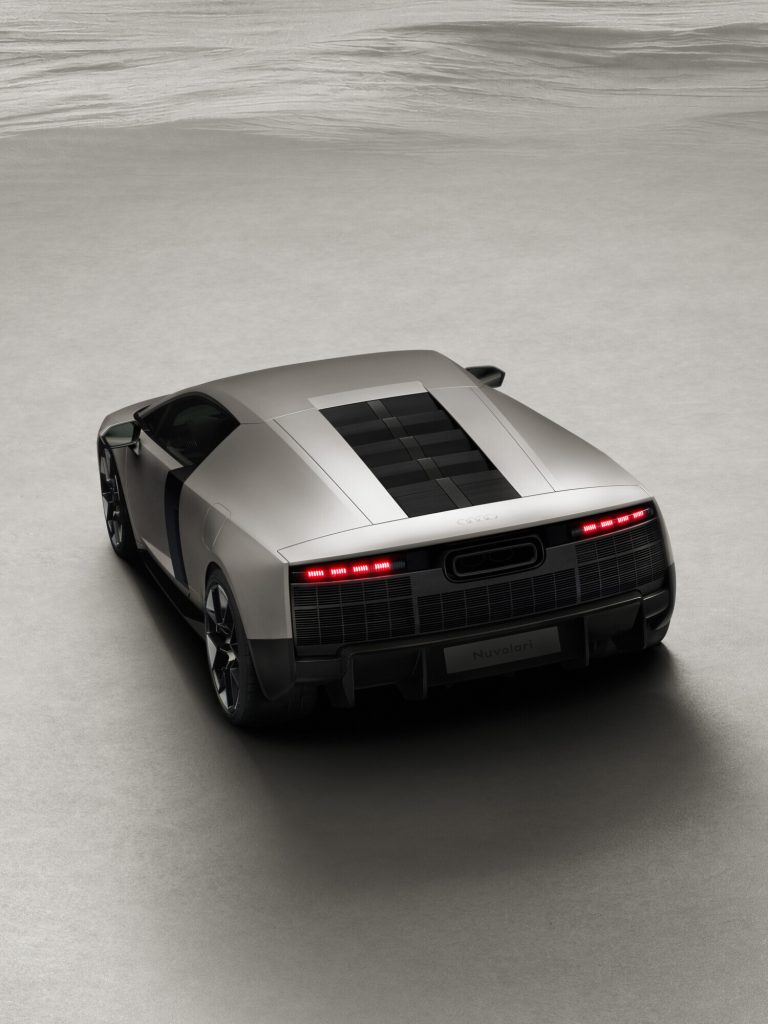
Audi unveiled the Nuvolari today, a 1,001-hp hybrid supercar powered by a 4.0-liter V8 biturbo and three electric motors. Limited to 499 units at roughly $700,000 each, it is the most powerful and fastest production vehicle in the brand’s history.
The reveal is notable for what it represents beyond raw performance. Audi pledged in 2021 to launch only electric vehicles starting in 2026 — and instead, it just unveiled a V8-powered supercar as its flagship.
The Nuvolari by the numbers
The Nuvolari’s powertrain combines a 4.0-liter V8 biturbo engine producing 588 kW (800 hp) and 730 Nm of torque with three axial flux electric motors, each delivering 110 kW. The combined system output hits 736 kW, or 1,001 PS (987 hp). The V8 revs to 10,000 rpm — territory previously reserved for motorsport applications.
Two oil-cooled axial flux electric motors sit at the front axle, delivering up to 2,150 Nm of torque and enabling variable torque vectoring through Audi’s quattro system. A third electric motor sits between the mid-mounted V8 and the transmission. The lithium-ion battery has a gross capacity of just 7.3 kWh — enough for short bursts of electric-only driving in urban settings, but this is fundamentally a combustion-powered machine.
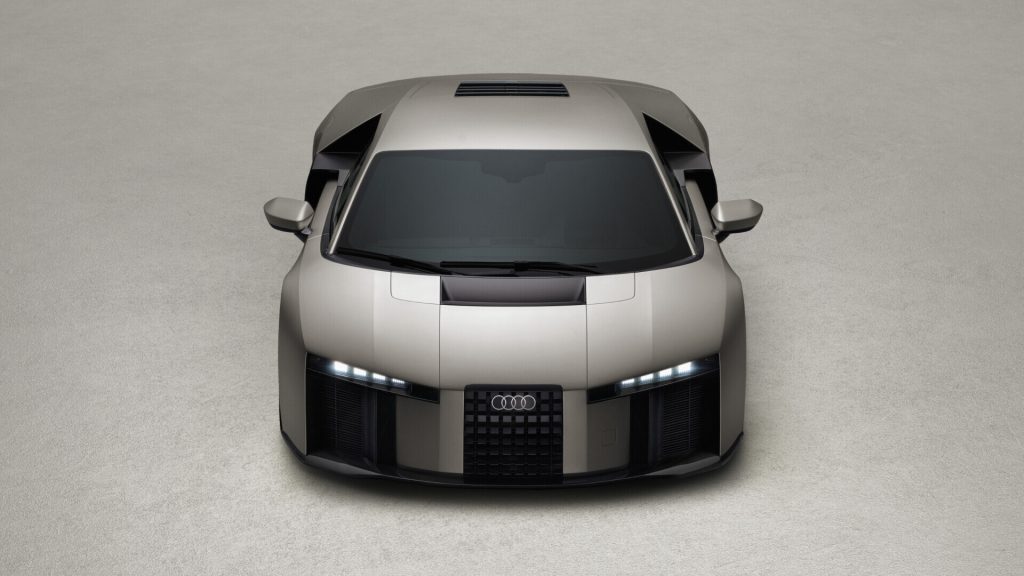
The numbers are staggering: 0 to 100 km/h (62 mph) in 2.6 seconds, 0 to 200 km/h (124 mph) in 6.8 seconds, and a top speed exceeding 350 km/h (217 mph). Audi notes that the acceleration figures require battery temperature above 28°C and a state of charge above 80%.
The car sits on a new Audi Space Frame clad entirely in carbon fiber — a first for the brand. All CFRP components were developed using prepreg autoclave technology borrowed from Formula 1, and Audi says its F1 drivers provided feedback during aerodynamic development. An active rear wing operates across three configurations and generates more than 400 kg of downforce in its high-downforce setting. A drag reduction system (DRS), borrowed directly from F1, can be activated via a button on the steering wheel.
The braking system absorbs up to 2.8 megawatts of energy — on par with a current F1 car, according to Audi. F1-derived long-fiber carbon brake discs at the front measure 420 x 40 mm with ten-piston calipers. Electric-only deceleration of up to 0.3g is possible, covering a significant portion of everyday braking events.
Deliveries of the 499 units begin in the first half of 2027, with a starting price of approximately €600,000 ($700,000).
A familiar powertrain — and a broken promise
If the Nuvolari’s specifications sound familiar, they should. The powertrain shares its fundamental architecture with the Lamborghini Temerario — the same 4.0-liter V8, the same three-motor hybrid layout, the same 730 Nm of torque from the combustion engine. The Temerario produces 920 PS to the Nuvolari’s 1,001 PS, with the difference coming from Audi’s ability to extract more electric power from the system. Both cars sit under the Volkswagen Group umbrella, so the parts-sharing is not surprising — but it does raise the question of what exactly justifies the Nuvolari’s roughly 2.5x price premium over the Temerario.
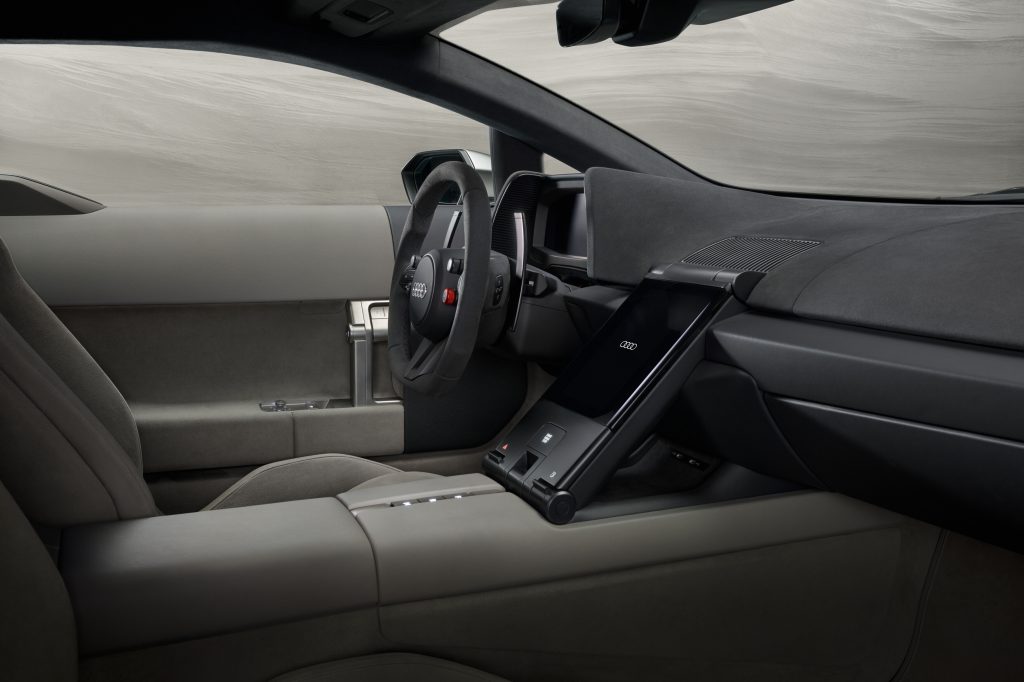
The bigger story, though, is what the Nuvolari says about Audi’s electrification strategy. In 2021, Audi announced it would only launch new electric vehicles starting in 2026 and would produce its last combustion engine by 2033. That pledge is now thoroughly dead. CEO Gernot Döllner has confirmed the company will maintain “complete flexibility” on powertrains for the foreseeable future, and the Nuvolari — a V8 supercar consuming 14.7 l/100 km with a discharged battery — is the most emphatic possible statement of that reversal.
In fairness, Audi is not alone. Virtually every legacy automaker that made aggressive EV-only timelines has walked them back. But Audi’s retreat is particularly striking because the brand had positioned itself as one of the most committed to electrification within the VW Group, and because it has an impressive electric performance car in the RS e-tron GT that proved the brand could build world-class electric grand tourers.
The competitive landscape has changed
The Nuvolari enters a hybrid supercar segment that has grown crowded. The Lamborghini Temerario (920 PS, ~$300,000), Ferrari 296 GTB (830 hp, ~$320,000), and McLaren Artura all use hybrid V6 or V8 powertrains with electric assist. At the very top, the Ferrari SF90 XX Stradale (1,030 hp) and the Mercedes-AMG One (1,063 hp) play in similar power territory.
But the most interesting competitive pressure may come from a different direction entirely. BYD’s Denza Z, an all-electric 1,000+ hp hypercar convertible headed to Europe, delivers comparable power figures on a fully electric platform at a fraction of the price. While the Denza Z targets a different buyer — and the Nuvolari is clearly positioned as a collector’s piece at 499 units — the contrast is telling. Chinese manufacturers are achieving four-digit horsepower with battery-electric powertrains while European brands return to combustion engines with a small electric assist.
Electrek’s Take
Top comment by Dan
It is interesting that you can get a performance sedan with 1234bhp, an EPA-rated 437 mile range and and superior acceleration numbers for $249,000. The Lucid Air Sapphire has an officially listed 0-60mph time of 1.89 seconds and a 0-120mph time of 3.84 seconds while Audi seems to feel that their customers need to pay nearly 3 times as much and buy a 4-liter biturbo V8 in a custom space-frame with a carbon fiber skin to accelerate more slowly. The only thing that the specs provided indicate that the Audi Nuvolari does better than the Lucid Air Sapphire is in top speed, and even then, 217mph is not impressive compared to 205mph given the price and practicality difference. Hybrid supercars are old news - existing technology - and in this end of the automotive industry, if you are standing still you are going backwards.
The Audi Nuvolari is an extraordinary piece of engineering. A 1,001-hp hybrid supercar with F1-derived technology, active aero, and a carbon-fiber body is objectively impressive. As a halo car, it will do its job of generating attention for the brand.
But we can’t ignore the context. Audi told us five years ago that it would only launch electric vehicles from 2026 onward. Instead, its flagship new product launch in 2026 is a V8 supercar that burns 14.7 liters per 100 km. The company had the technology and the track record, the RS e-tron GT is one of the best electric performance cars on the market, and chose to go backward.
The justification will be that a 499-unit limited supercar is a special case, and that’s fair. But the Nuvolari isn’t an isolated decision, it’s the flagship expression of Audi’s broader retreat from its electrification commitments. When you combine this with Döllner’s statements about “flexibility” and the cancellation of EV-only timelines, the picture is clear: Audi is no longer leading the electric transition. It’s hedging. The Nuvolari is a spectacular hedge, but a hedge nonetheless.
If you’re an EV enthusiast looking to cut your energy costs, going solar at home is one of the smartest moves you can make. With electricity rates climbing nearly 10% last year, home solar protects you against future rate increases. And with lease and PPA options, you can go solar with zero upfront cost and start saving immediately. If you want to find the best deal, check out EnergySage. It’s a free service with hundreds of pre-vetted installers competing for your business, so you save 20 to 30% compared to going it alone. No sales calls until you pick an installer. Get your free quotes here.


FTC: We use income earning auto affiliate links. More.



Comments