
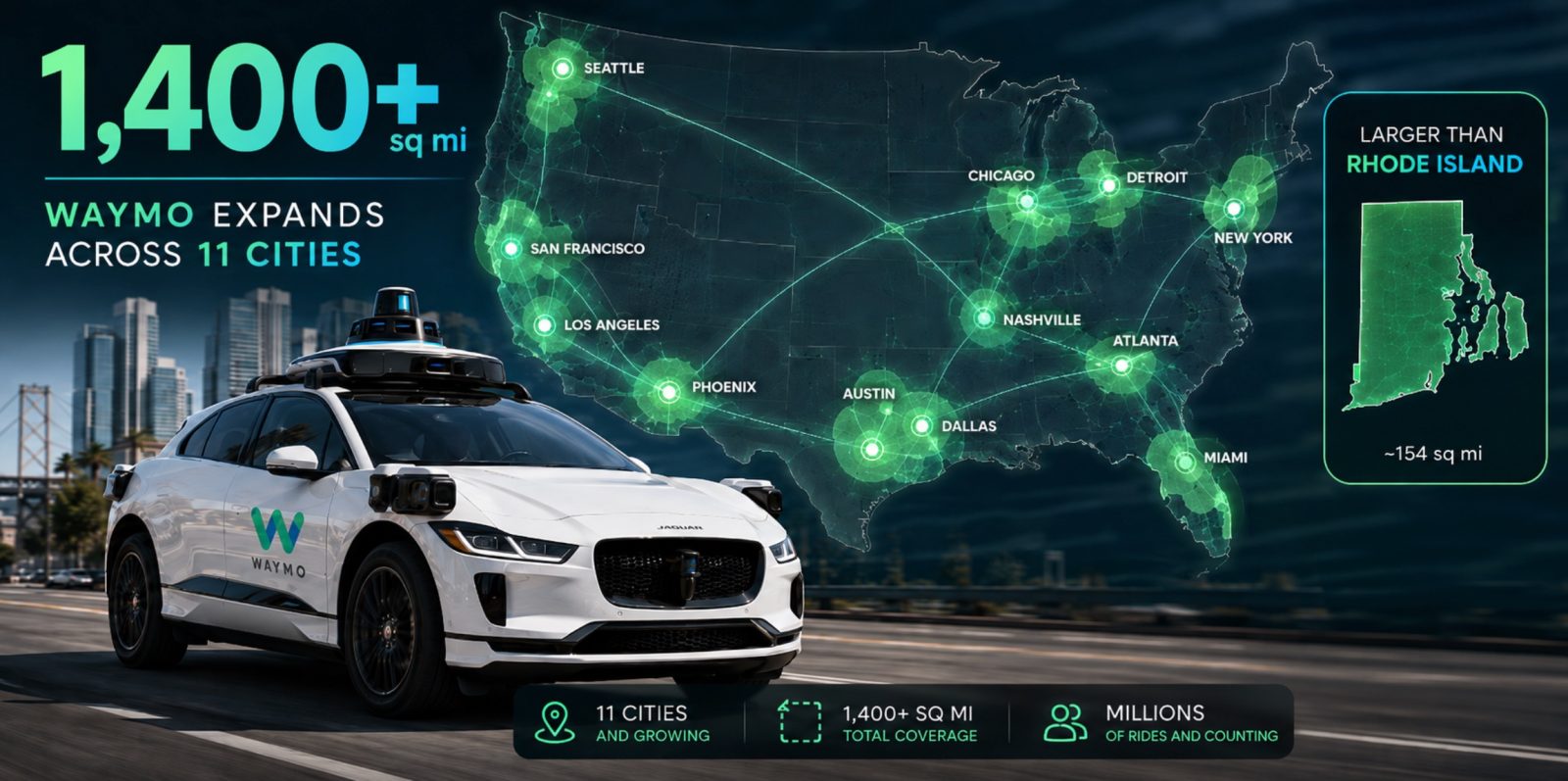
Waymo announced a major expansion of its autonomous robotaxi service area, growing to over 1,400 square miles across 11 US cities. That’s an estimated 27% increase from its previous coverage and more territory than the entire state of Rhode Island.
The expansion starts in Miami, with Austin, Atlanta, Houston, and the San Francisco Bay Area up next for broader coverage.
Growing within existing cities
Notably, this isn’t about launching in new cities — Waymo already operates in all of these markets. The expansion is about growing the service area within cities where Waymo has already proven the model works.
Based on the most recent data available, Waymo’s total coverage was estimated at roughly 1,100 square miles as of April 2026. The city-by-city breakdown looked approximately like this:
- Phoenix at ~315 square miles
- San Francisco Bay Area at ~260 square miles
- Austin at ~90–130 square miles
- Los Angeles at ~120 square miles
- Atlanta at ~65 square miles
- Miami at ~60 square miles
- Orlando at ~60 square miles
- San Antonio at ~60 square miles
- Dallas at ~50 square miles
- Houston at ~25 square miles.
That means the jump from an estimated ~1,100 to 1,400+ square miles represents roughly 300 additional square miles of autonomous robotaxi coverage in a single expansion wave.
In Miami specifically, Waymo launched with a 60-square-mile service area in January spanning the Design District, Wynwood, Brickell, and Coral Gables. The company expanded in April to include Miami Beach and highway trips on I-95, the Dolphin Expressway, and the Palmetto Expressway. Today’s announcement suggests the Miami footprint is growing further still.
Waymo’s aggressive 2026 push
The expansion comes as Waymo continues an aggressive 2026 growth campaign. The Alphabet-owned company raised a massive $16 billion round at a $126 billion valuation earlier this year — the largest investment ever in an autonomous vehicle company — specifically to fuel expansion.
Waymo now serves over 20 million trips, operates a fleet of roughly 3,000 robotaxis, and is targeting 1 million trips per week by the end of 2026. The company expanded to 10 US cities in February and has laid the groundwork for 20+ cities, including its first international markets in London and Tokyo.
The 6th-generation Waymo Driver, which the company began deploying in February, is built on a new Geely Zeekr RT platform with Waymo-designed sensors manufactured at a US facility in Mesa, Arizona.
The Tesla contrast
The scale difference with Tesla’s competing “Robotaxi” service remains stark. Tesla currently operates roughly 44 autonomous vehicles in Austin, where it took nearly a year to expand from an initial 20-square-mile geofence to about 245 square miles. Tesla launched in Houston and Dallas in April with geofences of roughly 25 and 30–35 square miles respectively.
Tesla still has five cities to go — Phoenix, Miami, Orlando, Tampa, and Las Vegas — to meet the seven-city target it set for the first half of 2026. And while Tesla’s rides are cheaper (roughly $0.81/mile vs. Waymo’s $1.36–$1.43), wait times average over 15 minutes compared to Waymo’s 5.7 minutes, and the majority of Tesla rides still include a safety driver.
Waymo’s 1,400+ square miles of fully driverless coverage dwarfs Tesla’s combined service area across its three cities, but that’s nothing compare to the size of the fleets and utilization rates.
Electrek’s Take
Top comment by RedCherries
IMHO, Tesla shouldn't even be included in the conversation since they have never demonstrated a working L4-capable vehicle. Waymo is, by a large margin, much further along in practical applications of autonomous vehicles than everyone else. I hope some of them are able to close the gap, but with Tesla's stubborn CEO rejecting anything but vision-only, it's very questionable if they can, or ever will, close the gap.
The 1,400-square-mile number is the headline here, and it should be. To put it in perspective, that’s larger than Rhode Island (1,034 sq mi) and approaching the size of Long Island. This is a fully driverless, commercial ride-hailing service covering that much ground — not a supervised test program.
What stands out is that Waymo is expanding within its existing cities rather than just rushing to plant flags in new ones. That signals the unit economics and operations are working well enough to justify serving more riders in markets they already understand. It’s the difference between a demo and a business.
The contrast with Tesla’s approach continues to widen. Tesla is slowly expanding tiny geofences with a handful of cars, many still carrying safety drivers. Waymo is scaling a proven commercial operation. The $16 billion raise at a $126 billion valuation clearly gave Waymo the firepower to move fast, and they’re using it.
The biggest question now is whether Waymo can sustain this pace of expansion while maintaining its safety record and service quality. Scaling from 1,100 to 1,400 square miles is impressive, but getting to the 20+ cities they’ve mapped out for the next phase is a different challenge entirely. So far, though, Waymo is executing.


FTC: We use income earning auto affiliate links. More.




Comments