
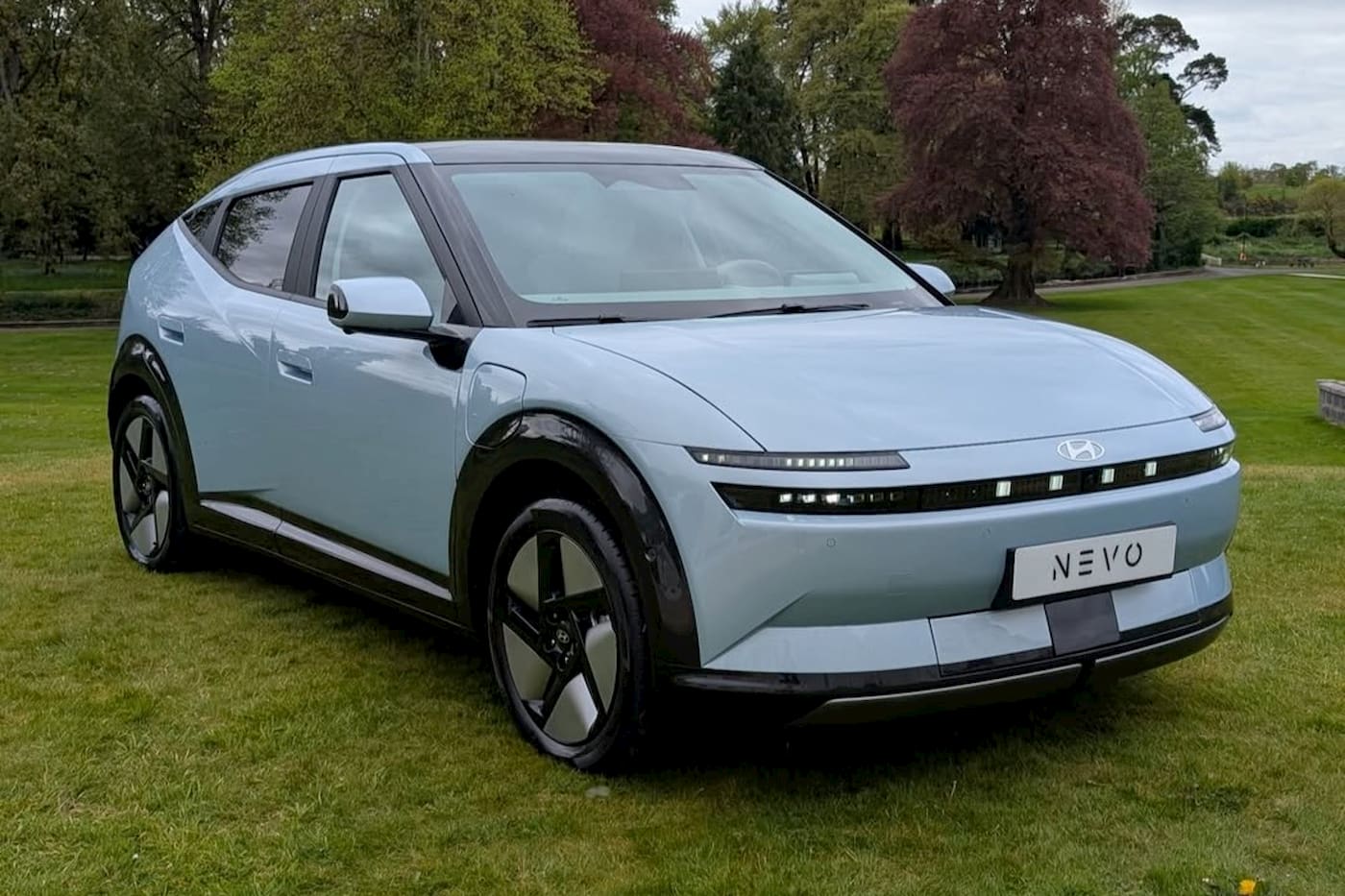
Just over a week after its official debut, Hyundai showcased the IONIQ 3 standard version for the first time.
A new type of EV hot hatch
Hyundai officially unveiled the IONIQ 3 at Milan Design Week last Monday, a smaller, more affordable sibling to the IONIQ 5. It’s the first compact EV under Hyundai’s IONIQ lineup.
Although it bears some resemblance to the IONIQ 5 and 6 with Hyundai’s signature design elements like pixel lighting, the IONIQ 3 stands apart with a unique “Aero Hatch” design.
Hyundai calls it “a new typology that reimagines the compact EV silhouette” with a low-slung, sporty overall look. The IONIQ 3 also features four dots up front that represent “H” in Morse Code.
Since Hyundai only showcased the N-Line model at the event, many of us were left wondering what the standard version would look like.
A week after its debut, Hyundai showcased the standard IONIQ 3 model in Ireland for the first time, giving media and journalists a closer look at the new EV inside and out, including the new Pleos Infotainment system. You can see in the video from Nevo EV Review that the standard model looks about the same as the N-Line trim, just a bit toned down, as expected.
Hyundai IONIQ 3 standard and N-Line variants
The standard model drops the black wheel arch cladding and upgraded sporty bumper, but keeps the overall shape and profile of the N-Line version. From the front, it almost looks like a mix between the IONIQ 6 and a Genesis model.
One of the most notable changes is the lack of a frunk (front trunk). Unlike the IONIQ 5 and IONIQ 6, the IONIQ 3 is equipped with a front-wheel-drive (FWD) powertrain, so the components fill the traditional frunk space.
Inside, the standard IONIQ 3 remains nearly identical to the N-Line version without the added badges and other extras that come with the upgraded trim.
The IONIQ 3 is the first European model to feature Hyundai’s new Pleos Connect Infotainment system. Hyundai’s new system is based on Android Automotive OS, offering a smartphone-like experience that’s customizable and easier to use.
It’s based on the same E-GMP platform that powers Hyundai’s other IONIQ EVs, with two battery pack options: 42.2 kWh and 61 kWh, delivering WLTP ranges of up to 213 miles (344 km) and 308 miles (496 km), respectively.


However, unlike the IONIQ 5 and 9, the IONIQ 3 uses a 400V architecture, rather than 800V, to keep costs down. The electric hatch can still recharge from 10% to 80% takes around 29 minutes with the standard (42.2 kWh) battery. The long-range (61 kWh) battery version takes about 30 minutes.
At 4,155 mm in length, 1,800 mm in width, and 1,505 mm in height, with a wheelbase of 2,680 mm, the IONIQ 3 is even smaller than the Volkswagen ID.3, or the 2027 Chevy Bolt EV for those in the US.


Top comment by Soup
I was very excited when they announced the ioniq5, however I thought it was going to be much smaller. I also thought that they had established a great new design vernacular back then and that they would probably make a smaller three door eventually that was more akin to a vw hatchback. Instead they don't seem to have any design consistency other than "pixel" lighting. I'm not sure how others feel but I think when a brand develops a standard, a language, it empowers the brand. Hyundai and Kia et al sort of feel like they're shooting odd sneaker designs from the hip without much consistency. Design du jour. Not that there is anything wrong with that, I was just looking forward to a compact 3 door ioniq5.
We will learn prices closer to when it goes on sale later this year, but the IONIQ 3 is expected to start at around €30,000 ($35,000) in Europe and £25,000 in the UK.
The N-Line variant will likely cost at least €10,000 ($11,700) more. For reference, the IONIQ 5 starts at €45,550 ($53,500) in Germany, while the N-Line variant costs €58,3000 ($68,500).
Those in the US, don’t get your hopes up. The IONIQ 3 is designed and built in Europe for European drivers. Hyundai is producing the electric hatch at its İzmit plant in Turkey, so importing it would likely be too costly due to the Trump Administration’s tariffs. Plus, hatchbacks are a tough sell in the US, given that Americans tend to favor larger trucks and SUVs.
Hyundai does, however, still offer one of the most affordable EVs in the US with IONIQ 5 leases currently starting at just $259 a month. You can use our link to find deals on the 2026 Hyundai IONIQ 5 in your area (trusted affiliate link).


FTC: We use income earning auto affiliate links. More.


Comments