
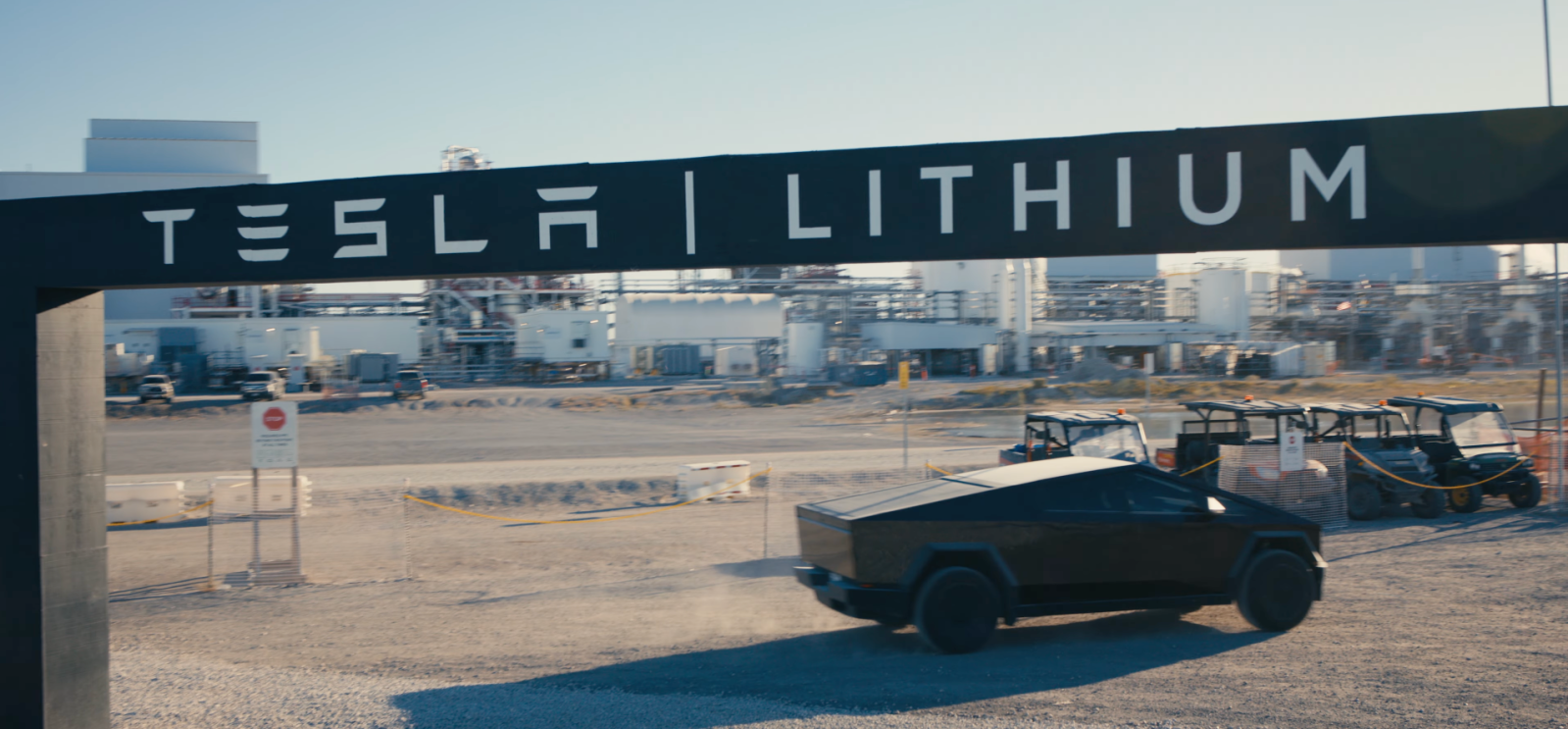
Independent lab testing has found traces of hexavalent chromium — a known carcinogen — along with arsenic and elevated levels of lithium in wastewater discharged from Tesla’s nearly $1 billion lithium refinery in Robstown, Texas.
The Nueces County Drainage District No. 2, which manages the ditch receiving Tesla’s 231,000-gallon daily discharge, has issued a cease-and-desist letter demanding the company halt its wastewater flow pending further discussion.
The findings are particularly notable because when Tesla unveiled the Robstown refinery earlier this year, it touted the facility’s “acid-free” process as a cleaner alternative to traditional lithium refining. The company claimed its alkaline leach method produces benign byproducts — sand and limestone materials suitable for concrete — rather than the hazardous sodium sulfate waste typical of conventional acid-roasting operations.
What the testing found
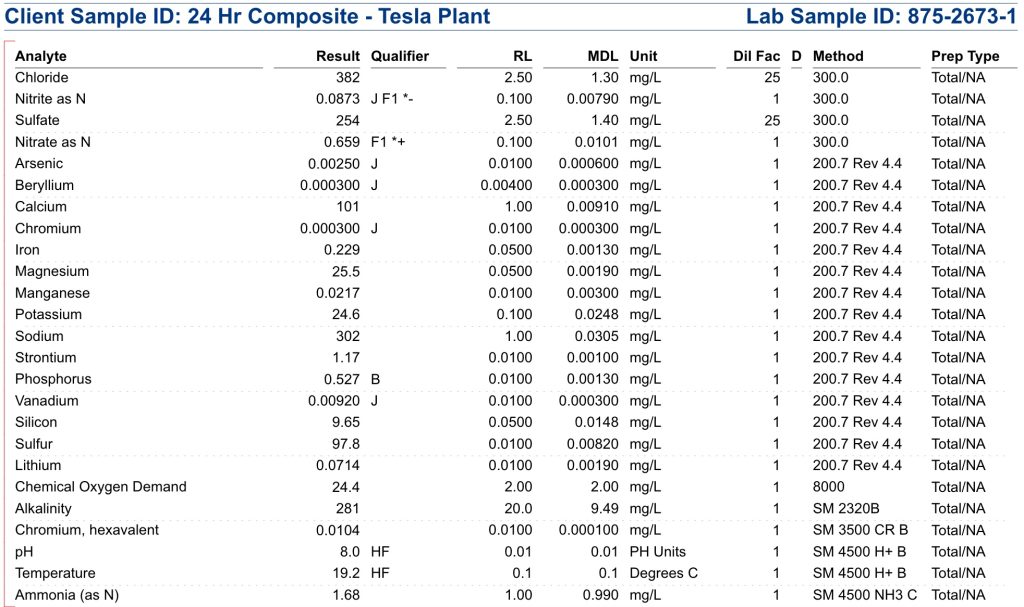
The lab results, generated by accredited environmental testing firm Eurofins Environment Testing on April 10, paint a detailed picture of the refinery’s wastewater composition. A 24-hour composite sample collected on April 7 revealed:
Hexavalent chromium measured at 0.0104 mg/L — just above the lab’s reporting limit of 0.01 mg/L. While trace-level, hexavalent chromium is classified as a known human carcinogen by the National Toxicology Program and is the same substance made infamous by the Erin Brockovich case. Arsenic was detected at 0.0025 mg/L, below the federal drinking water standard of 0.01 mg/L but still present. Neither substance appears in Tesla’s TCEQ-issued wastewater discharge permit.
Beyond the heavy metals, the water chemistry tells a broader story. Sodium levels hit 302 mg/L and chloride reached 382 mg/L, creating brackish conditions that the drainage district’s consultant described as 10-20 times saltier than normal waterway conditions. Elevated strontium (1.17 mg/L), phosphorus (0.527 mg/L), and ammonia (1.68 mg/L) were also detected, each carrying its own environmental concerns — from bone density effects to algae blooms to direct toxicity for aquatic life.
The discharged water flows through the drainage ditch into Petronila Creek and ultimately into Baffin Bay, a longtime fishing destination with an already deteriorating ecosystem.
Regulatory gaps
This situation exposes a significant gap in the regulatory framework around the refinery. The Texas Commission on Environmental Quality (TCEQ) issued Tesla a discharge permit in January 2025, and the agency conducted its own investigation in February 2026. TCEQ found Tesla in compliance with its permit — but the agency only tested for conventional pollutants like dissolved solids, chlorides, sulfates, and oil and grease. TCEQ did not test for heavy metals.
Critically, lithium itself is not included in the monitoring requirements of Tesla’s wastewater permit, despite it being the primary material the facility processes. The drainage district was not notified during TCEQ’s permitting process, according to the district’s attorney Frank Lazarte, who called the lab findings “quite disturbing” – via Texas Tribune.
Tesla’s Senior Manager of Site Operations, Jason Bevan, stated that the company “routinely monitors and tests its permitted wastewater discharge” and is “reviewing the letter” from the drainage district, adding that Tesla “looks forward to working cooperatively.”
The drainage district’s engineering consultant has recommended Tesla install an on-site multi-stage wastewater treatment plant with reverse osmosis technology, heavy metals removal systems, and either a hazardous waste disposal plan for concentrated brine or a zero-liquid discharge system.
Bigger picture: South Texas water crisis
The wastewater controversy arrives at the worst possible time for the region. Corpus Christi, located just 16 miles east of the refinery, is in the grip of a severe water crisis. Lake Corpus Christi sits at roughly 9% capacity, and Choke Canyon Reservoir is below 8%. City officials are projecting emergency water restrictions by September 2026 if conditions don’t improve, and industrial facilities now consume as much as 60% of the city’s water supply.
Tesla’s refinery wasn’t the only Musk-owned operation to face water-related scrutiny recently. xAI’s Memphis data center was reported to consume up to 1.5 million gallons per day for cooling, with plans to scale dramatically — prompting its own $80 million wastewater treatment plant project.
And this isn’t Tesla’s first brush with environmental oversight issues at its facilities. The automaker previously skirted Austin’s environmental regulations at its Texas Gigafactory after its removal from the city’s extraterritorial jurisdiction, and faced criminal allegations related to water pollution at Gigafactory Berlin.
Electrek’s Take
This is a serious issue that Tesla needs to address head-on, and quickly. The company built an impressive marketing narrative around its “acid-free” lithium refining process — and the core chemistry may well be cleaner than traditional methods. But “acid-free” doesn’t mean “pollution-free,” and the presence of hexavalent chromium and arsenic in the discharge, even at trace levels, undermines the clean-tech story Tesla has been telling.
Top comment by Tom D
Hexavalent chromium is nasty stuff. The way that a company addresses it is with comprehensive policies for dealing with toxic materials, and by following those processes. At the company that I worked at before I retired, we had a materials team that researched every part on the BOM (bill of material) for our assemblies and they flagged any components that might require special handling. That, in turn, required that appropriate handling notes be placed on our assembly drawings (and, yes, we had a note for hexavalent chromium) -- and the drawing could not be released until that note was added.
In turn, that note triggered specific requirements that had to be followed in component storage and handling, and in the assembly shop, as appropriate for a given component. There was auditing and quality control to ensure compliance, as well.
But Elon Musk is one of those "move fast, break things" kind of guys. Anyone think that he would support those kinds of comprehensive policies and processes at Tesla or any other company that he runs? No chance! Instead, he'll advocate to cut every possible corner and to take shortcuts. And the latest consequence of that is hexavalent chromium in discharged water. It's not like it is even surprising considering the lengthy history of environmental violations by Musk's companies.
And, yes, this absolutely is on Elon Musk. He sets the tone for how things are run at Tesla. And the tone he sets is to hold rules and regulations in contempt.
At the risk of stating the obvious, clean water is critical. You can’t mess with that.
The bigger concern here is the regulatory framework. The fact that TCEQ issued a discharge permit for a lithium refinery that doesn’t require monitoring for lithium, or for heavy metals that are known byproducts of mineral processing, is a head-scratcher. And the fact that the local drainage district wasn’t even notified that 231,000 gallons per day would be flowing into its infrastructure reveals a permitting process that needs reform.
What’s up with Texas?
I am starting to get a pretty good idea of why Elon loves to build there. Look, no one likes red tape. But don’t mess with the water.


FTC: We use income earning auto affiliate links. More.



Comments