
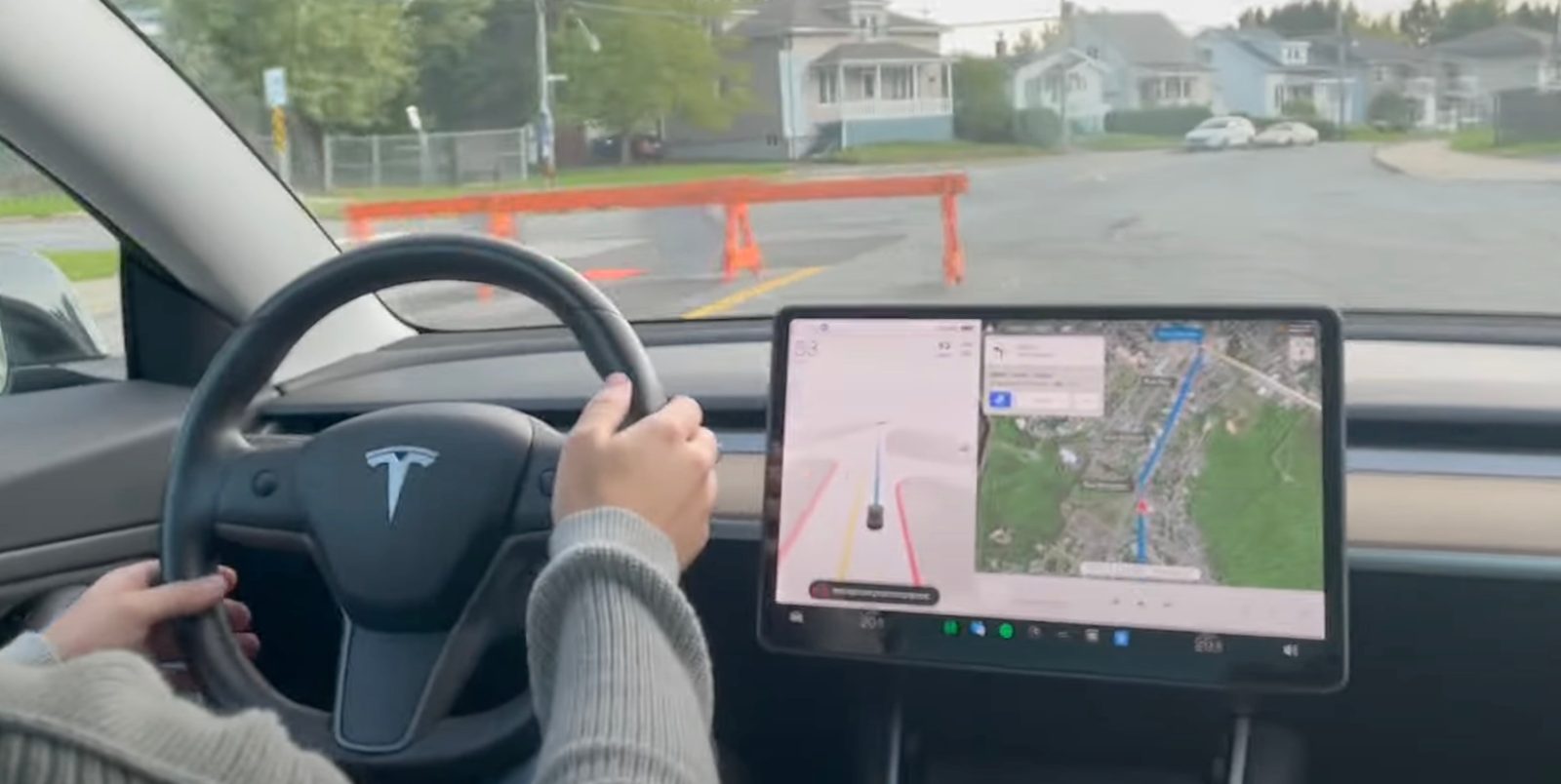
The Dutch Tesla owner who launched a collective claim against Tesla over FSD on HW3 cars called Tesla to ask about the €6,400 he paid for “Full Self-Driving” in 2019. After 7 years of waiting, Tesla’s answer was to “just be patient.”
It’s an almost comically tone-deaf response that perfectly encapsulates Tesla’s approach to the HW3 problem — and it’s only going to fuel the growing legal pressure in Europe.
What Tesla told an HW3 owner on the phone
Mischa Sigtermans, the Dutch Model 3 owner who launched the HW3 collective claim site we reported on earlier this week, called Tesla today and recorded the entire conversation. He posted the details in a thread on X.
Sigtermans paid €6,400 for FSD when he bought one of the first Model 3s in the Netherlands in 2019. Last week, the Dutch vehicle authority RDW granted Tesla type approval for FSD Supervised — the first in the EU. But the approved build only runs on Tesla’s newer AI4 computer. HW3 cars like his get nothing.
So he called Tesla. His first question: when does FSD come to HW3 cars?
Tesla’s answer: “No information about when it comes, or if it comes at all.”
Not when. If.
Sigtermans then asked what exactly he paid for. Tesla told him he paid for “the full self-drive capability.” As he pointed out, that’s what’s on his 2019 invoice — “capability.” Not “supervised.” Not “lite.” The full capability.
When he brought up Musk’s admission that HW3 isn’t enough for unsupervised FSD, Tesla said it had “no information about this.” When he asked about the promised free hardware upgrade, Tesla said there was “no information within Europe.” When he asked how Tesla plans to handle all the Europeans who bought FSD on HW3, Tesla said: “We share whatever information is available at that moment.” The information available: none.
Sigtermans then told the agent about the 3,000 HW3 owners from 29 countries who signed up to his claim site — representing €6.5 million in FSD purchases. He asked to speak to a spokesperson about finding a solution. The agent put him on hold, checked with his manager, and came back with the final answer: “You just have to be patient.”
After Sigtermans hung up, Tesla immediately closed his case. He received an automated email: “Your question is closed” — with a link to book a test drive.
The HW3 timeline of broken promises
The full context here makes Tesla’s “be patient” response even more absurd. Here’s what HW3 owners have been told over the years:
In 2019, when Sigtermans and hundreds of thousands of other owners purchased FSD, Tesla sold it as a package that would enable full autonomy through software updates alone. The hardware was supposedly sufficient.
By August 2024, Tesla VP of AI Ashok Elluswamy acknowledged that HW3 runs a “relatively smaller model” than AI4 with workarounds. The gap between HW3 and HW4 was widening, not closing.
In January 2025, Elon Musk finally admitted what many had long suspected: Tesla would “need to replace all HW3 computers in vehicles where FSD was purchased.” On the Q4 2024 earnings call, he called the hardware replacement “painful and difficult” and said he was “kind of glad that not that many people bought the FSD package.”
Tesla even filed a patent describing a “math trick” to squeeze a modern FSD model onto HW3. The patent itself acknowledges this workaround can render the system “inoperable” for perception units.
Now, 15 months after Musk’s admission, Tesla still has no hardware retrofit program, no refund policy, and no concrete timeline. The company has vaguely promised a stripped-down “v14 Lite” for HW3 sometime in Q2 2026, but that’s a fundamentally different product than what was sold. It’s a diet version of a system that itself is still only Level 2 driver assistance — not the autonomous driving Tesla originally promised.
And when an owner who has waited since 2019 calls to ask about it, the answer is: be patient.
Growing legal pressure in Europe
Sigtermans isn’t just venting on X. He launched hw3claim.nl, a site to bundle HW3 + FSD owners across the EU into a collective claim against Tesla, seeking €6,800 per owner. In one week, 3,000 owners from 29 countries signed up — representing over €6 million in FSD purchases.
The timing is significant. FSD launching in Europe was always going to be the moment the HW3 problem stopped being abstract and became a concrete, quantifiable harm. European owners can now see exactly what they’re missing — their neighbors with AI4 cars are getting FSD Supervised, while they get nothing despite paying thousands of euros for the same promise.
EU consumer protection law is considerably stronger than what Tesla faces in the US. Buyers have robust rights around conformity with advertised features, and countries like the Netherlands, Germany, and France have mature collective-redress frameworks.
This isn’t the first legal action either. In October 2025, thousands of Tesla owners joined a class-action lawsuit in Australia alleging Tesla misrepresented FSD capabilities. That action was directly triggered by Musk’s HW3 admission.
Electrek’s Take
“Be patient” is an extraordinary thing to tell someone who paid you €6,400 seven years ago for a product you now admit you can’t deliver on their hardware.
Top comment by Damon Ekstrom
Imagine paying between $8k - $15k for something that Musk said at the time would make your car an "appreciating asset". Fast forward to 2025 and Musk announces that HW3 will not be able to achieve full autonomy, and here we sit over a year later and we're being told to "be patient".
At the end of the day, they deserve every lawsuit coming their way. I hope they lose billions.
We’ve been covering the HW3 saga for years, and this phone call perfectly captures the core problem: Tesla has no answer. Not a bad answer — no answer. The company hasn’t announced a retrofit program, hasn’t offered refunds, hasn’t set a timeline. All it can offer is the same thing it’s been offering since 2019: wait.
The difference now is that the waiting has an endpoint, and it’s not the one Tesla promised. FSD launched in Europe last week, and HW3 owners are locked out. The harm isn’t theoretical anymore — it’s their neighbor driving with FSD while they stare at the same “coming soon” message they’ve had for seven years.
Sigtermans’ collective claim is going to grow. EU consumer law is built for exactly this scenario: a company that sold a capability it cannot deliver. Tesla’s own CEO admitted HW3 can’t support self-driving. Tesla’s own patent describes workarounds that can render the system “inoperable.” That’s not a he-said-she-said — that’s Tesla’s own paper trail.
I’m increasingly convinced this will end up in court. And when it does, “be patient” is going to look very bad in front of a European judge.


FTC: We use income earning auto affiliate links. More.


Comments