
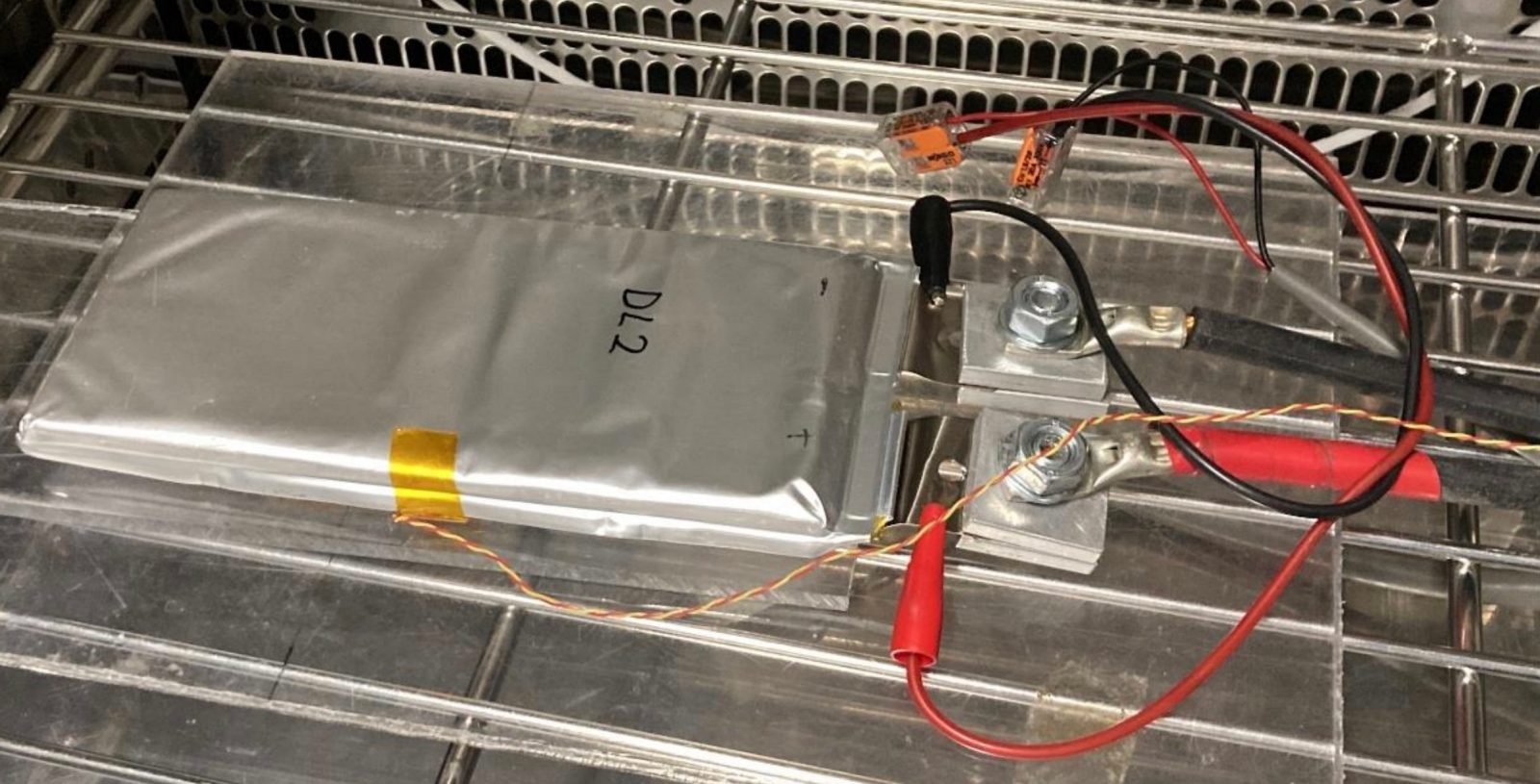
Donut Lab has released a second set of independent test results for its controversial solid-state battery — this time proving the cell can discharge at extreme temperatures up to 100°C and actually gain capacity in the process.
The new VTT report, released just one week after the first test confirmed the cell’s fast-charging capability at 0-80% in 4.5 minutes, adds another data point in favor of Donut Lab’s claims. But the most extraordinary specs remain unverified.
What the new VTT test shows
VTT Technical Research Centre of Finland, the same state-backed institution that conducted the fast-charging test, performed a high-temperature discharge performance test on a cell Donut Lab identified as its “Donut Solid State Battery V1.” The report (VTT-CR-00124-26), authored by research team leader Ari Hentunen and reviewed by research professor Mikko Pihlatie, was approved today by VTT’s vice president of transport technologies.
The cell tested had a nominal capacity of 26 Ah and 94 Wh of nominal energy at 3.6 V. VTT first established a baseline: at room temperature (+20°C), the cell delivered 24.9 Ah of discharge capacity at a 1C rate (24 A) — about 4% below the stated 26 Ah nominal.
Then things got interesting.
At +80°C, the cell was discharged at the same 24 A rate and delivered 27.5 Ah — 110.5% of its room-temperature capacity. At +100°C, using a 12 A discharge rate, it delivered 27.6 Ah — 107.1% of the reference capacity at the same current. In both cases, the cell charged normally at room temperature afterward.
For context, most conventional lithium-ion pouch cells face serious degradation and thermal runaway risk at these temperatures. The fact that this cell not only survived but delivered more energy is consistent with solid-state electrolyte behavior, where ionic conductivity improves with heat because there is no flammable liquid electrolyte to decompose.
There was one notable issue: after the 100°C discharge, VTT observed the cell pouch had lost its vacuum. The cell still functioned, it charged normally afterward, but the outgassing suggests either the packaging or the cell chemistry produced gas at that extreme temperature. Whether that is a materials issue or a sealing problem remains unclear.
Second test in two weeks — progress is real
The pace here is worth noting. Donut Lab is releasing VTT test results at a rate of about one per week, and both have confirmed specific claims. Last week’s report validated the fast-charging performance, 0-80% in 4.5 minutes at 11C. This week’s report validates the high-temperature claim, stable operation at 80°C and 100°C.
The company had originally claimed the battery operates safely from -30°C to 100°C with over 99% capacity retention. The VTT data actually shows the cell exceeding its room-temperature capacity at elevated temperatures, which is even better than the claim in absolute discharge terms. However, VTT did not test at -30°C, and the pouch losing vacuum at 100°C raises questions about long-term durability at that extreme.
Donut Lab initially drew massive skepticism when it announced at CES 2026 that it had a production-ready solid-state battery with 400 Wh/kg energy density, 100,000-cycle life, and 5-minute charging. By commissioning VTT to independently verify its claims and publishing the results through its “I Donut Believe” campaign, the company is at least doing the right thing in terms of transparency.
What still hasn’t been proven
Two tests in, and the two most extraordinary claims remain completely untested by any independent party:
Energy density: 400 Wh/kg. This is the claim that Svolt’s chairman called “physically impossible.” The VTT report lists the cell as 26 Ah at 3.6 V nominal — that is 94 Wh. To hit 400 Wh/kg, the cell would need to weigh approximately 235 grams. VTT’s report does not include the cell’s weight, so this claim cannot be verified from the available data.
Cycle life: 100,000 cycles. Donut Lab claims the cell can last 100,000 charge-discharge cycles. For context, top commercial lithium-ion cells manage 1,000 to 5,000 cycles. Factorial Energy’s validated solid-state cells show over 600 cycles. Donut Lab’s claim is orders of magnitude beyond anything demonstrated in the industry. Proving this through independent testing would take considerable time at any reasonable test rate.
Cold temperature performance (-30°C). Donut Lab claims over 99% capacity retention at -30°C. The VTT high-temperature test did not include cold testing.
Cost claims. Donut Lab says its cells will cost less than lithium-ion batteries using “100% green and abundant materials.” No independent cost analysis has been published.
Meanwhile, the biggest established players in solid-state batteries — Toyota, Samsung SDI, CATL, and BYD — are all targeting 2027 or later for initial production of their own solid-state cells. None of them claim to have a production-ready cell matching all of Donut Lab’s specifications simultaneously. CEO Marko Lehtimäki staked his reputation on shipping Verge Motorcycles with these cells in Q1 2026 — that deadline is now weeks away.
Electrek’s Take
Top comment by Dean C.
It's hard to imagine that a small outfit in Finland quietly cracked the solid-state nut when well financed giants have not been able to deliver anything remotely close to these KPIs after billions spent on R&D.
That said, history is lousy with cases of small teams stumbling upon game-changing innovations. So... I'm staying open minded on these guys.
We have to give Donut Lab credit where it is due. Two independent VTT test reports in two weeks, both confirming specific claims, is more transparency than most battery startups have ever offered. The high-temperature results are particularly meaningful, surviving and gaining capacity at 80°C and 100°C is not something conventional lithium-ion cells can do, and it is consistent with the behavior you would expect from a genuine solid-state electrolyte.
But the pattern is also clear: Donut Lab is proving the easier claims first. Fast charging and high-temperature tolerance, while impressive, are the least controversial aspects of what the company announced at CES. The claims that drew the harshest criticism from the battery industry, 400 Wh/kg energy density and 100,000-cycle life, remain completely untested.
The pouch losing vacuum at 100°C is also a yellow flag. It may be a simple packaging issue, or it may point to gas generation in the cell chemistry at extreme temperatures. Either way, it is the first physical sign that the cell has limits that do not appear in the marketing materials.
We remain in the same position as last week: cautiously interested, but reserving judgment on the claims that would actually make this battery revolutionary. The fast-charging and temperature data are real and independently verified. But if the energy density or longevity do not hold up, this is an interesting cell, not the world-changing breakthrough Donut Lab pitched to the world at CES.


FTC: We use income earning auto affiliate links. More.



Comments