
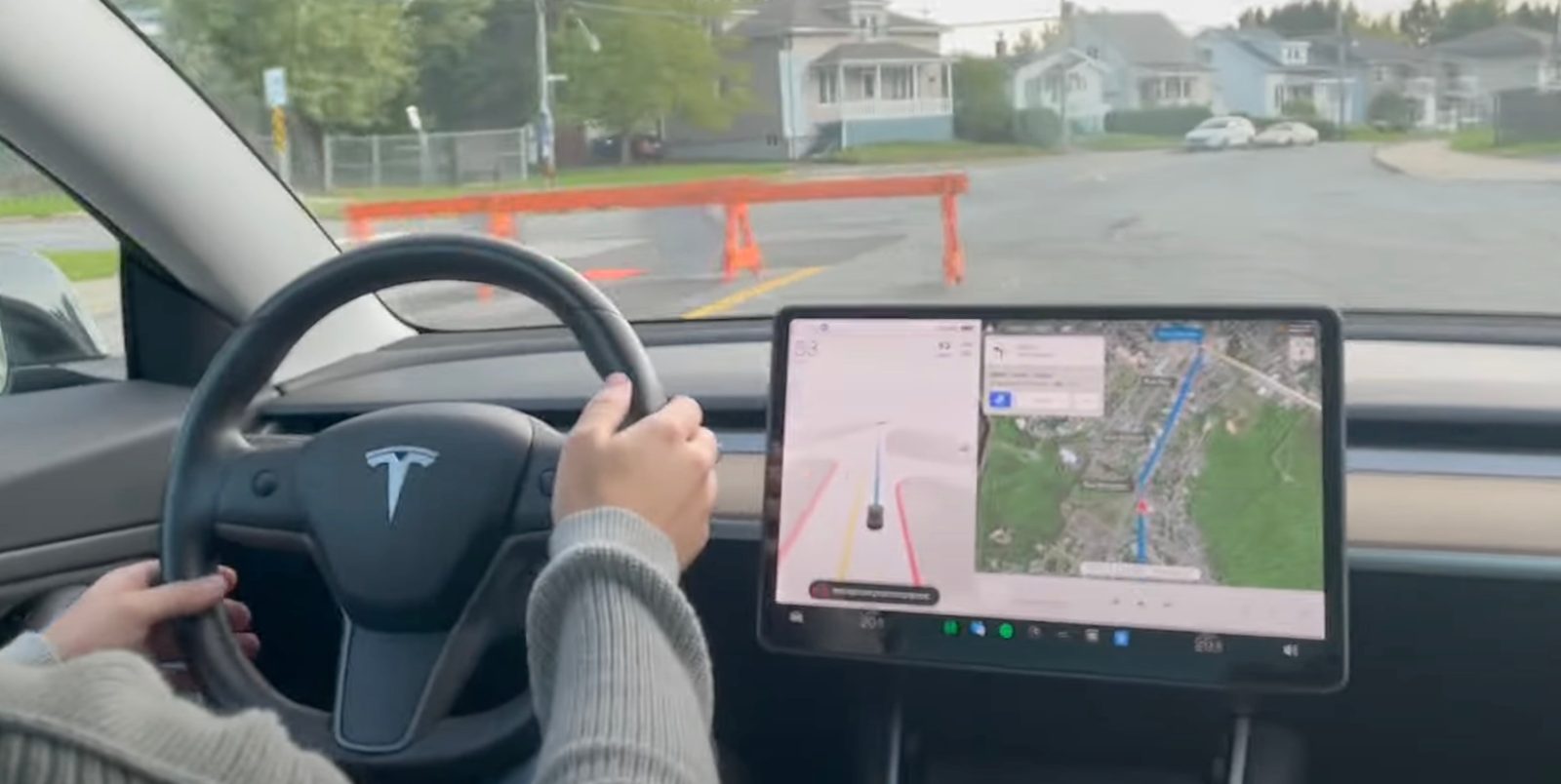
I was the first journalist to test Tesla’s Autopilot before it launched over a decade ago. I’ve tested every version of Autopilot and “Full Self-Driving” since. FSD v14 is by far the most impressive — and that’s exactly what makes it the most dangerous.
The danger isn’t that FSD v14 is bad. The danger is that it’s so good enough that it can make you stop paying attention — and Tesla is not doing enough to discourage complacency.
In fact, I’d argue that it is actively encouraging complacency with its marketing.
A decade of progress — and a decade of paying attention
I’ve corrected Autopilot and FSD away from dangerous situations more times than I can count over the last 10 years. I’ve watched the system evolve from a basic lane-keeping assist that needed constant intervention into something that can genuinely navigate complex urban environments. Through it all, I’ve preached the same message on this site: FSD is a Level 2 driver-assist system, and the driver is responsible at all times.
I always remembered that. I always paid attention.
But daily driving FSD v14 for the past few weeks has changed something. The system is getting to a truly impressive level. I now often travel hundreds of miles without having to intervene. You do that enough times, and keeping the complacency away becomes more difficult.
Even myself, someone who has been preaching carefulness on this topic for over a decade, I find myself becoming more complacent. And I don’t like it.
This is the “ironies of automation” problem that researchers have warned about since the 1980s: an unreliable system keeps you alert because it fails often enough to demand your attention. A perfect system needs no oversight. But a system that works almost perfectly creates a trap — drivers trust it just enough to stop paying attention, but it still fails unpredictably and sometimes critically.
The data is starting to confirm the problem
We’re now getting data suggesting FSD v14 can travel a couple thousand miles between critical interventions. That sounds impressive — and it is. But think about what that means for driver vigilance.
If you drive 2,000 miles without needing to intervene, that’s roughly 30-40 hours of driving where the system handles everything. Human psychology simply isn’t built to stay vigilant through that. Psychologists call it the “vigilance decrement” — monitoring a nearly perfect system is boring, boredom leads to mind-wandering, and research shows drivers need 5 to 8 seconds to mentally reengage after an automated system hands control back.
When that critical intervention comes — a sudden obstacle, a confused intersection, a construction zone FSD doesn’t understand — if you’re not paying attention during those few seconds, it can be extremely dangerous. Even if FSD v14 is 3 times better than previous versions, one moment of inattention at the wrong time can be fatal.
We saw this play out dramatically when Raffi Krikorian, the former head of Uber’s self-driving division, crashed his Tesla Model X while using FSD. Here was someone who literally built autonomous driving systems for a living — and FSD’s near-perfect performance still lulled him into a false sense of security. When the system suddenly lost its bearings in a turn, he couldn’t recover in time. The car was totaled.
If automation complacency can catch the former head of Uber’s self-driving program, it can catch anyone.
The Insurance Institute for Highway Safety has warned that automakers need to fundamentally rethink the design of Level 2 systems to safeguard against this exact problem. NHTSA has expanded crash reporting requirements for Level 2 ADAS. And Reuters recently found that Tesla’s own AI trainers don’t trust the system — seven of nine former data labelers said they wouldn’t trust FSD to drive them.
Tesla’s marketing is making the problem worse
I strongly believe Tesla is not doing enough to address this complacency issue. In fact, the company is actively making it worse.
Tesla’s official accounts on X have been running a sustained campaign that frames FSD as something that drives for you — not something you supervise. Here’s what Tesla and Elon Musk have been posting:
Telling you it “gives back time” and “freedom”:
Tesla posted that “FSD Supervised can give you back your freedom” and “takes the stress out of driving so you can enjoy going places.” The company called it “your personal chauffeur.” Musk said “Tesla self-driving massively improves your quality of life and safety for the thousands of life hours you’re in a car.”
Every one of these posts tells drivers: relax, the car is handling it. That is the opposite of what you should be telling people operating a Level 2 system.
Promoting FSD to people who can’t always supervise it:
This is where it gets genuinely irresponsible. Tesla’s official account promoted a 71-year-old with failing eyesight buying a Cybertruck for FSD, replying “Freedom.” They shared a 93-year-old using FSD to drive to church because she can “drive without the fear or fatigue that can naturally come with age.” They amplified a man born without arms calling FSD “life-changing accessibility.” They posted that FSD “will help us stay independent as we age and are not able to drive ourselves.”
I think automated driving will have an incredible impact on the lives of people with disabilities, but despite its name, that’s not what Tesla’s ‘Full Self-Driving’ is. It’s a level 2 driver assistance system.
A Level 2 system requires a fully capable driver ready to take over at any moment. That directly contradicts the profile of every person Tesla keeps choosing to spotlight. As I wrote back in March, these tweets will end up as evidence in a court case about a Tesla FSD crash at some point. A plaintiff’s attorney will hold them up and say: “Tesla’s own official account promoted a testimonial from a vision-impaired buyer who purchased the vehicle specifically because he believed FSD could drive for him — and Tesla amplified that message to millions.”
Telling drivers they can text while driving:
Musk was asked if FSD allows texting and driving and replied: “Depending on context of surrounding traffic, yes.” Texting while driving is illegal in nearly all 50 states. Tesla’s own terms still require full driver supervision.
Calling the car “sentient”:
Musk posted that “by V14.3, your car will feel like it is sentient.” That’s not a technical claim — it’s a psychological prompt designed to make drivers anthropomorphize the system and trust it more than they should.
Electrek’s Take
I’ve been covering Tesla’s Autopilot and FSD longer than anyone. I wrote back in October 2024 that FSD was getting more dangerous as it got better. Now, a year and a half later, the system is dramatically more capable — and the complacency problem is dramatically worse.
Top comment by taverngeek
Tesla's time between critical interventions is about where Waymo was a decade ago. Waymo wrote academic papers showing that there was a point where driver complacency rendered them useless as supervisory drivers. Thus, the Waymo development path was to let people drive and have their automated driving system track what it would have done differently. When Waymo's data showed that human drivers were making more mistakes than their automated system would have made is when they switched to having their system drive and the human was there primarily to deal with unique situations.
FSD v14 is genuinely impressive technology. I use it every day. But the better it gets without reaching true autonomy and with Tesla taking responsability for it, the more dangerous the gap becomes between what drivers believe the system can do and what it actually can do in every situation.
Tesla has two choices. It can keep loosening driver monitoring, posting “zero intervention” streaks, telling blind people FSD gives them “freedom,” and encouraging drivers to text — all while the fine print still says “Level 2, driver responsible at all times.” Or it can take the complacency problem seriously: strengthen driver monitoring, stop marketing FSD as a substitute for an attentive driver, and be honest with customers about the system’s real limitations.
Right now, Tesla is choosing the first path. And that should worry everyone who drives on public roads — whether they own a Tesla or not. Because when a complacent FSD driver misses that one critical intervention in 2,000 miles, the person they hit didn’t sign up for Tesla’s beta test.
If you’re a Tesla owner looking to reduce your overall driving costs, powering your EV with home solar is one of the smartest moves you can make. With electricity rates climbing nearly 10% last year, home solar protects you against future rate increases. And with lease and PPA options, you can go solar with zero upfront cost and start saving immediately. If you want to find the best deal, check out EnergySage. It’s a free service with hundreds of pre-vetted installers competing for your business, so you save 20 to 30% compared to going it alone. No sales calls until you pick an installer. Get your free quotes here.


FTC: We use income earning auto affiliate links. More.


Comments